

MOSCOW (BN24) — Russia on Monday alleged that Britain and France are considering transferring a nuclear device to Ukraine, escalating rhetoric as the conflict enters its fourth year.
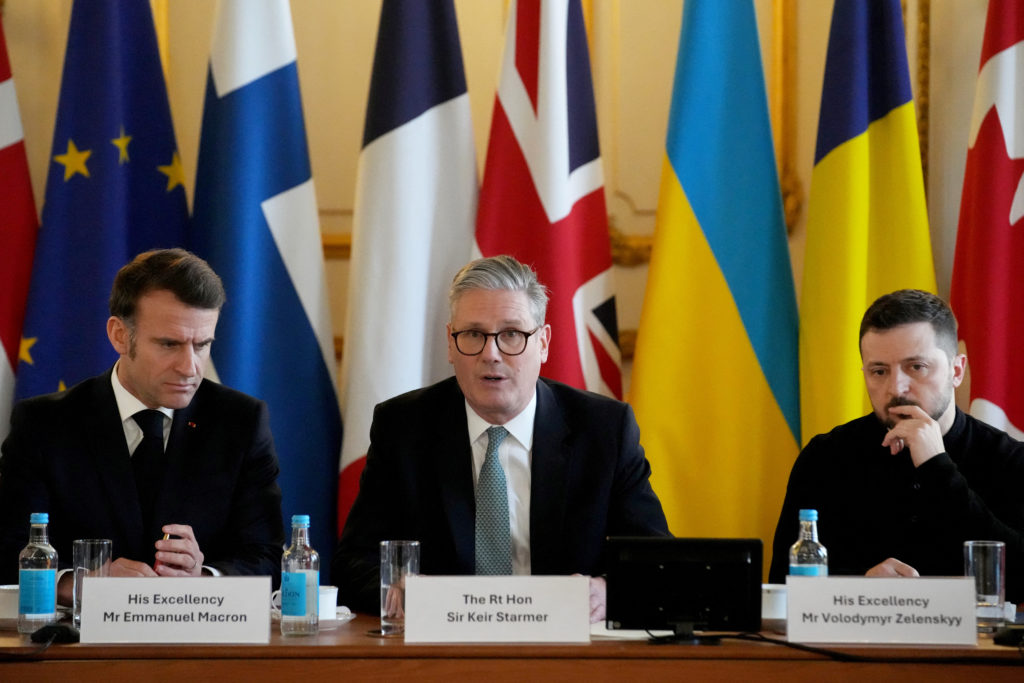
The accusation was issued by Russia’s Foreign Intelligence Service, known as the SVR, which asserted it had obtained intelligence suggesting that London and Paris are exploring ways to equip Kyiv with what it described as a “wunderwaffe,” or wonder weapon. The agency contended that Ukrainian authorities believe possession of a nuclear bomb or at minimum a so-called “dirty bomb” would strengthen their hand in eventual negotiations to end hostilities.
The SVR maintained that Germany declined involvement in the purported initiative, portraying Berlin’s stance as a rejection of what it characterized as a perilous course of action. The Russian intelligence body framed the alleged discussions as evidence that Western governments recognize Ukraine faces diminishing prospects of achieving outright victory on the battlefield.
British officials swiftly rejected the claims. A spokesperson for Downing Street dismissed the allegations as baseless and characterized them as an effort by Russian President Vladimir Putin to divert attention from Moscow’s own military campaign. The spokesperson pointed to the prime minister’s recent remarks honoring Ukrainian resilience and highlighted Britain’s continued military, humanitarian and reconstruction assistance to Kyiv as proof of London’s sustained support.
French authorities also repudiated the assertion. In a message posted on the social media platform X, France’s Foreign Ministry mocked the allegation, suggesting Moscow was attempting to redirect scrutiny away from its protracted military operation in Ukraine.
The SVR further alleged that any such transfer would be concealed to appear as a domestically developed Ukrainian weapons program. Kremlin spokesperson Dmitry Peskov warned that, if substantiated, the move would constitute what he described as a coordinated attack on Russia and urged international scrutiny. Dmitry Medvedev, deputy chairman of Russia’s Security Council and a former president, escalated the rhetoric further, cautioning that such an action could prompt Moscow to consider nuclear retaliation not only against Ukraine but potentially against countries it deemed complicit.
Ukraine has not indicated any pursuit of nuclear arms. Following the dissolution of the Soviet Union in 1991, Ukraine inherited the world’s third-largest nuclear arsenal. In 1994, Kyiv agreed to relinquish those weapons under the Budapest Memorandum, securing assurances from Russia, the United States and the United Kingdom that its sovereignty and territorial integrity would be respected.
In October 2024, Ukrainian President Volodymyr Zelensky publicly reflected on that decision, suggesting it appeared questionable in hindsight given Russia’s invasion. However, he clarified that Ukraine’s preferred long-term security guarantee would be NATO membership rather than reacquiring nuclear capability.
Throughout the war, Russian officials have repeatedly invoked nuclear doctrine in public remarks. In September 2022, Medvedev declared that Russia reserved the right to employ nuclear weapons if its territorial integrity were threatened, emphasizing that such warnings were not a bluff. In 2024, President Vladimir Putin reiterated that Moscow would contemplate nuclear retaliation in response to certain conventional attacks.
Ukrainian officials have consistently portrayed Moscow’s nuclear references as coercive tactics designed to intimidate both Kyiv and its Western backers.
While no evidence has emerged to substantiate Moscow’s latest accusation, the timing is notable. The claim coincides with the fourth anniversary of Russia’s full-scale invasion of Ukraine, a milestone that has prompted renewed pledges of support for Kyiv from European capitals.
Analysts say nuclear rhetoric has become a recurring feature of the conflict, often surfacing during periods of intensified Western military assistance or battlefield setbacks. By raising the specter of nuclear escalation, Moscow may be attempting to sow divisions within NATO and deter additional arms shipments.
The reference to Germany’s purported refusal to participate could also reflect longstanding Kremlin efforts to highlight differences among European allies. Berlin has at times approached military aid decisions with caution, particularly regarding advanced weapons systems, though it remains one of Ukraine’s largest supporters.
There is also a strategic communications dimension. Accusations involving nuclear weapons tend to command global attention and can shift media focus away from developments on the ground. Western officials have frequently accused Moscow of deploying disinformation narratives to complicate diplomatic efforts and weaken international backing for Kyiv.
From a geopolitical standpoint, any verified move by a nuclear-armed NATO state to transfer such capabilities would represent an extraordinary departure from established nonproliferation norms. Britain and France are signatories to the Nuclear Non-Proliferation Treaty, which aims to prevent the spread of nuclear weapons. Providing a nuclear device to a non-nuclear state would carry profound legal and strategic consequences.
Security experts note that Ukraine’s longstanding pursuit of NATO membership reflects a preference for collective defense guarantees rather than independent nuclear deterrence. Zelensky’s public comments underscoring NATO accession as the favored path reinforce that strategic orientation.
As the war grinds on, rhetoric surrounding nuclear weapons remains one of the most volatile aspects of the conflict. While Western governments continue to supply advanced conventional arms to Ukraine, they have repeatedly stated they are not seeking direct confrontation with Russia.
The renewed exchange of nuclear accusations highlights the fragile balance underpinning the war: sustained Western support for Ukraine alongside careful avoidance of actions that could trigger direct NATO-Russia conflict. Whether Moscow’s latest claim gains traction internationally may depend less on evidence and more on the broader information struggle that has accompanied the fighting since 2022.
For now, Britain and France have dismissed the allegation outright, and no independent confirmation has emerged to support Russia’s assertion. The episode nonetheless illustrates how nuclear signaling continues to shape both the narrative and strategic calculations surrounding Europe’s most consequential conflict in decades.





