

(AP) — A Russian missile strike demolished part of a five-story residential building in the northeastern Ukrainian city of Kharkiv early Saturday, killing at least 10 people — including two children — as Moscow unleashed a sweeping overnight wave of missiles and drones across the country, Ukrainian officials said.
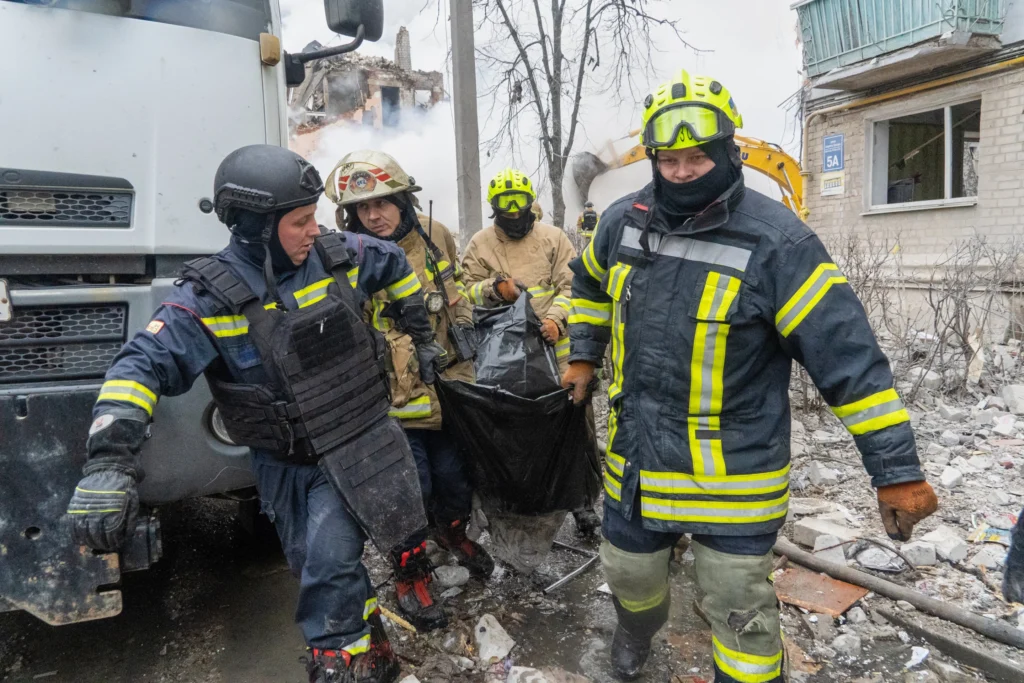
Emergency crews continued combing through shattered concrete and twisted metal hours after the explosion tore through the apartment block in Ukraine’s second-largest city. Authorities warned that the death toll could rise as rescuers searched for survivors trapped beneath the rubble.
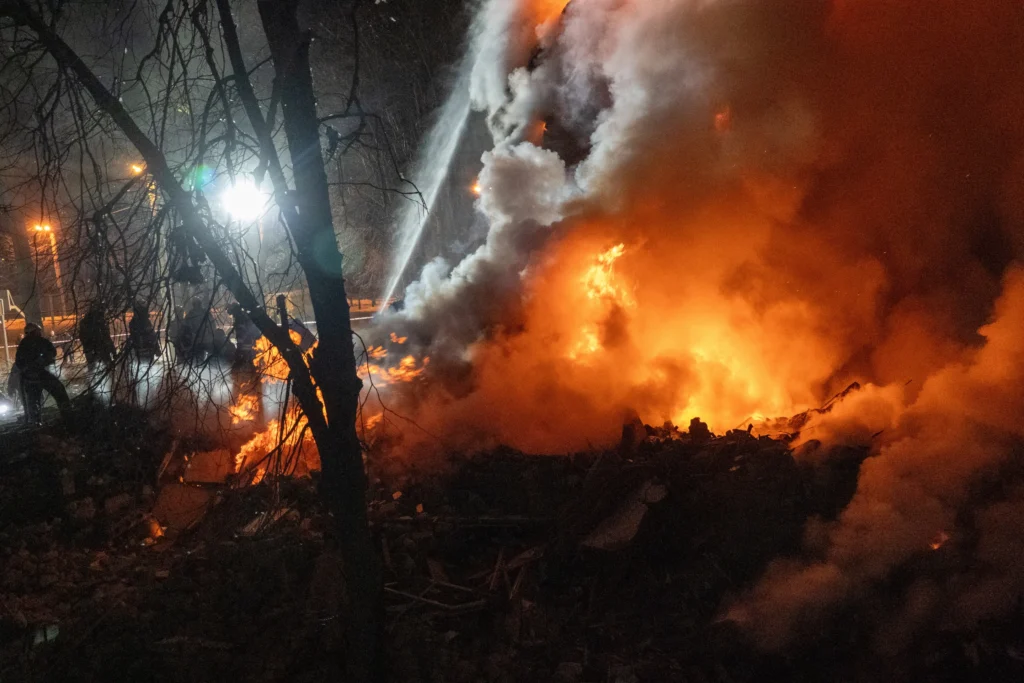
Sixteen other people were injured in the strike, local officials confirmed.
Kharkiv Mayor Ihor Terekhov said several victims were members of families who were inside their homes when the missile struck the building in a densely populated residential district.
Among those killed were a primary school teacher and her young son, a second-grade student, who died in their apartment, Terekhov said. An eighth-grade girl and her mother were also among the victims.
The attack formed part of a broader wave of aerial assaults launched by Russian forces overnight, according to Ukrainian President Volodymyr Zelenskyy, who urged Ukraine’s international partners to respond more forcefully.
Zelenskyy said Russia fired 29 missiles and 480 drones across multiple regions of Ukraine during the overnight operation, targeting energy facilities and infrastructure in the capital region and central parts of the country.
Preliminary military assessments indicate that Ukrainian air defense systems intercepted 19 of the missiles and 453 drones, though several weapons penetrated defenses.
Authorities documented nine missile impacts and 26 drone strikes across 22 locations, Zelenskyy said in a message posted on X.
The attacks caused damage in at least seven additional locations across the country.
In the Kyiv region, falling debris from intercepted drones and missiles damaged structures in three districts, regional officials said.
Further south in the Odesa region, dozens of firefighters were deployed to contain large fires that erupted at infrastructure sites following multiple drone strikes.
Ukraine’s national rail operator, Ukrzaliznytsia, said damage to rail facilities forced officials to reroute several passenger and freight trains traveling through the center-west of the country.
Investigators believe the Kharkiv apartment building was hit by a newly deployed Russian cruise missile.
Ukraine’s regional Prosecutor’s Office indicated the weapon was likely the Izdeliye-30, a subsonic air-launched missile that Russian forces have recently begun deploying in attacks on Ukrainian territory.
Ukrainian military analysts say the missile has an estimated range of about 1,500 kilometers (930 miles) and incorporates an upgraded satellite navigation system designed to reduce vulnerability to electronic jamming.
If confirmed, the Kharkiv strike would represent one of the first instances in which the weapon has been used against densely populated civilian areas.
Russia’s Defense Ministry issued a statement asserting that the overnight operation focused on military targets, including factories producing equipment for Ukraine’s armed forces, energy infrastructure and air bases.
Zelenskyy condemned the Kharkiv attack as a deliberate assault on civilian life and appealed to Ukraine’s allies for stronger assistance.
“There must be a response from partners to these savage strikes against life,” Zelenskyy wrote on social media.
“Russia has not abandoned its attempts to destroy Ukraine’s residential and critical infrastructure, and therefore support must continue,” he added.
The Ukrainian leader said Kyiv is working with the European Union and other allies to strengthen air defense systems and expand protective measures for civilians.
Russia has relied heavily on Iranian-designed Shahed drones during the conflict, launching tens of thousands since the full-scale invasion began more than four years ago.
Moscow has expanded domestic production of the drones and frequently deploys them in large coordinated waves intended to overwhelm Ukraine’s air defenses.
Recent attacks have involved hundreds of drones in a single night — far exceeding the number used in some entire months earlier in the war.
The drones have become one of Russia’s primary tools for striking Ukrainian infrastructure, energy networks and military positions.
Iran itself has also used the same type of drone in retaliatory attacks across the Middle East following joint U.S.-Israeli military strikes, Zelenskyy said.
According to the Ukrainian president, the United States recently approached Kyiv seeking assistance in countering those drones.
Zelenskyy said he authorized the transfer of equipment and the deployment of Ukrainian specialists to help partners improve defenses against Shahed drone attacks.
The intensifying conflict in the Middle East has begun drawing international focus away from the war in Ukraine, which remains Europe’s largest armed conflict since World War II.
Diplomatic efforts to negotiate a settlement between Moscow and Kyiv have slowed as global attention shifts to the escalating confrontation involving Iran, Israel and the United States.
A new round of U.S.-brokered negotiations between Russia and Ukraine had been scheduled for this week but was postponed amid the broader geopolitical tensions.
Despite those diplomatic setbacks, Zelenskyy said Ukraine continues coordinating with Western allies to secure additional military and humanitarian assistance.
While Russian aerial attacks on Ukrainian cities have been frequent throughout the conflict, the scale and technological evolution of recent strikes suggest the war may be entering a new and more dangerous phase.
The deployment of the Izdeliye-30 missile, if confirmed, would indicate Russia is expanding its arsenal of long-range precision weapons capable of bypassing Ukrainian air defenses. Combined with the massive drone swarms launched overnight, the strategy appears designed to overwhelm interception systems through sheer volume and technological diversity.
At the same time, the broader geopolitical environment is shifting in ways that could reshape the conflict. The Middle East crisis has redirected diplomatic attention and military resources, potentially weakening the sustained focus that Western governments have maintained on Ukraine since 2022.
Another emerging factor is the growing global circulation of Iranian drone technology. Originally supplied to Russia for use in Ukraine, the same systems are now appearing in other conflicts, illustrating how modern warfare increasingly spreads across regions through shared weapon systems and strategic partnerships.
Ukraine’s decision to provide expertise in countering these drones to partners in the Middle East reflects the unusual position Kyiv now occupies: a country simultaneously fighting a major war and serving as a testing ground for defense tactics against rapidly evolving technologies.
For civilians in cities like Kharkiv, however, the geopolitical dynamics offer little immediate relief. As rescue crews continue searching through the collapsed apartment building, the attack stands as another reminder of the human toll of a war that shows little sign of ending.





