

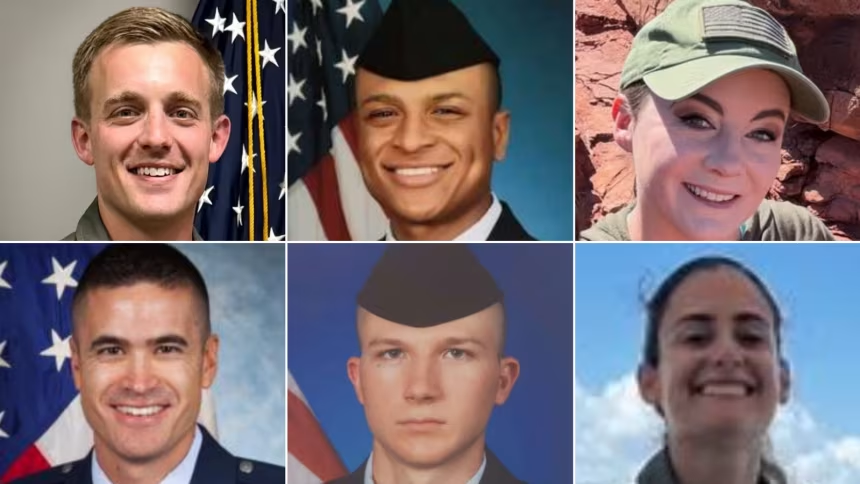
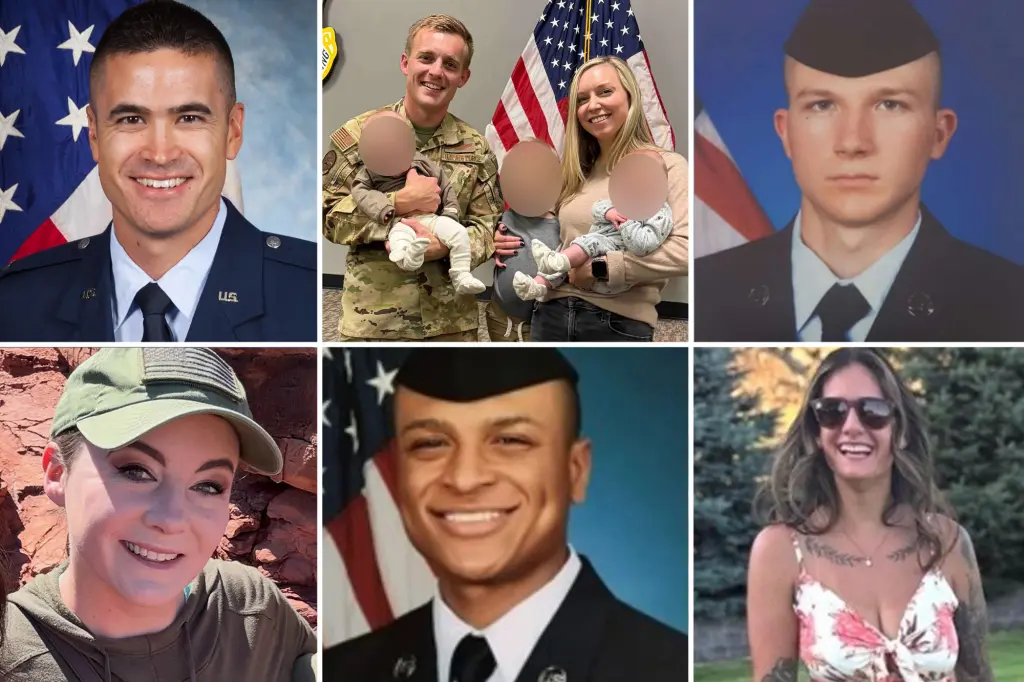
All six airmen killed when an Air Force refueling aircraft crashed in Iraq have been identified by the Pentagon, including a beloved 33-year-old Alabama father of three who deployed just one week before the deadly collision that brought the total U.S. military death toll in the Iran conflict to 13 service members.
Major Alex Klinner, a seven-year U.S. Air Force pilot, was aboard the doomed KC-135 Stratotanker when it collided with another tanker over “friendly airspace” in western Iraq on Thursday during operations supporting the ongoing military campaign. The crash, which U.S. Central Command emphasized was “not due to hostile fire or friendly fire,” remains under investigation as military officials work to determine what caused two American refueling aircraft to collide during what should have been routine operations.
“It’s kind of heartbreaking to say: He was just a really good dad and really loved his family a lot — like a lot,” Klinner’s brother-in-law James Harrill said Saturday, his voice conveying the profound grief overwhelming the Birmingham, Alabama family that lost a devoted husband and father whose children will now grow up without him.
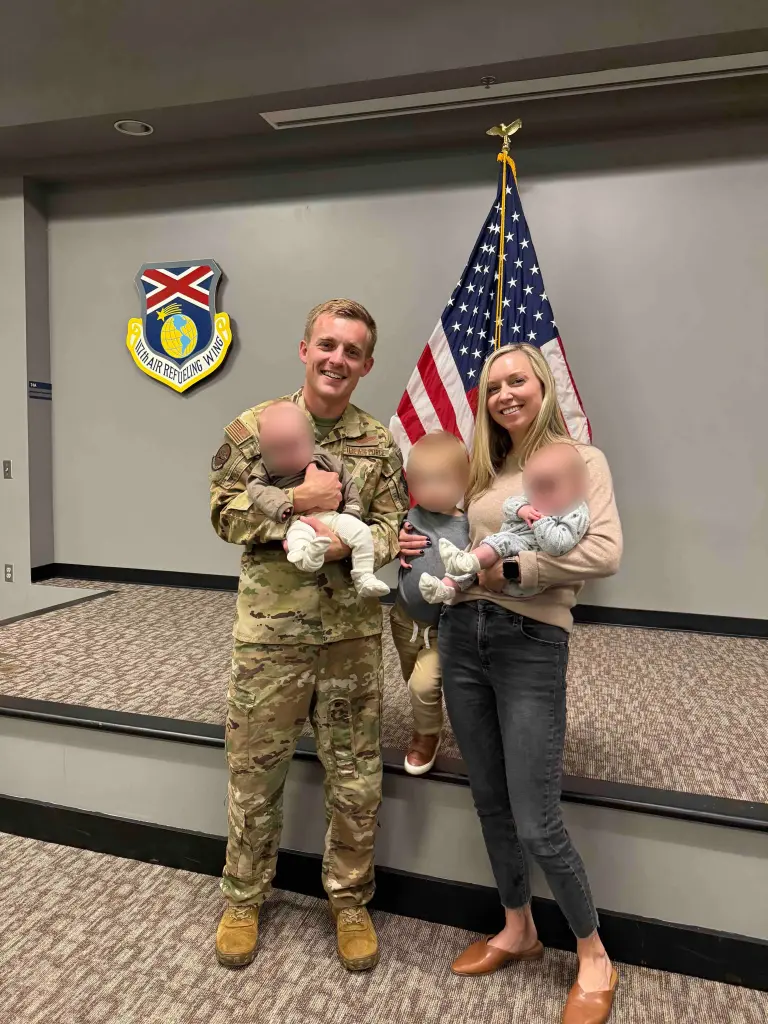
The Birmingham resident, who enjoyed hiking and outdoor activities, leaves behind seven-month-old twins and a two-year-old son who will never truly know their father beyond photographs and stories, Harrill confirmed. Klinner had deployed on March 12—just days before the fatal crash—to support Operation Epic Fury, the Pentagon’s designation for military operations against Iran.
His grieving widow Libby Klinner expressed heartbreak that their children will grow up never experiencing firsthand the man who defined selfless service and devotion to family. “They won’t get to see firsthand the way he would jump up to help in any way he could,” she wrote in a social media post that captured both her anguish and her determination to preserve her husband’s memory for their sons.
“They won’t see how goofy and funny he was. They won’t witness his selflessness, the way he thought about everyone else before himself. They won’t get to feel the deep love he had for them,” she continued, painting a portrait of a man whose character extended far beyond his military service to encompass the qualities that made him an exceptional father and husband.
A GoFundMe campaign established for the grief-stricken family has raised more than $467,000 as communities across Alabama and beyond rallied to support the widow and three young children facing life without their primary provider and emotional anchor. The outpouring of financial support reflects both the tragedy’s impact and widespread recognition that families of fallen service members deserve tangible assistance as they navigate devastating loss.
The Auburn University graduate was remembered as someone perpetually ready to help others and embodying qualities of a “servant leader”—military terminology for officers who prioritize their subordinates’ welfare and lead through example rather than mere authority. “Alex was one of those guys that had this steady command about him,” Harrill said, noting that Klinner had recently been promoted to major in January, recognizing his leadership capabilities and professional excellence.
“He was literally one of the most kindest, giving people,” Harrill added, employing the emphatic grammar of genuine grief that transcends concerns about linguistic precision to express overwhelming loss.
Tech. Sgt. Tyler Simmons, 28, from Columbus, Ohio, described as possessing a “million-dollar smile,” was also identified as being aboard the deadly flight. Simmons served as a boom operator—the crew member responsible for the technically demanding task of extending the refueling boom from the tanker aircraft to precisely connect with receiving aircraft traveling at hundreds of miles per hour, requiring exceptional skill, concentration, and nerves.
Simmons was assigned to the 121st Air Refueling Wing at Ohio’s Rickenbacker Air National Guard Base before deploying to the Middle East to support combat operations. His cousin Tracy Peaks told CNN affiliate WBNS that the family always knew Simmons’ infectious smile would take him places, including his dream job operating as a military boom operator combining his passion for aviation with service to his country.
Simmons played football and graduated from Eastmoor Academy High School in 2015, subsequently working in security before pursuing his military aviation aspirations. His parents remembered the exact moment uniformed officers arrived at their door to inform them their only child had perished, his mother Cheryl Simmons told WBNS through tears that no passage of time will ease.
Tyler’s mother had once hoped he would choose a different path than military service, according to WBNS, though his passion for aviation and serving his country proved overwhelming. Columbus Mayor Andrew Ginther extended “deepest condolences” to Simmons’ family after his “life was taken far too soon in a recent accident in Iraq,” honoring his memory “as a true hero who served our country with courage and dedication.”
The other service members killed in the crash were identified by the Pentagon Saturday as Captain Ariana G. Savino, 31, of Covington, Washington; Tech. Sgt. Ashley Pruitt, 34, of Bardstown, Kentucky; Captain Seth R. Koval, 38, of Mooresville, Indiana; and Captain Curtis J. Angst, 30, of Wilmington, Ohio—all experienced aviators and aviation support personnel whose expertise in aerial refueling operations made them essential to sustaining combat aircraft over extended missions.
Pentagon officials confirmed that Klinner, Savino, and Pruitt were assigned to the 6th Air Refueling Wing at MacDill Air Force Base in Tampa, Florida, though all three served with the 99th Air Refueling Squadron, a geographically separated unit based at Sumpter Smith Joint National Guard Base in Birmingham, Alabama. The unusual administrative arrangement reflected Air Force efficiency measures consolidating specialized refueling squadrons while maintaining geographic distribution.
“They were not only outstanding Airmen. They were our neighbors – our fellow Alabamians. May their service and that of their families never be forgotten,” Alabama Governor Kay Ivey declared via social media platform X, acknowledging both their professional excellence and their roots in communities now mourning their loss.
Koval, Angst, and Simmons were assigned to the 121st Air Refueling Wing at Rickenbacker Air National Guard Base in Columbus, Ohio, representing the state’s contribution to aerial refueling capabilities essential for projecting American air power across vast distances. Ohio Governor Mike DeWine said he was mourning all the airmen alongside the entire state, emphasizing the specialized skills of Ohio Air National Guard members.
They were trained to “transfer fuel from one plane to another in midair, and their work was critical in long-distance missions in defense of our nation. Every mission they undertook involved risks that they were willing to take and the courage to put the lives of others above their own. They served with honor,” DeWine wrote on X, capturing the inherent dangers of aerial refueling operations even absent enemy action.
The second U.S. aircraft involved in the fatal collision—also a KC-135 Stratotanker—landed safely following the incident, U.S. Central Command confirmed. “The incident occurred in friendly airspace during Operation Epic Fury, and rescue efforts are ongoing,” CENTCOM wrote in a statement, though the confirmed deaths of all six crew members suggested that rescue efforts focused on recovery rather than survival hopes.
CNN documented that Captain Ariana Savino was described as a “great human, a future senior leader, a mentor to Latina youth and current Air Force superstar” who died “doing what she loved,” according to her friend Ernesto Nisperos in a Facebook post memorializing the accomplished aviator whose career trajectory suggested she would have risen to senior leadership positions.
Savino was Nisperos’s mentee and a “source of positive energy,” he revealed. “She was one of those people who lit up every room she walked into. That smile of hers wasn’t just infectious, it was disarming. She brought energy, grit, and a ruthless commitment to making everyone around her better,” Nisperos added, painting a portrait of someone whose leadership extended beyond formal authority to genuine inspiration.
Savino served as chief of current operations for the 99th Air Refueling Squadron, overseeing the unit’s daily flight schedule and coordinating training and missions—responsibilities requiring exceptional organizational skills and technical knowledge. She commissioned in 2017 through the Air Force ROTC program at Central Washington University, initially serving as a combat systems officer before completing pilot training in 2025 and earning her wings as a KC-135 pilot just months before her death.
Senator Patty Murray of Washington expressed being “heartbroken” by Savino’s death while feeling “deeply grateful for her courage and sacrifice in service to our country.” Women like Savino represent “the absolute best of our state and country,” Murray declared, adding that the nation must honor them “not only with words but by supporting the families they leave behind.”
Tech. Sgt. Ashley Pruitt served as an instructor boom operator and assistant flight chief of operations with the 99th Air Refueling Squadron, where she oversaw training and readiness while instructing fellow boom operators in the precise mechanics of midair refueling—technical skills requiring thousands of practice hours to master. She entered the Air Force in 2017 and rose steadily through enlisted ranks, earning leadership responsibilities and deploying multiple times supporting Middle East operations before her promotion to technical sergeant last May.
MacDill Air Force Base, home station for Pruitt, Klinner, and Savino, issued a statement expressing devastation at their loss. “To lose a member of the Air Force family is excruciatingly painful, especially to those who know them as son, daughter, brother, sister, spouse, mom or dad,” said U.S. Air Force Col. Ed Szczepanik, 6th Air Refueling Wing Commander. “Our communities feel this loss deeply and Team MacDill will ensure their sacrifices and service to our nation are never forgotten.”
Captain Seth Koval served in the Air Force for 19 years, first enlisting as a machinist with the Ohio National Guard before pursuing his childhood dream of becoming a pilot. He was responsible for training pilots in “worldwide air refueling, aeromedical, cargo and passenger operations,” requiring comprehensive knowledge of KC-135 capabilities across multiple mission profiles.
Koval’s family said their “world was shattered” by the sudden loss of the husband and father who wore the uniform with purpose and pride. “My husband was many things – loving, generous, kind-hearted, smart, devoted, a fixer of all things, a real outdoorsman, and selfless,” his wife Heather Nicole wrote on Facebook. “He always put others before himself – until the very end. I will see him in the smile of our son and carry him with me in every moment.”
Captain Curtis Angst earned his bachelor’s degree in aerospace engineering at the University of Cincinnati before enlisting in the Ohio National Guard in May 2015 as a vehicle maintenance technician. He completed undergraduate pilot training in 2022 before achieving pilot initial qualification in 2024, demonstrating the lengthy preparation required to operate complex military aircraft safely.
The fatal crash brings the total U.S. military death toll from Operation Epic Fury to 13 service members, including six killed in a March 1 Iranian attack on a U.S. base in Kuwait. Additionally, approximately 140 American forces have sustained wounds, eight of them severely, according to Pentagon disclosures earlier this week. The mounting casualties underscore the genuine dangers American service members confront even during operations their government characterizes as proceeding according to plan.
The KC-135 Stratotanker allows combat aircraft to refuel in flight, extending their operational range and enabling them to remain in battle zones for extended periods without returning to distant airbases. The aircraft can also be configured to transport cargo and medical patients, providing versatile capabilities essential to sustained military operations. The Air Force declined specifying what specific mission the aircraft involved in Thursday’s collision were performing when disaster struck.
For the families now mourning six exceptional Americans who perished serving their country, the circumstances of the crash matter far less than the devastating reality that loved ones will never return home. As investigations proceed and military officials work to prevent future accidents, these six names join the growing list of service members who paid the ultimate price during operations whose strategic necessity and eventual outcomes remain subjects of intense debate across a divided nation.
NewYorkPost/CNN




