

JOHANNESBURG, SOUTH AFRICA (BN24) — South Africa has officially declared gender-based violence (GBV) and femicide a national disaster after widespread protests and an online campaign aimed at drawing attention to the country’s deepening crisis. This declaration follows nationwide demonstrations, including a coordinated “lie down” protest held on Friday, where women in major cities such as Johannesburg, Cape Town, and Durban, along with other locations, lay down for 15 minutes at noon to honor the 15 women killed every day in South Africa.
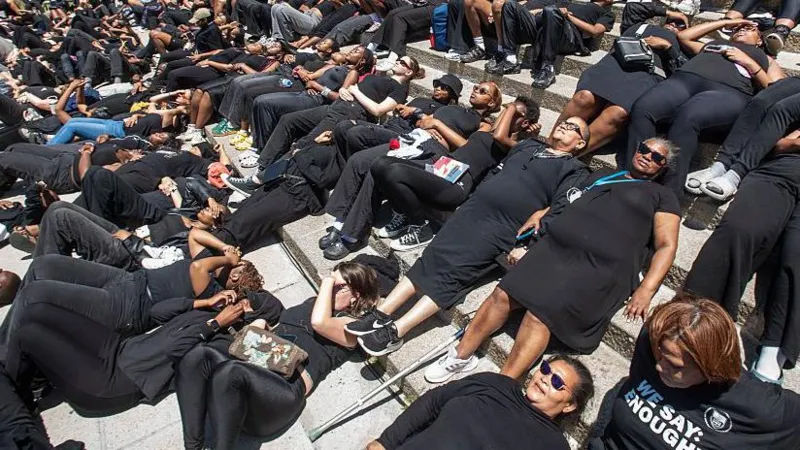
The protests, led by the activist group Women for Change, culminated in a powerful national statement. Demonstrators wore black in a sign of both mourning and resistance. The campaign was amplified online, where celebrities and citizens changed their social media profiles to purple, a color symbolic of awareness against gender-based violence. A petition urging government action has garnered over a million signatures.
The national disaster declaration was made after extensive pressure from civil organizations and activists. Cooperative Governance and Traditional Affairs Minister Velenkosini Hlabisa confirmed that, following a thorough review, the National Disaster Management Centre (NDMC) had reclassified GBV and femicide as a national disaster, acknowledging the “persistent and immediate life-safety risks posed by ongoing acts of violence.”
Before the announcement, the South African government had resisted this move, citing legal requirements that activists’ calls had not met. However, in light of the growing outcry and an evaluation of updated reports from state bodies and civil organizations, the government has now taken this step.
South Africa’s levels of gender-based violence are among the highest globally. According to UN Women, the femicide rate in the country is five times higher than the global average. Women in South Africa face daily threats, and the situation has worsened with the COVID-19 pandemic, as reports of domestic violence, sexual assault, and femicide surged during lockdowns.
The protests on Friday were part of the G20 Women’s Shutdown movement organized by Women for Change. The event sought to raise awareness about the horrific scale of violence against women in South Africa, with many activists calling for more than just symbolic gestures but real, effective action from the government. “We have written history together,” Women for Change said in a statement on its social media, emphasizing that the country’s persistence in confronting this issue has finally been recognized.
“This is a victory, but the battle is far from over,” said Women for Change spokesperson Cameron Kasambala. She stressed that despite past efforts—such as the 2019 declaration of GBV and femicide as a national crisis lack of implementation and transparency in government actions had long hindered real change.
The government’s new classification as a national disaster will allow various departments to allocate their resources more effectively to combat the crisis. Minister Hlabisa confirmed that this shift would enable the state to implement every possible measure to reduce the scourge of violence against women. If these efforts do not yield tangible results, the government has the option of declaring a national state of disaster, granting even more urgent powers for intervention.
While the declaration is seen as a step forward, many women and activists argue that the government’s response has been too slow. The protest has gained significant traction not only in South Africa but across the region, with allies in Eswatini, Kenya, and Namibia joining the movement in solidarity.
Some women have taken matters into their own hands due to frustration with state inaction. Lynette Oxeley, the founder of Girls on Fire, a self-defense initiative aimed at helping women protect themselves through gun ownership, noted the rising need for personal safety in light of the government’s failure to protect women. Oxeley, whose organization trains women to handle firearms legally, emphasized that her group’s approach is not about glorifying violence but empowering women to “fight back” against the pervasive threat of GBV.
Prudence, a member of Girls on Fire, shared her painful experience with sexual violence. After being raped in 2022, she faced an uphill battle for justice, with her case eventually dropped due to a lost rape kit. “This isn’t just a police problem, it’s a national problem,” she said, expressing her anger at the system’s failure to bring perpetrators to justice.
The National Disaster classification is expected to mobilize greater resources and attention to the problem of gender violence. However, for many South African women, including Girls on Fire members, it remains to be seen if the government’s newfound commitment will result in meaningful change. The country has long faced challenges in addressing gender violence, from insufficient law enforcement to widespread social acceptance of abuse.
As the national disaster declaration makes its way through the bureaucratic system, many activists have vowed to continue pushing for concrete action, including legislative reform, better law enforcement, and more significant resources for survivors of gender-based violence. The “purple movement,” with its wide reach across social media platforms, continues to grow as a testament to the public’s demand for an end to the daily violence faced by women in South Africa.
In the coming days, all eyes will be on the government’s next steps and whether they can turn this declaration into effective policy changes that truly address the crisis at hand.





 and femicide a national disaster following widespread protests and an online campaign highlighting the crisis. The move comes after persistent demands from activists and civil society.)