

(AP) — Soldiers moved into several crime-stricken neighborhoods of Johannesburg, South Africa, on Wednesday as Cyril Ramaphosa began a major security operation using the military to support police efforts against organized crime.
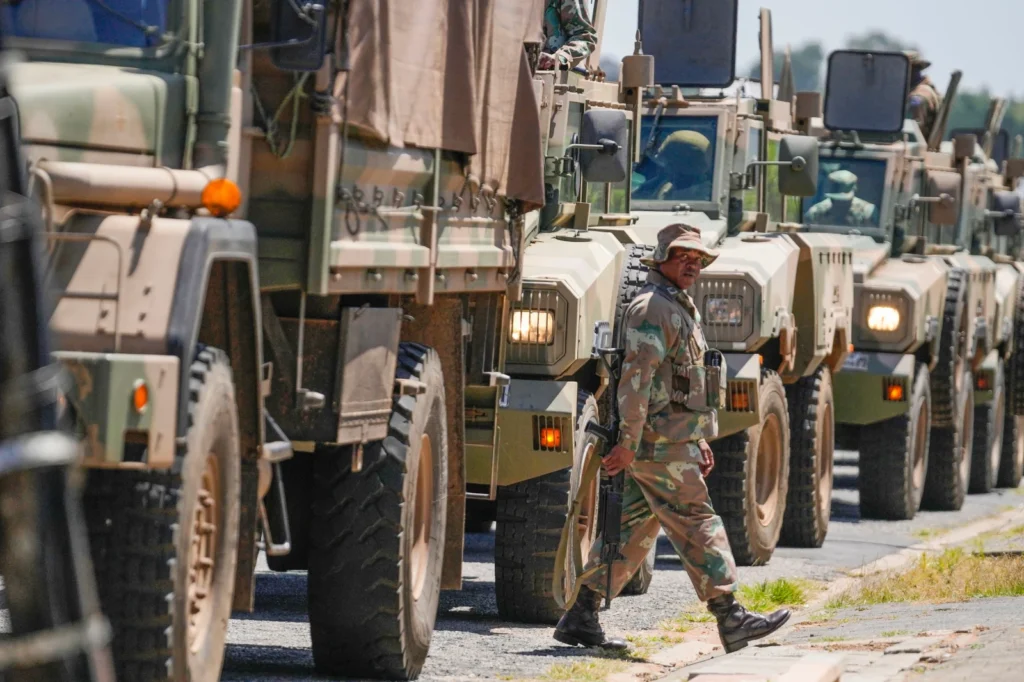
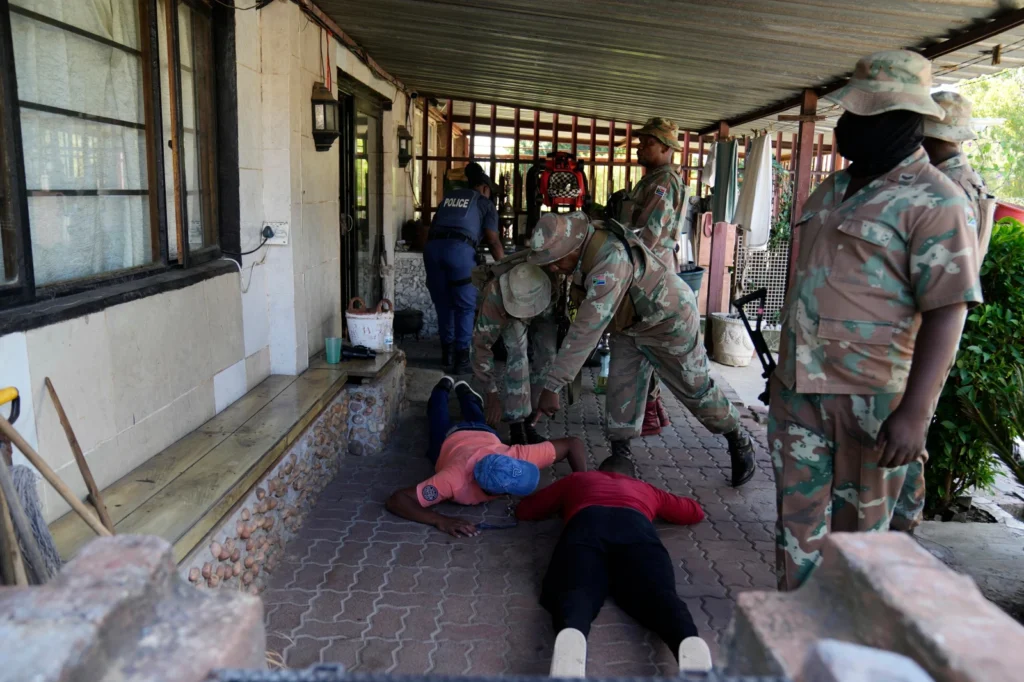
Military vehicles rolled through the suburbs of Riverlea and Westbury, two communities long troubled by violent crime. Armed troops disembarked from armored carriers and entered residential buildings as part of patrol operations designed to deter gangs and illegal mining syndicates.
The deployment marks the first significant implementation of Ramaphosa’s pledge, announced during his annual address to the nation last month, to deploy the army against criminal networks he described as one of the most serious threats facing the country’s democracy and economy.
Authorities indicated that soldiers would operate under police supervision during the operation.
Residents in Riverlea, where gunfire and gang activity have become a near-daily occurrence, reacted with cautious optimism as troops arrived in the neighborhood.
Pearl Hilma, a resident of the area, said she supported the security crackdown.
“Because there’s lots of gangsterism as well as gunshots every night,” Hilma told The Associated Press, describing the atmosphere in the community.
Nearby walls and buildings reflect similar frustrations with crime. One message painted on a structure near a school reads: “No to Guns, Pray for our Community.”
The South African government had initially scheduled the operation to begin March 1, but the rollout was delayed while soldiers completed additional training.
The deployment is being coordinated by South African Police Service and the Department of Defence and Military Veterans, which oversees the country’s armed forces.
Officials have yet to release detailed operational plans, though Ramaphosa informed Parliament that about 550 soldiers would initially be assigned to security duties in Gauteng Province, the region that includes Johannesburg.
That deployment is expected to run until the end of April.
Police authorities have indicated that the broader operation could extend across five of South Africa’s nine provinces, depending on conditions on the ground.
Yasin Botha, another resident of Riverlea, said the presence of both police and soldiers gave him a sense that authorities would be able to respond more quickly to violence.
“Currently, I feel unsafe because we don’t know when the next shooting is going to happen and we don’t know who it is targeted at,” Botha told the AP.
Government plans show that the deployment will focus on two major security threats: illegal mining operations and gang violence.
Illegal mining activity will be targeted primarily in Gauteng, North West Province, and Free State Province.
Meanwhile, gang violence will be the focus in the Western Cape Province and Eastern Cape Province.
Officials have indicated that parts of the operation could continue for more than a year if conditions require extended intervention.
South Africa’s second-largest city, Cape Town, has become one of the most notorious centers of gang violence in the country.
On the outskirts of Cape Town, areas collectively known as the Cape Flats have been plagued by turf wars between rival gangs for decades.
Groups with names such as the Americans, the Hard Livings and the Terrible Josters have fought for control of lucrative illegal drug markets, while also participating in extortion, prostitution rings and contract killings.
Bystanders — including children — are frequently caught in the crossfire.
Police statistics indicate that three of South Africa’s most crime-ridden precincts are located in and around Cape Town, reflecting the intensity of the violence.
Illegal mining has also emerged as a major national security challenge.
Across Gauteng and surrounding regions, abandoned gold mines have become hubs for underground mining gangs commonly referred to as “zama zamas.”
Authorities say these operations are often controlled by heavily armed criminal syndicates.
The gangs recruit informal miners from impoverished communities to descend into abandoned shafts in search of leftover gold deposits.
Investigators say these operations are frequently linked to violent crime in nearby communities.
One of the most shocking incidents connected to illegal mining occurred in 2022, when about 80 suspected illegal miners were accused of gang-raping eight women who were filming a music video near an abandoned mine.
Another confrontation last year resulted in at least 87 illegal miners dying after police cut off supplies to a mine shaft in an effort to force them to surface.
Officials estimate that around 30,000 illegal miners are currently operating across South Africa, using roughly 6,000 abandoned mines.
The government estimates that illegal mining operations cost the country more than $4 billion annually in lost gold, much of it believed to be controlled by criminal networks with links to migrants from neighboring Lesotho, Zimbabwe, and Mozambique.
South Africa continues to struggle with some of the highest violent crime rates in the world.
Police data show that 6,351 homicides occurred between October and December 2025, an average of nearly 70 killings every day in a country with a population of roughly 62 million people.
In addition to homicide, authorities also report high levels of attempted murder, armed robbery and aggravated assault.
The scale of violence has fueled growing public pressure on the government to take stronger action.
The use of the military to support domestic policing has occurred several times in recent years.
In 2021, thousands of troops were deployed following riots and widespread looting in two provinces after the imprisonment of former president Jacob Zuma.
Those unrests left more than 350 people dead and caused extensive economic damage.
South Africa also used soldiers to enforce strict COVID-19 lockdown measures in 2020.
Ramaphosa has acknowledged that deploying the army domestically carries historical sensitivities.
During the decades of racial segregation under the Apartheid, which ended in 1994, government troops were frequently used to suppress pro-democracy protests.
Mindful of that legacy, Ramaphosa said the current decision had not been taken lightly.
“It has become necessary due to a surge in violent organized crime that threatens the safety of our people and the authority of the state,” the president said.
He also emphasized that soldiers would operate under police command to avoid concerns about military overreach.
The military deployment reflects both the severity of South Africa’s crime problem and the growing political pressure on the government to demonstrate decisive action.
For many analysts, the decision suggests that conventional policing alone has struggled to keep pace with sophisticated criminal networks involved in drugs, mining and organized violence.
Illegal mining syndicates in particular have evolved into complex operations that resemble organized crime cartels, often equipped with weapons and international connections.
Yet security experts caution that military intervention may offer only temporary stability.
Soldiers are trained for combat rather than community policing, and long-term reductions in crime typically depend on economic development, police reform and stronger judicial systems.
Still, for communities such as Riverlea and Westbury — where residents describe nightly gunfire — the visible presence of troops may provide a sense of security that has been missing for years.
Whether the strategy succeeds in reducing violence, however, will likely determine how far the government is willing to rely on the military to confront crime in the future.




