

The Supreme Court on Friday struck down a central pillar of President Donald Trump’s trade agenda, ruling that he exceeded his authority when he imposed sweeping tariffs under a federal law designed for national emergencies.
In a 6-3 decision, the justices concluded that the International Emergency Economic Powers Act, known as IEEPA, does not grant a president the power to unilaterally levy broad tariffs on imports. The ruling invalidates many — though not all — of the tariffs Trump put in place during his second term.
Chief Justice John Roberts authored the majority opinion, joined by the court’s three liberal justices and two conservatives, Justices Neil Gorsuch and Amy Coney Barrett. The dissent came from Justices Clarence Thomas, Brett Kavanaugh and Samuel Alito.
“The president asserts the extraordinary power to unilaterally impose tariffs of unlimited amount, duration and scope,” Roberts wrote. However, he added, the administration “points to no statute” in which Congress authorized IEEPA’s language to apply to tariffs. The court therefore concluded that “IEEPA does not authorize the president to impose tariffs.”
The White House did not immediately issue a formal statement. After learning of the ruling during a meeting with governors, President Donald Trump described the decision as a “disgrace,” according to a person familiar with his reaction, and indicated he had contingency plans. A day earlier, Trump had warned that eliminating tariffs would leave the country “in such trouble right now.”
Financial markets responded positively. Stocks rallied on news of the decision, reflecting investor relief over the potential unwinding of tariffs that had unsettled global supply chains.
Scope of the Ruling
The decision leaves intact certain tariffs Trump imposed under separate statutory authorities, including duties on steel and aluminum. But it dismantles two major categories of tariffs enacted through IEEPA.
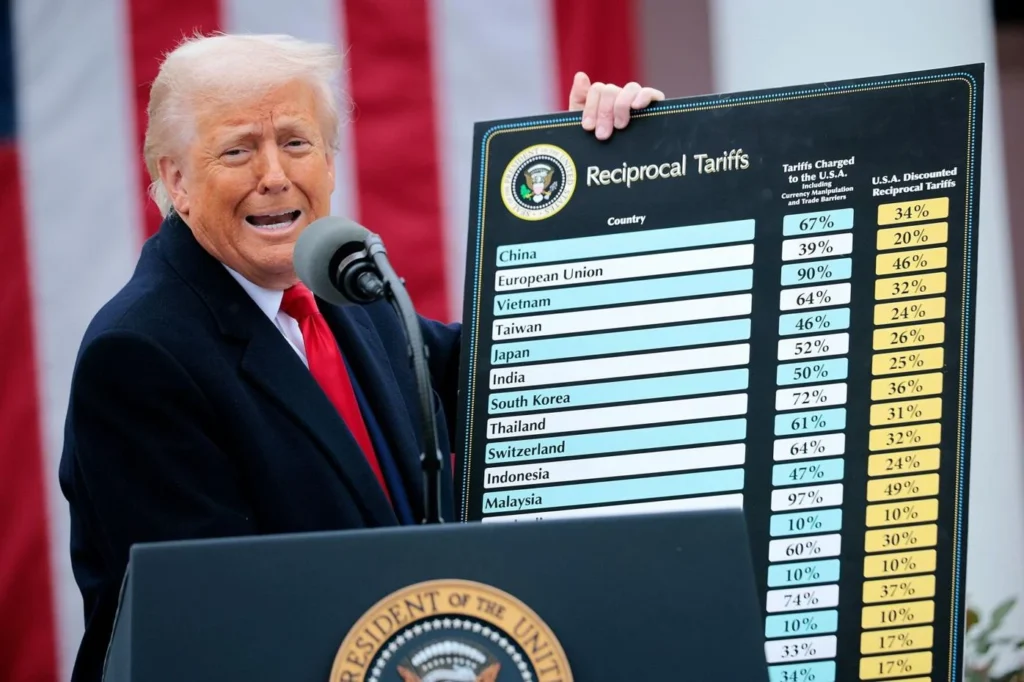
One category involved country-specific “reciprocal” tariffs, which ranged as high as 34% on imports from China and included a 10% baseline applied to most other nations. The second involved a 25% tariff on selected goods from Canada, China and Mexico, which the administration justified as a response to those countries’ alleged failure to stem the flow of fentanyl into the United States.
Businesses that challenged the tariffs in court welcomed the ruling. Victor Schwartz, founder of New York-based wine and spirits importer VOS Selections, characterized the duties as “arbitrary” and harmful to commerce. He said lower courts and now the Supreme Court recognized them as unconstitutional overreach.
In addition to VOS Selections, companies including Plastic Services and Products, a pipe and fittings supplier, and two educational toy retailers pursued legal action. A coalition of states led by Oregon also brought suit.
As of mid-December, tariffs imposed under IEEPA had generated approximately $130 billion in revenue, according to data from U.S. Customs and Border Protection. Trump had previously cited significantly higher figures, including projections tied to trade agreements negotiated by his administration.
The court did not resolve whether importers will automatically receive refunds. In dissent, Kavanaugh observed that the ruling leaves open significant questions about how the government should handle the billions already collected. “The Court says nothing today about whether, and if so how, the Government should go about returning the billions of dollars,” he wrote.
We Pay the Tariffs, a coalition of small businesses, urged the Treasury Department to establish a “full, fast and automatic” reimbursement process. Executive director Dan Anthony said smaller firms cannot withstand prolonged litigation to recover funds deemed unlawfully collected.
Constitutional Authority and the “Major Questions” Debate
The Constitution assigns Congress the power to regulate commerce and set tariffs. IEEPA, enacted in 1977, permits the president to “regulate” imports and exports in response to an “unusual and extraordinary threat.” Before Trump, no president had relied on the statute to impose across-the-board tariffs.
Lower courts had ruled against the administration in consolidated cases, prompting both sides to seek definitive guidance from the Supreme Court.
The dispute placed renewed attention on the court’s approach to executive authority. In recent years, the justices have scrutinized expansive uses of presidential power. The court blocked President Joe Biden’s attempt to forgive large portions of federal student loan debt, invoking the “major questions doctrine,” which requires clear congressional authorization for policies with vast economic impact.
In Friday’s opinion, Roberts referenced that doctrine, though that portion of the analysis did not command a majority. The liberal justices, who had dissented in the Biden case, agreed the tariffs were invalid but grounded their reasoning in statutory interpretation rather than the major questions framework.
Implications for Presidential Power and Trade Policy
The ruling represents a rare setback for President Donald Trump at a Supreme Court with a 6-3 conservative majority, particularly during his second term. It signals that even a court often sympathetic to executive authority may draw firm lines when statutory language does not clearly support sweeping action.
For future presidents, the decision underscores the limits of invoking emergency powers to enact broad economic measures absent explicit congressional backing. While Kavanaugh suggested the ruling may not drastically restrict presidential tariff authority under other statutes, it narrows the scope of IEEPA and could deter similarly expansive interpretations of emergency laws.
The decision also reshapes the political terrain of trade policy. If the White House seeks to reinstate some of the invalidated tariffs, it may need to rely on alternative statutes or pursue legislative approval — a process that requires bipartisan negotiation in Congress.
Economically, the ruling may stabilize import markets in the short term, though uncertainty remains over potential refunds and whether new tariffs will emerge under different legal frameworks. Importers and exporters alike must now assess the financial impact of a decision that could involve billions of dollars in repayments.
Politically, the case reinforces ongoing debates about separation of powers. While Trump defended tariffs as essential to economic security and leverage in trade negotiations, the court’s majority emphasized that such sweeping tools remain primarily within Congress’s constitutional domain.
The judgment does not eliminate presidential influence over trade but clarifies that emergency statutes cannot serve as blank checks. As the administration weighs next steps, the balance between executive initiative and legislative authority — a recurring theme in recent Supreme Court jurisprudence — remains firmly in the spotlight.
NBC




