

Tatiana Schlossberg, an environmental journalist and author who was a granddaughter of President John F. Kennedy, has died after a battle with cancer, her family announced Tuesday. She was 35.
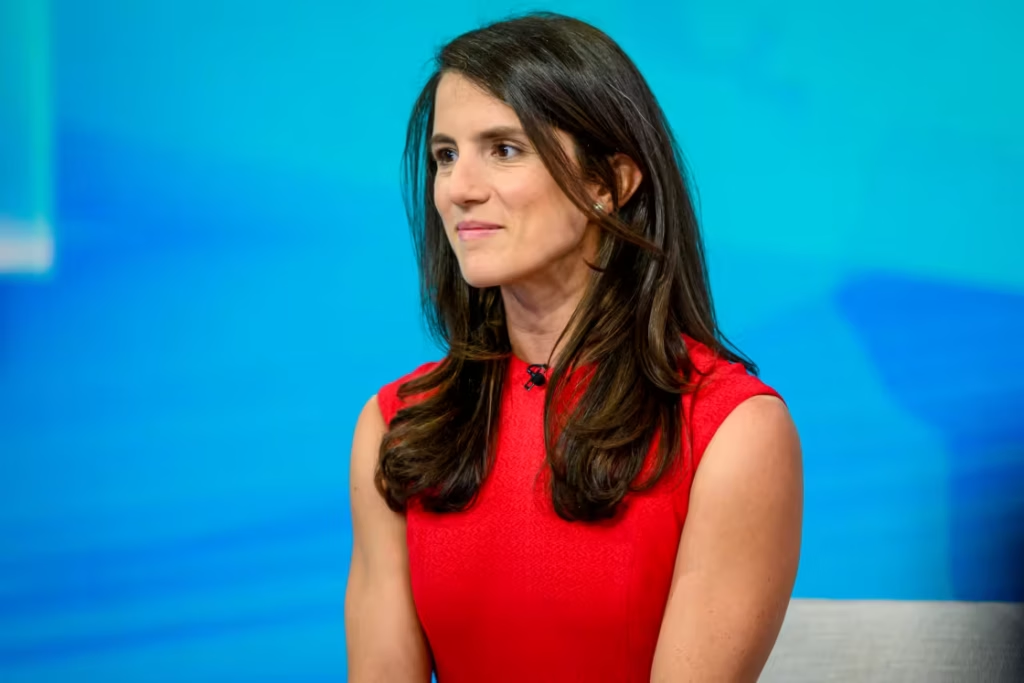
“Our beautiful Tatiana passed away this morning. She will always be in our hearts,” her family said in a statement shared on social media, confirming her death without disclosing additional details.
Schlossberg revealed in a deeply personal essay published in The New Yorker on Nov. 22 that she had been diagnosed with acute myeloid leukemia, a rare and aggressive form of blood cancer, complicated by an uncommon genetic mutation known as Inversion 3. She wrote that the diagnosis came on May 25, 2024 — the same day she gave birth to her second child — after a routine blood test showed abnormally high white blood cell levels.
In the essay, Schlossberg described how doctors quickly ordered further tests, leading to weeks of hospitalization at NewYork-Presbyterian Hospital before she began chemotherapy at home and later underwent a bone marrow transplant. Despite aggressive treatment, her prognosis remained grim.
“During the latest clinical trial, my doctor told me that he could keep me alive for a year, maybe,” she wrote. “My first thought was that my kids, whose faces live permanently on the inside of my eyelids, wouldn’t remember me.”
The daughter of artist and designer Edwin Schlossberg and U.S. diplomat Caroline Kennedy, Schlossberg was part of one of America’s most prominent political families. Caroline Kennedy is the eldest child of President Kennedy, who was assassinated in 1963. Despite her lineage, Schlossberg built a career defined less by politics and more by journalism, environmental reporting and public service.
She worked as a reporter for The New York Times and contributed to The Atlantic and The Washington Post, developing a reputation for deeply reported stories on climate change, consumer behavior and environmental accountability. Her 2019 book, Inconspicuous Consumption: The Environmental Impact You Don’t Know You Have, examined how everyday choices quietly shape global environmental outcomes.
Colleagues noted her commitment to immersive reporting. For one assignment, Schlossberg completed a 30-mile, seven-hour cross-country ski race in Wisconsin to better understand the environmental and cultural dimensions of the story she was covering.
In her final essay, Schlossberg reflected candidly on the psychological toll of confronting terminal illness while raising young children. She wrote of memories resurfacing with unusual clarity, questioning whether her mind was “sifting through the sands” because time was running out. The diagnosis, she said, felt especially surreal given her active lifestyle; the day before giving birth, she had swum a mile in a pool.
Beyond illness, Schlossberg also used her platform to express concern about public health policy. In the same New Yorker essay, she criticized her cousin, Health Secretary Robert F. Kennedy Jr., calling his rise to national office “an embarrassment to me and the rest of my family.” She wrote that she watched his confirmation to President Donald Trump’s Cabinet from a hospital bed while undergoing a clinical trial for CAR T-cell therapy.
Schlossberg said she feared that Kennedy’s skepticism about vaccines could have real-world consequences for patients like herself. Severely immunocompromised, she needed to be revaccinated but worried about future access amid growing political attacks on vaccination programs.
Her death has prompted renewed reflection on the intersection of public health, politics and personal vulnerability — themes that increasingly defined her later work. While her life was cut short, Schlossberg leaves behind a body of writing that blended scientific rigor with human empathy, and a legacy shaped by both public history and deeply personal courage.
NBC




