

WASHINGTON (BN24) — A massive banner bearing President Donald Trump’s image was fastened Thursday to the exterior of the Justice Department’s headquarters, an unmistakable visual statement underscoring the administration’s imprint on the nation’s top law enforcement agency.
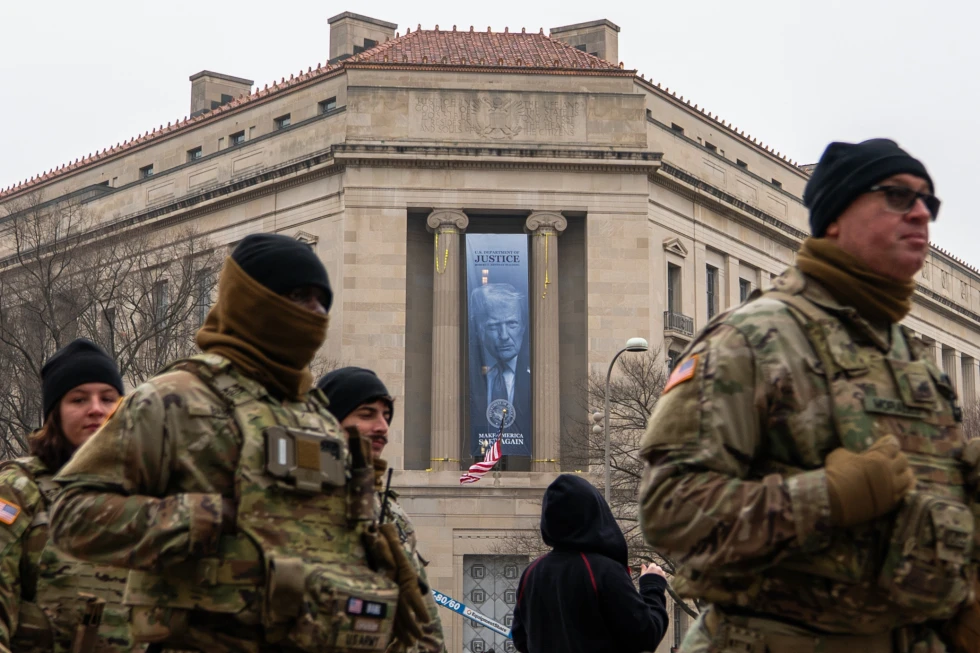
The display, positioned between two towering columns on a corner of the Robert F. Kennedy Building, features the slogan “Make America Safe Again,” a phrase the White House has adopted to frame its immigration crackdown and anti-crime agenda.
Though banners spotlighting Trump have appeared at other federal buildings across the capital, the decision to place one on the Justice Department carries particular symbolism. The department has long sought to maintain a buffer between its prosecutorial functions and direct political influence from the White House, preserving public confidence in impartial enforcement of federal law.
In a statement released Thursday, the Justice Department said it was proud to commemorate “250 years of our great country and our historic work to make America safe again at President Trump’s direction.”
Attorney General Pam Bondi has emerged as one of Trump’s most visible allies within the Cabinet. Her approach diverges from that of several predecessors who emphasized operational distance from the Oval Office as a safeguard against perceptions of political interference in criminal investigations and prosecutions.
Senior administration officials have forcefully rejected claims that the department is being steered to advance political objectives. They maintain that accusations of politicization are misplaced and contend that the prior administration under President Joe Biden injected politics into law enforcement by pursuing two federal criminal cases against Trump. Those cases were later dropped after Trump prevailed in the 2024 presidential election.
Even so, the banner’s installation has reignited debate over the department’s trajectory.
In recent weeks, federal authorities have initiated inquiries involving figures publicly critical of Trump. Among them are New York Attorney General Letitia James and former FBI Director James Comey. Charges were filed in both matters but ultimately dismissed. Separately, prosecutors sought indictments against several Democratic lawmakers connected to a video encouraging U.S. military personnel to resist what they described as unlawful orders.
Comey responded on social media, calling the banner “sickening to see.” He added that the administration appeared to have overlooked a long-standing inscription carved into the building’s façade: “Where law ends tyranny begins.”
The department has also opened investigations into Federal Reserve Chair Jerome Powell related to congressional testimony and into Democratic officials in Minnesota over whether their public remarks impeded federal immigration enforcement efforts.
Taken together, these actions have intensified scrutiny in Washington over whether the Justice Department is upholding its tradition of independence or more closely aligning its work with presidential priorities.
For decades, administrations of both parties have publicly recognized the importance of insulating prosecutorial decisions from overt political direction. That principle gained renewed emphasis following historical controversies that tested executive authority and prompted reforms aimed at strengthening institutional guardrails.
The Trump administration asserts that its law enforcement initiatives reflect a mandate from voters to restore public safety, particularly at the southern border and in communities grappling with violent crime. The “Make America Safe Again” slogan, now prominently displayed on the building, encapsulates that message.
Critics argue, however, that affixing the president’s image to the department’s headquarters risks blurring the distinction between political leadership and prosecutorial discretion. They contend that symbolism alone can influence public perception, especially when investigations involve political opponents.
The installation of a presidential banner on the Justice Department’s exterior represents more than a decorative change; it signals a recalibration of executive visibility over federal law enforcement. Historically, federal buildings have emphasized institutional identity rather than individual officeholders. Portraits of presidents typically reside inside government facilities, not draped across their façades.
By placing Trump’s likeness alongside a campaign-style slogan, the administration is communicating a direct linkage between the presidency and the department’s operational priorities. Supporters view the move as a transparent acknowledgment of executive authority. In their assessment, voters elected Trump on a platform centered on immigration enforcement and crime reduction, and the banner simply reflects that mandate.
Yet institutional norms often function as stabilizing forces in American governance. The Justice Department’s credibility rests heavily on public belief that prosecutorial decisions are driven by evidence and legal standards rather than political considerations. Even absent demonstrable interference, visible signs of presidential branding could shape perceptions domestically and abroad.
Legal analysts note that the president possesses broad constitutional authority over the executive branch. However, modern practice has evolved to include informal guardrails designed to protect the appearance and reality of fairness in law enforcement. Attorneys general from both parties have traditionally articulated a commitment to impartiality as essential to the rule of law.
The juxtaposition of the banner with the building’s engraved maxim “Where law ends tyranny begins” adds a historical dimension to the current debate. That inscription reflects a long-standing aspiration to separate lawful governance from arbitrary power. Its renewed visibility amid the banner controversy highlights broader questions about how executive power should be exercised.
The episode also unfolds against a backdrop of heightened political polarization. Investigations involving high-profile officials, whether Republicans or Democrats, inevitably draw partisan scrutiny. In that environment, visual symbols can take on amplified meaning.
Whether the banner becomes a defining emblem of the administration’s approach to federal law enforcement may depend on how ongoing investigations are resolved and whether courts uphold prosecutorial decisions as legally sound. Judicial review, rather than symbolism, will ultimately shape the department’s institutional legacy.
For now, the banner stands as a prominent feature of the Washington skyline a vivid representation of presidential influence and a catalyst for renewed discussion about the delicate balance between democratic accountability and the independence of those entrusted with enforcing the law.





