

President Donald Trump said Friday he is weighing the possibility of a limited military strike on Iran, as his administration increases pressure on Tehran to reach an agreement over its nuclear program.
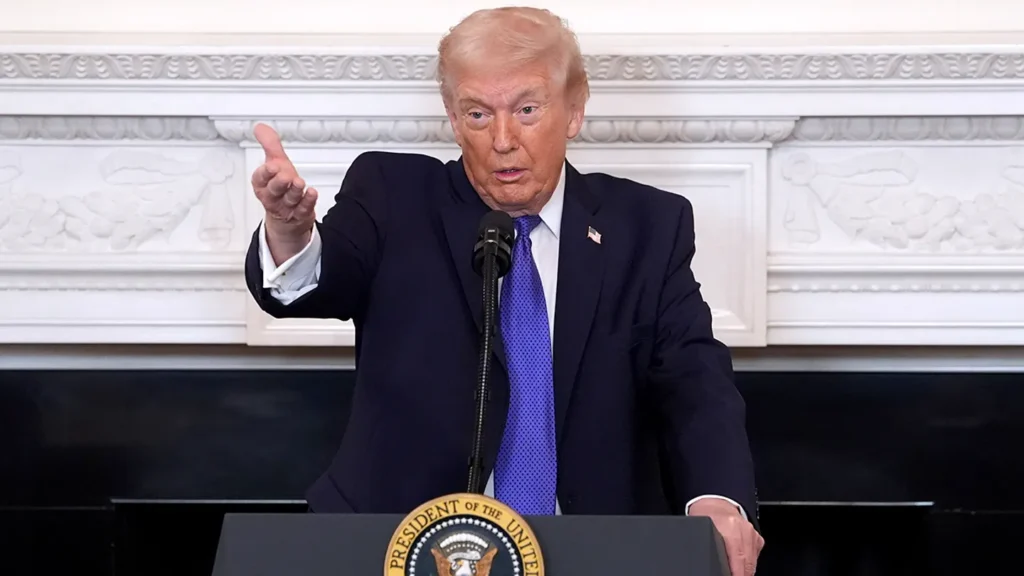
“I guess I can say, I am considering that,” President Trump said during a breakfast meeting with governors at the White House when asked whether he was contemplating a targeted strike to push Iran toward a deal.
The remarks came amid heightened tensions between Washington and Tehran and a visible expansion of U.S. military assets in the Middle East. President Trump has repeatedly indicated that time is running short for a diplomatic breakthrough, stating Thursday that Iran has no more than “10, 15 days, pretty much maximum” to finalize an agreement.
“We’re either going to get a deal, or it’s going to be unfortunate for them,” the president said.
The White House did not elaborate on what form a potential strike might take or under what conditions it would be authorized. Reporters were ushered out of the room shortly after the president’s comments, cutting short further clarification.
CBS News, citing sources familiar with internal deliberations, said President Trump had not made a final decision on military action. According to those sources, senior national security officials have advised the president that U.S. forces could be prepared to conduct strikes as soon as this weekend, though any timeline could extend beyond that.
The Pentagon has moved additional naval assets into the region in recent weeks. The aircraft carrier USS Gerald R. Ford and its accompanying strike group are en route to the Middle East. The USS Abraham Lincoln, along with three guided-missile destroyers, arrived more than two weeks ago.
On Wednesday, United States Central Command released images showing F/A-18 Super Hornets landing on the deck of the Abraham Lincoln in the Arabian Sea, underscoring the increased operational tempo.
The deployments reflect what administration officials describe as a deterrence posture, intended to signal U.S. readiness while diplomatic channels remain open.
President Trump has framed the buildup as leverage, arguing that Iran must choose between negotiation and confrontation.
“Now is the time for Iran to join us on a path that will complete what we’re doing,” President Trump said Thursday during the inaugural meeting of his Board of Peace, which also addressed security in Gaza. “They cannot continue to threaten the stability of the entire region and they must make a deal.”
As tensions rise, Moscow has called for caution. Kremlin spokesman Dmitry Peskov urged Iran and other regional actors to prioritize diplomacy, warning against escalation.
“Russia continues to develop relations with Iran, and in doing so, we call on our Iranian friends and all parties in the region to exercise restraint and caution,” Peskov said, as carried by Reuters. He emphasized political and diplomatic means as the preferred path to resolving disputes.
Russia’s statement highlights the broader geopolitical stakes. Iran maintains strategic ties with Moscow, and any U.S. military action could reverberate beyond the immediate theater.
President Trump’s comments mark one of his clearest acknowledgments that military force is under active consideration. While he stopped short of committing to action, his timeline — giving Iran roughly two weeks — signals mounting impatience within the administration.
Throughout the week, President Trump warned that “bad things” would occur if Iran fails to reach an agreement. Yet he has also left room for negotiation, stating that a deal would be “great” if achieved.
The administration has not publicly detailed what concessions it seeks beyond curbs on Iran’s nuclear activities. Previous negotiations between the two countries have faltered over uranium enrichment levels, inspections and sanctions relief.
The president’s posture reflects a strategy combining public deadlines, visible military deployments and strategic ambiguity. By declining to confirm a final decision while openly discussing the possibility of strikes, President Trump preserves both deterrence credibility and diplomatic flexibility.
Military analysts note that the presence of two carrier strike groups significantly enhances U.S. operational capacity in the region. However, even a limited strike carries risks, including retaliation against U.S. bases or regional allies and disruptions to energy markets.
The timing also matters. Iran has long calibrated its nuclear policy in response to sanctions and military threats. A compressed deadline could either accelerate diplomatic concessions or entrench hardline positions within Tehran.
Russia’s appeal for restraint underscores the international dimension of the standoff. Any escalation could complicate U.S. relations with Moscow and other global powers, particularly amid ongoing geopolitical tensions elsewhere.
At home, the issue may also test political alliances. While some lawmakers favor a strong deterrent stance, others have cautioned against unilateral military action without congressional authorization.
For now, President Trump’s statement signals that the administration is prepared to shift from rhetoric to action if negotiations stall. Whether the looming deadline compels compromise or confrontation remains uncertain.
What is clear is that the combination of diplomatic pressure and military readiness has moved the U.S.-Iran standoff into a critical phase — one where decisions made in the coming days could reshape security dynamics across the Middle East.
Foxnews/CBS/Reuters/Aljazeera




