

President Donald Trump declared Thursday that the United States must play a role in determining Iran’s next supreme leader and made clear he would reject the prospect of Ayatollah Ali Khamenei’s son succeeding him, a statement that underscores the widening geopolitical stakes of the ongoing conflict with Tehran.
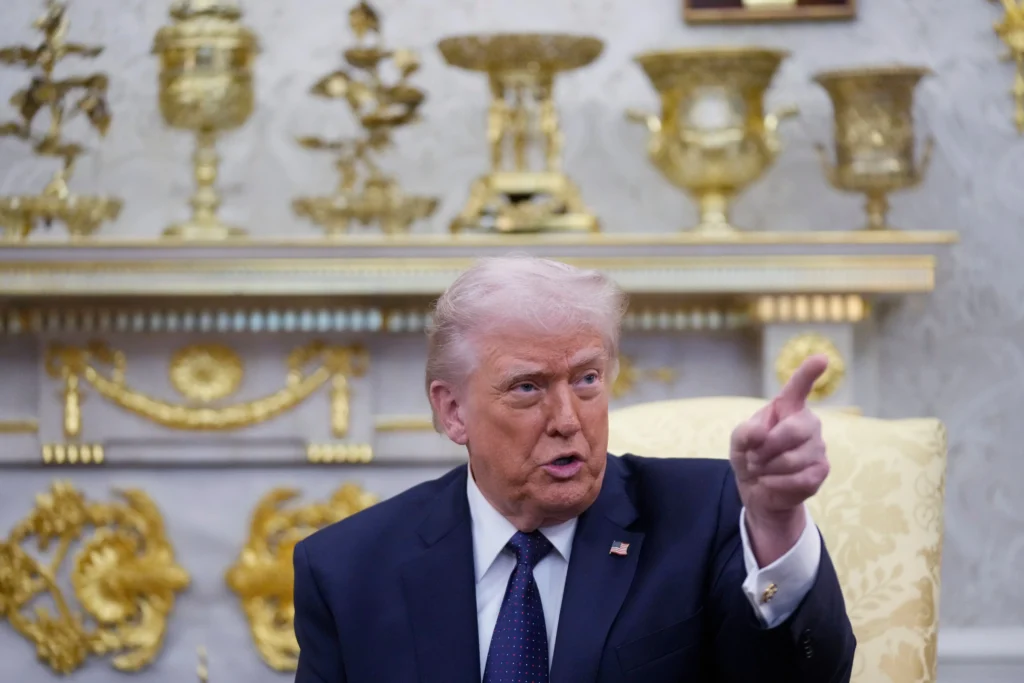
Trump’s remarks came during an interview with Axios, in which he asserted that Washington should influence the leadership transition in Iran following the death of Supreme Leader Ayatollah Ali Khamenei during recent U.S.-Israeli military strikes.
“Khamenei’s son is unacceptable to me,” Trump said. “We want someone that will bring harmony and peace to Iran.”
The president also indicated he believes the United States should participate directly in shaping Iran’s political future.
“They are wasting their time. Khamenei’s son is a lightweight,” Trump told the outlet. “I have to be involved in the appointment.”
His comments represent one of the most explicit statements yet suggesting Washington could attempt to influence the leadership of the Islamic Republic after the removal of its longtime ruler.
Iran is facing a historic moment as it prepares to select a successor to Khamenei, who ruled the country for decades and served as the ultimate authority over its military, judiciary and foreign policy.
The decision falls to Iran’s Assembly of Experts, a powerful clerical body responsible for appointing the supreme leader.
Several Iranian officials have indicated that Mojtaba Khamenei — the late leader’s 56-year-old son — has emerged as a leading contender to inherit the position.
Mojtaba Khamenei is a conservative cleric who has long maintained influence within Iran’s religious and political establishment, particularly through connections with the Islamic Revolutionary Guard Corps. Despite his influence behind the scenes, he has never held elected office or a formal government post.
Trump’s comments signaled strong opposition to that potential outcome.
He argued that installing a successor who continues Khamenei’s political agenda could quickly reignite conflict between Iran and the United States.
Trump warned that allowing a hard-line figure to take power could place the two nations back on a path toward war “in five years.” (Business Today)
The succession crisis comes amid an expanding military confrontation between the United States and Iran.
Khamenei was killed during coordinated U.S.-Israeli strikes targeting Iranian leadership and military infrastructure earlier in the conflict, an operation that has triggered widespread political upheaval in Tehran.
Trump suggested that several Iranian officials who might have been considered potential successors were also killed during those attacks.
“Most of the people we had in mind are dead,” Trump told reporters earlier this week when asked about possible future leaders in Iran. (Axios)
The president’s remarks suggest that the strikes have not only weakened Iran’s military capabilities but also disrupted its political hierarchy.
Iranian authorities have yet to formally announce a new supreme leader, though signals from officials indicate the decision could come soon.
Trump’s comments about influencing Iran’s leadership have complicated the administration’s messaging about the purpose of the ongoing military campaign.
Defense Secretary Pete Hegseth and other senior officials have insisted that the primary objective of the operation is not regime change but rather the destruction of Iran’s nuclear and missile capabilities. (Axios)
However, Trump’s statements about choosing Iran’s next leader suggest a broader political goal that goes beyond military deterrence.
The president has repeatedly emphasized that the current conflict represents an opportunity for a transformation of Iran’s leadership.
His remarks echo previous comments in which he suggested that the Iranian people might seize the moment to reshape their government.
Trump’s position has sparked a debate in Washington about the scope of U.S. involvement in Iran’s internal affairs.
Some lawmakers argue that influencing the leadership of a foreign adversary could escalate tensions and prolong the conflict.
Others believe that the death of Khamenei presents a rare strategic opportunity to encourage political change inside Iran.
The war itself has already had far-reaching consequences across the Middle East, including rising oil prices, disruptions to shipping routes and heightened military tensions involving multiple regional actors.
Trump’s assertion that the United States should help determine Iran’s next supreme leader represents a striking departure from traditional diplomatic norms.
Historically, Washington has sought to influence adversaries through sanctions, negotiations and covert pressure rather than openly declaring a role in choosing their leadership.
By publicly stating that he must be involved in the selection process, Trump has signaled a willingness to shape Iran’s political future in a direct and unprecedented way.
The statement also highlights the strategic stakes surrounding Iran’s leadership transition.
The next supreme leader will control the country’s armed forces, intelligence services and foreign policy — decisions that will determine whether Iran moves toward confrontation or de-escalation with the West.
If a hard-line cleric such as Mojtaba Khamenei were to take power, analysts say tensions with Washington and its allies could remain high for years.
Conversely, a more pragmatic or reform-minded figure could potentially open the door to negotiations and a reconfiguration of relations with the international community.
For now, the uncertainty surrounding Iran’s succession process continues to grow, while Trump’s insistence on playing a role in the outcome adds another unpredictable dimension to an already volatile geopolitical crisis.




