

A tense moment unfolded inside the Oval Office on Thursday when a pharmaceutical representative collapsed while standing behind President Donald Trump during a high-profile announcement about lowering the cost of weight-loss medications.
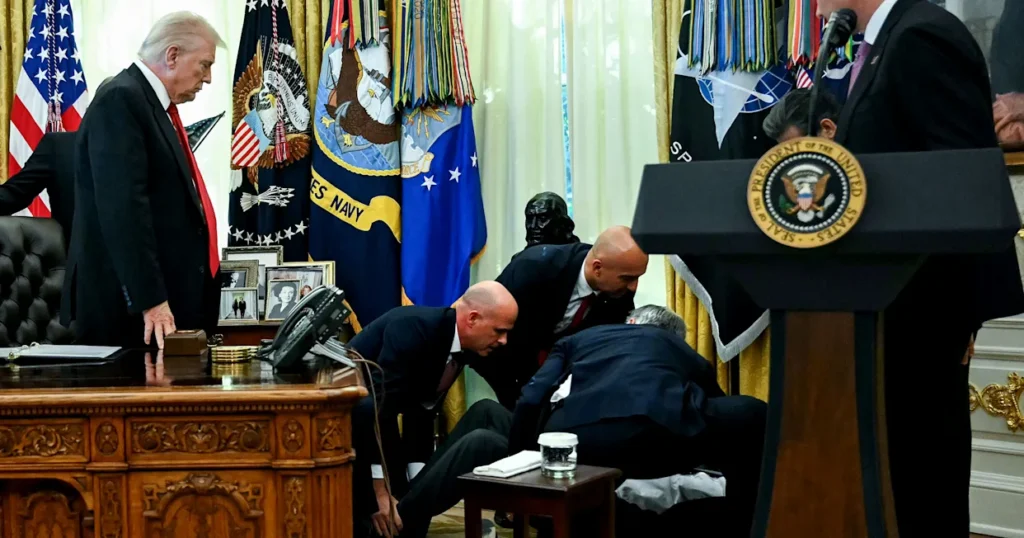
The incident occurred as Trump and members of his administration detailed a new agreement with pharmaceutical giants Novo Nordisk and Eli Lilly aimed at expanding access to popular obesity drugs. Witnesses said the man, initially identified by reporters as Novo Nordisk executive Gordon Finlay, suddenly lost balance and collapsed mid-event. The company later denied that the individual was Finlay.
According to reporters present, Dr. Mehmet Oz, Administrator for the Centers for Medicare & Medicaid Services, quickly came to the man’s aid, helping guide him safely to the floor to prevent head injury. Cabinet members immediately provided assistance while White House staff ushered reporters out of the room.
In a statement issued shortly afterward, White House Press Secretary Karoline Leavitt confirmed the episode and assured the public that the individual was stable. “During the Most Favored Nations Oval Office Announcement, a representative with one of the companies fainted. The White House Medical Unit quickly jumped into action, and the gentleman is okay. The press conference will resume shortly,” Leavitt said.
The Oval Office event highlighted a landmark deal between the Trump administration and leading pharmaceutical companies to reduce the prices of GLP-1 medications—a class of weight-loss and diabetes drugs that have surged in popularity under brand names such as Ozempic, Wegovy, and Zepbound.
Under the terms of the agreement, both Novo Nordisk and Eli Lilly will offer lower-cost access to these medications through TrumpRx, a new federal platform expected to launch next year. The initiative will make oral versions of the drugs available for as little as $149 per month, pending approval by the U.S. Food and Drug Administration, while injectable GLP-1 treatments will be priced at $245 per month for Medicare and Medicaid patients.
Health and Human Services Secretary Robert F. Kennedy Jr. praised the initiative as a major step toward health equity, noting the growing affordability gap in obesity treatment. “Obesity is a disease of poverty—overwhelmingly so—and these drugs have only been available for people who have wealth,” Kennedy said.
Dr. Oz, who helped the collapsed representative, later highlighted the broader health implications of the administration’s plan, predicting that by next year, Americans could collectively lose “135 billion pounds” through expanded access to affordable treatments.
The unexpected medical episode briefly interrupted the announcement but underscored the gravity of the administration’s focus on health reform and access to life-changing medications.




