

WASHINGTON (BN24) — President Donald Trump promised to pay many Americans $2,000 as he touted his tariff plan in a Sunday morning Truth Social posting spree.
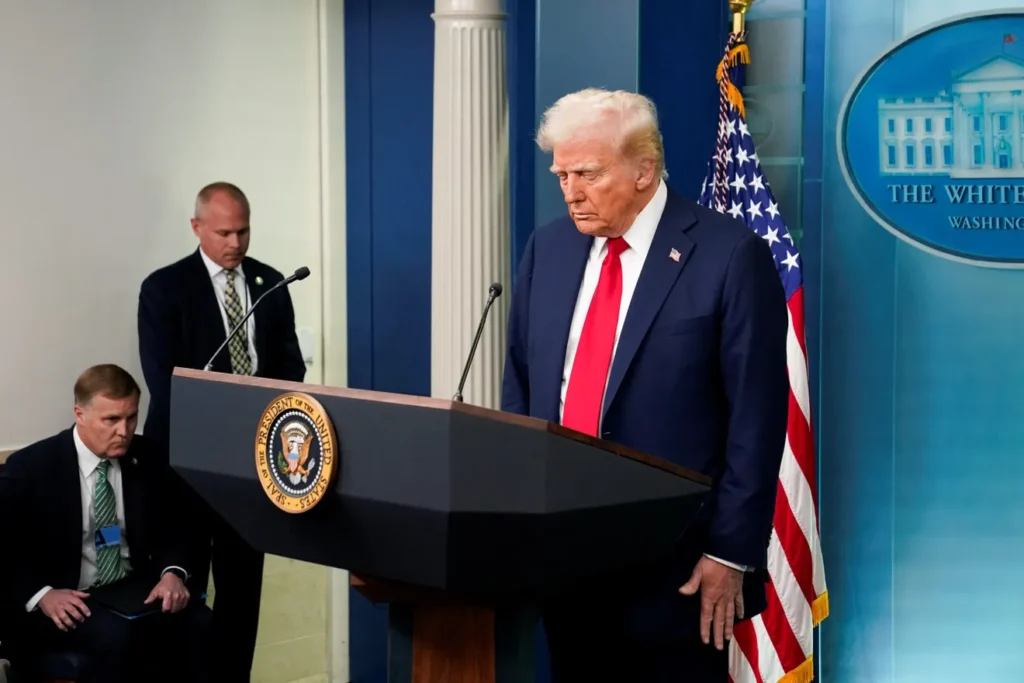
As part of his multi-post commentary touting tariffs, the president promised: “A dividend of at least $2000 a person (not including high income people!) will be paid to everyone.”
It is not immediately clear when that payment would come or who qualifies as “high income.” The president mentioned no other details about the payment.
The announcement comes a day after Trump attended a lavish dinner party at Mar-a-Lago as the longest-ever government shutdown drags on. As many Americans turn to food banks during the shutdown, the event Trump attended featured a three-course menu of beef filet, truffle dauphinoise, pan-seared scallops and a trio of desserts, including “Trump chocolate cake.”
“People that are against Tariffs are FOOLS! We are now the Richest, Most Respected Country In the World, With Almost No Inflation, and A Record Stock Market Price. 401k’s are Highest EVER,” Trump wrote Sunday morning.
“We are taking in Trillions of Dollars and will soon begin paying down our ENORMOUS DEBT, $37 Trillion. Record Investment in the USA, plants and factories going up all over the place,” he continued.
The Supreme Court last week heard arguments in the challenge to Trump’s sweeping tariffs. Three lower courts have already ruled that his use of emergency powers to impose the levies was illegal.
The justices appeared skeptical of his tariff plan. As the high-stakes case is in their hands, Trump posted about why he believes the tariffs should remain in place.
“So, let’s get this straight??? The President of the United States is allowed (and fully approved by Congress!) to stop ALL TRADE with a Foreign Country (Which is far more onerous than a Tariff!), and LICENSE a Foreign Country, but is not allowed to put a simple Tariff on a Foreign Country, even for purposes of NATIONAL SECURITY,” the president wrote in a separate Truth Social post Sunday morning.
“That is NOT what our great Founders had in mind! The whole thing is ridiculous! Other Countries can Tariff us, but we can’t Tariff them??? It is their DREAM!!! Businesses are pouring into the USA ONLY BECAUSE OF TARIFFS. HAS THE UNITED STATES SUPREME COURT NOT BEEN TOLD THIS??? WHAT THE HELL IS GOING ON???” he continued.
Trump has also emphasized a push for affordability as the holiday season nears.
The president claimed that Walmart’s Thanksgiving dinner this year was “down 25 percent since under Sleepy/Crooked Joe Biden.”
“AFFORDABILITY is a Republican Stronghold,” Trump claimed on Truth Social Wednesday. “Hopefully, Republicans will use this irrefutable fact!”
Trump’s claims were swiftly met with criticism from social media users, who pointed out that Walmart’s 2025 meal basket is cheaper this year because it is offering fewer items and different, less pricey items than in last year’s basket.
The president’s focus on affordability seems to have been renewed this week after Democrats clinched key elections across the country, including New York City Mayor-elect Zohran Mamdani, who campaigned on lowering the cost of living in the city.
James Blair, the White House Deputy Chief of Staff, told Politico this week: “Why did Zohran Mamdani do so well last night? He relentlessly focused on affordability.” He added: “People talk about communists, they can say all these things, but the fact is he was talking about the cost of living.”
Still, Trump said Friday that he thought Democrats’ messaging on the issue was a “con job.”
“It was a con job, affordability, they call it, was a con job by the Democrats. The Democrats are good at a few things, cheating in elections and conning people with facts that aren’t true,” the president said.
The promised $2,000 payment represents Trump’s attempt to connect his tariff policy directly to benefits for ordinary Americans. The framing of the payment as a “dividend” suggests the president views tariff revenues as generating surplus funds that can be distributed to citizens, though economic experts have long noted that tariffs function as taxes ultimately paid by consumers through higher prices on imported goods.
The lack of specifics about the payment timing, eligibility criteria and funding mechanism raises questions about how such a program would be implemented. The exclusion of “high income people” suggests some form of means testing would be required, though no income threshold was provided.
The contrast between the Mar-a-Lago dinner party and the ongoing government shutdown has drawn attention to the disconnect between the president’s lifestyle and the struggles facing federal workers and Americans dependent on government services. Food banks across the country have reported increased demand as the shutdown affects paychecks and benefit distributions.
The Supreme Court’s apparent skepticism about Trump’s tariff authority, as evidenced during last week’s oral arguments, creates uncertainty about whether the tariff regime generating the promised revenue will even survive legal challenge. Three lower courts have already deemed the emergency powers invoked for the tariffs to be illegal, setting up a potential clash between the president’s economic promises and judicial oversight.
Trump’s defensive posture in his Sunday posts, questioning why the Supreme Court has not been informed about businesses pouring into the United States because of tariffs, suggests frustration with legal constraints on his trade policy. His comparison to other presidential powers, such as the ability to stop all trade with a foreign country, reflects arguments his administration has made about broad executive authority over international commerce.
The president’s claims about economic performance, including assertions about being the “Richest, Most Respected Country In the World” with “Almost No Inflation,” stand in tension with various economic indicators and his own emphasis on the need for affordability measures. The government’s $37 trillion debt, which Trump mentioned as something that will “soon” begin being paid down, has continued growing during his administration.
The focus on Walmart’s Thanksgiving basket pricing illustrates Trump’s attempt to claim credit for consumer cost reductions, even as critics have noted that the year-over-year comparison involves different product selections. The debate over who deserves credit or blame for cost-of-living changes has become central to political messaging from both parties.
The White House Deputy Chief of Staff’s comments about Mamdani’s electoral success focusing on affordability suggest the administration recognizes the political salience of economic concerns, even as Trump dismisses Democratic messaging on the issue as fraudulent. The president’s characterization of Democratic affordability talk as a “con job” while simultaneously promising $2,000 payments linked to his own policies reflects competing narratives about which party better addresses economic pressures facing American families.
As the government shutdown continues without resolution and the Supreme Court deliberates on tariff authority, Trump’s Sunday morning promise of direct payments to Americans adds another element to an already complex economic and political landscape.




