

Thousands of soccer supporters from Senegal and Ivory Coast face the bitter reality that they will be unable to watch their national teams compete in next year’s World Cup despite the tournament being held partially on American soil, a consequence of travel restrictions imposed by the Trump administration that have transformed qualification joy into visa-related disappointment, according to The Associated Press.

The two West African nations were added to the United States’ partial entry restriction list in December, joining a roster of countries whose citizens face significant barriers to obtaining American visas. The timing proves particularly cruel for fans whose teams earned World Cup berths through competitive qualification processes, only to discover that geographic proximity to host venues in the United States offers them no advantage in witnessing their countries’ participation.
The restrictions effectively prohibit citizens of the affected nations who do not already possess valid U.S. visas from obtaining new ones, creating an insurmountable obstacle for supporters hoping to travel to the June 11-July 19 tournament. The United States will share hosting duties with Canada and Mexico, offering multiple North American venues but providing no relief for fans blocked by immigration policy.
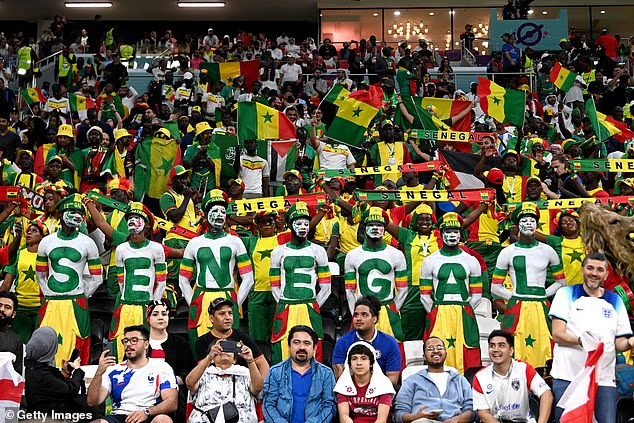
Supporters gathering in Morocco for the ongoing Africa Cup of Nations have expressed frustration and bewilderment at finding themselves excluded from an event that represents the pinnacle of international soccer competition. For many, the World Cup offers a once-in-a-generation opportunity to support their national teams on the global stage, an experience now placed beyond reach by diplomatic decisions unrelated to sport.
“I don’t know why the American president would want teams from certain countries not to take part. If that’s the case, they shouldn’t agree to host the World Cup,” Djibril Gueye, a Senegal supporter, told The Associated Press in Tangier. “It’s up to the United States to provide the conditions, the means, and the resources to allow the qualified countries so everyone can go and support their team.”
Gueye’s comments reflect a broader sentiment among affected supporters that hosting rights carry implicit obligations to facilitate access for participants and their supporters, regardless of ongoing political or security considerations that might otherwise influence visa policy.
President Donald Trump cited “screening and vetting deficiencies” as justification for implementing the travel suspensions, framing the restrictions as necessary measures to protect American security rather than punitive actions targeting specific nations. The administration has maintained that countries unable to meet U.S. standards for identity verification and information sharing pose unacceptable risks that override other considerations, including major sporting events.
The World Cup restrictions extend beyond African nations. Fans from Iran and Haiti, both of which qualified for the tournament, face identical barriers to U.S. entry. These countries appeared on the initial travel ban announced during Trump’s first presidential term, making their inclusion in current restrictions a continuation of longstanding policy rather than a new development.
The situation creates an unprecedented scenario in modern World Cup history, where qualified nations will compete while their domestic supporter bases remain largely unable to attend matches. While some citizens from the affected countries who obtained visas before the restrictions took effect retain the ability to travel, the vast majority of potential supporters find themselves excluded from an event their teams earned the right to contest.
This development raises complex questions about the responsibilities nations assume when accepting roles as major tournament hosts. FIFA, soccer’s international governing body, typically requires host countries to facilitate entry for teams, officials and supporters as a condition of awarding hosting rights. The intersection of these sporting commitments with national security policies creates tensions that have no clear resolution.
The economic implications prove significant for both excluded fans and the tournament itself. World Cup attendance generates substantial revenue through ticket sales, hospitality packages and ancillary spending at host city businesses.
Supporters from qualifying nations typically purchase tickets in large numbers, travel in organized groups and contribute meaningfully to the tournament’s financial success and cultural atmosphere.
African nations have historically brought passionate, visible supporter contingents to World Cups held on various continents, creating memorable scenes that enhance the tournament’s global character. Senegal’s dramatic run to the quarterfinals at the 2002 World Cup in South Korea and Japan, supported by thousands of traveling fans, remains one of African soccer’s defining moments. Ivory Coast’s “Golden Generation” of the 2000s attracted substantial supporter followings to World Cups in Germany, South Africa and Brazil.
The 2026 tournament represents a particularly significant opportunity for African soccer, with FIFA expanding the field from 32 to 48 teams and guaranteeing additional qualification spots for African nations.
This expansion was designed partly to increase representation from underrepresented confederations and provide more opportunities for fans from diverse nations to participate in soccer’s marquee event.
The travel restrictions undermine these inclusion objectives, creating a situation where African nations gain additional tournament places while their supporters lose access to venues.
The irony of this outcome has not escaped notice among soccer administrators and supporters who view the World Cup as a celebration of global unity through sport.
Canada and Mexico, the tournament’s co-hosts, do not face the same visa restrictions for citizens of Senegal, Ivory Coast, Iran and Haiti, creating a disparity where matches played in those countries remain accessible to all qualified teams’ supporters while U.S.-hosted fixtures do not.
This geographic lottery adds an additional layer of complexity to fans’ planning, as they must track which venues will host their teams’ matches and whether those locations fall within accessible territory.
The scheduling of matches by FIFA, typically completed months before tournaments begin, will determine whether affected teams play any group stage fixtures in Canada or Mexico. Random draw procedures mean some teams might contest all three group matches in the United States, while others could play one or more games in accessible venues across the northern or southern borders.
Supporters from the restricted countries face difficult decisions about whether to travel to Canada or Mexico in hopes of attending matches held there, knowing they cannot cross into the United States for any fixtures scheduled at American venues. The logistical complications and financial risks associated with such partial tournament attendance make planning exceptionally challenging.
The diplomatic ramifications extend beyond immediate sporting contexts. Host nations typically leverage major tournaments to project soft power and demonstrate hospitality on the global stage.
Travel restrictions that prevent qualified teams’ supporters from attending undermine these objectives, potentially generating resentment in excluded nations and complicating bilateral relationships in ways that persist long after the final whistle.
African nations have invested heavily in developing soccer infrastructure and youth programs, viewing success in international competition as a source of national pride and global recognition.
Qualifying for the World Cup represents the culmination of these efforts, celebrated across societies as evidence of progress and achievement. The inability of domestic supporters to witness these triumphs in person diminishes the experience in ways that transcend sport.
The restrictions also affect diaspora communities. Many citizens of the affected nations reside in the United States on valid visas or as permanent residents, giving them the ability to attend World Cup matches.
However, their families and friends in home countries cannot visit to share the experience, fracturing celebrations that might otherwise unite far-flung communities around shared national identity.
Commercial interests face disruption as well. Travel agencies, hospitality providers and merchandise vendors in affected countries had anticipated robust demand for World Cup packages, generating revenue while facilitating supporter travel.
The restrictions eliminate these business opportunities, creating economic losses that ripple through tourism sectors already strained by various challenges.
The Trump administration has shown no indication of modifying its travel policies to accommodate the World Cup, suggesting that security considerations trump sporting or diplomatic concerns in its policy hierarchy.
This position reflects a broader approach to immigration and border security that prioritizes perceived threats over other interests, including international goodwill and cultural exchange.
For supporters like Gueye, watching from Tangier as his team competes at the Africa Cup of Nations, the World Cup restrictions represent a profound disappointment.
The dream of traveling to North America, experiencing the tournament atmosphere firsthand and supporting Senegal on the biggest stage in soccer now exists only as a hypothetical, replaced by the reality of watching from home while their team plays thousands of miles away.
The situation underscores fundamental tensions between globalization’s promise of increased mobility and connection versus national security policies that restrict movement based on citizenship. Major sporting events like the World Cup exist as celebrations of international unity, yet they unfold within political contexts that often contradict those ideals.
As the tournament approaches, affected supporters will make their peace with attending vicariously through television broadcasts and social media, their presence reduced to digital traces rather than the physical support that traveling fans provide.
Their teams will compete, possibly advance deep into the tournament, and these achievements will be celebrated at home, but the supporters who made those successes possible through years of passionate backing will experience them from enforced distance, watching history unfold from behind barriers constructed not around stadiums but around borders.
The Associated Press original




