

MAR-A-LAGO, Florida — President Donald Trump declared Saturday that the United States will temporarily “run” Venezuela following the capture of President Nicolás Maduro and his wife, announcing plans for American oil companies to invest billions extracting Venezuelan petroleum resources while the administration works toward what Trump characterized as a “safe, proper and judicious transition” to new leadership.
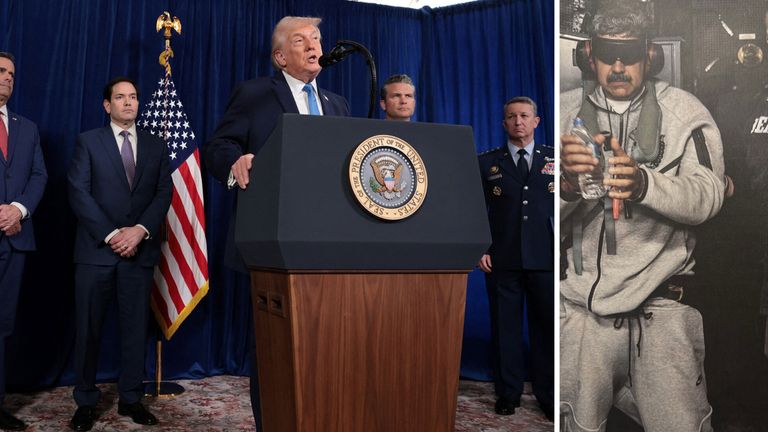
“We’re going to run the country until such time as we can do a safe, proper and judicious transition” to new leadership, Trump stated during a press conference at his Florida resort, flanked by Defense Secretary Pete Hegseth, Secretary of State Marco Rubio, and Chairman of the Joint Chiefs of Staff Gen. Dan Caine. The president did not provide detailed specifics about how the U.S. would control Venezuela, saying only that a group of officials would be named to oversee the occupation.
Trump emphasized that he opposed allowing another leader to assume power who might perpetuate what he characterized as years of corruption and narco-terrorism under Maduro. “We can’t take a chance that somebody else takes over Venezuela that doesn’t have the good of the Venezuelan people in mind,” the president stated, suggesting the U.S. would maintain direct governance rather than immediately recognizing a successor government.
The announcement of direct U.S. governance of a sovereign nation represented an extraordinary assertion of American power with few modern precedents, echoing colonial-era occupations and raising immediate questions about international law, the duration of U.S. control, and whether American military personnel would enforce governance on Venezuelan soil.
When reporters questioned whether U.S. governance would involve deploying military personnel throughout Venezuela, Trump responded bluntly: “We’re not afraid of boots on the ground.” The president added, “We don’t mind saying it, but we’re going to make sure that that country is run properly. We’re not doing this in vain,” explicitly acknowledging that U.S. military occupation remained an option despite potential international condemnation and risks of insurgent resistance.
Trump warned that U.S. military forces stood ready to conduct additional strikes if Venezuelan resistance emerged. “We are ready to stage a second and much larger attack if we need to do so. So we were prepared to do a second wave if we need to do so,” the president stated, suggesting initial strikes represented measured force that could escalate dramatically if the U.S. faced opposition to its governance plans.
The military operation that captured Maduro represented months of planning and took several hours to execute, according to officials who briefed reporters. Two U.S. officials familiar with the planning told NBC News that Trump approved the military and law enforcement actions more than a week before execution, with forces waiting for favorable weather conditions before launching the operation.
Gen. Caine confirmed that military personnel waited over a week for weather to clear in Venezuela. “Weather in Venezuela is always a factor this time of the year, and over the weeks through Christmas and New Year’s, the men and women of the United States military sat ready, patiently waiting for the right triggers to be met and the president to order us into action,” Caine told reporters.
“Last night, the weather broke just enough, clearing a path that only the most skilled aviators in the world could maneuver through,” Caine added, describing challenging conditions that delayed the operation beyond initial planning timelines. The weather-dependent nature of the mission explained why congressional notification proved difficult, according to administration officials who argued that trigger-based operations requiring specific conditions could not accommodate advance legislative briefings.
Trump gave the final order to proceed at 10:46 p.m. Eastern Time Friday night, Caine revealed. Military forces arrived at Maduro’s compound by 1:01 a.m. Saturday morning, completing the actual capture within approximately two hours. By 3:29 a.m. Saturday, Caine reported, military forces were back over water with Maduro and Flores aboard U.S. aircraft, suggesting rapid execution once weather conditions permitted the operation.
Trump, who stated he watched the operation unfold via live video feed from Mar-a-Lago, provided dramatic details about Maduro’s final moments of freedom. “He was trying to get to a safe place, which wasn’t safe, because we would have had the door blown up in about 47 — I think, 47 seconds,” Trump recounted. “It was a very thick door, a very heavy door, but he was unable to get to that door. He made it to the door. He was unable to close it.”
The president’s commentary suggested U.S. forces cornered Maduro as he attempted to reach a fortified safe room within his compound, a scenario implying that the Venezuelan leader had advance warning of the assault—whether through Venezuelan security detecting the approaching aircraft or through intelligence leaks that remain unconfirmed.
Caine detailed that the aircraft used in the operation included multiple types of military planes plus remotely piloted drones, all deployed to protect helicopters and personnel conducting the ground raid in Caracas. Caine added that U.S. helicopters “were fired on and U.S. forces replied to that fire with overwhelming force in self-defense,” confirming that the operation involved combat exchanges between American military personnel and Venezuelan security forces defending Maduro’s compound.
One U.S. military aircraft sustained damage but remained flight-capable, Caine reported. Later Saturday, one U.S. official and one White House official told NBC News that the operation resulted in several injuries to U.S. troops, all of whom remain in stable condition. The acknowledgment of American casualties, though described as non-life-threatening, underscored that the raid involved significant combat rather than unopposed capture.
Vice President JD Vance participated in the operation’s planning through secure video conferences, according to a spokesperson who stated that Vance “joined several late night meetings via secure video conference with National Security principals leading up to the operation.” The vice president’s involvement suggested high-level coordination across the administration’s national security apparatus for what officials characterized as among the most sensitive operations of Trump’s presidency.
Trump confirmed that Maduro and Flores were en route to New York, where federal prosecutors had unsealed an indictment in the Southern District charging them with narco-terrorism conspiracy, cocaine importation conspiracy, and weapons offenses. The Venezuelan leader could appear in court as early as Monday for initial arraignment proceedings, Trump stated, beginning what could become one of the most significant narcotics prosecutions in U.S. history.
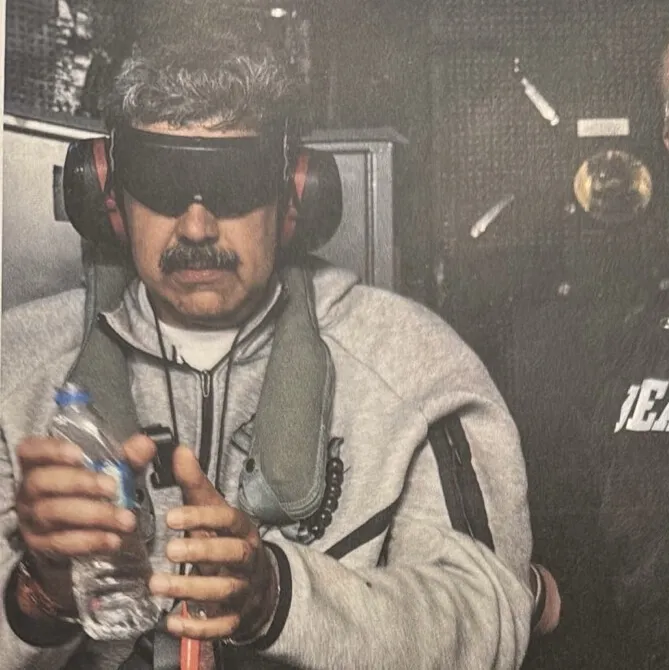
Minutes before addressing reporters, Trump posted on Truth Social a photo purportedly showing Maduro aboard the USS Iwo Jima wearing an apparent blindfold and holding a water bottle, an image evoking controversial photographs of detained terrorism suspects during the war on terror. Trump also posted video of U.S. strikes on Venezuela set to “Fortunate Son” by Creedence Clearwater Revival, a Vietnam War-era protest song whose ironic use suggested either the president missed the song’s anti-war message or deliberately invoked it provocatively.
Attorney General Pam Bondi declared in a post on X that Maduro would “face the full wrath” of the U.S. justice system. The unsealed indictment alleged that Maduro “is at the forefront of that corruption and has partnered with his co-conspirators to use his illegally obtained authority and the institutions he corroded to transport thousands of tons of cocaine to the United States.”
Federal prosecutors also alleged that Maduro and other Venezuelan government members sold passports, provided protection, and enabled the sale and transportation of hundreds of tons of illegal drugs through Venezuelan ports, including narcotics from several recognized Mexican drug cartels. The indictment painted a picture of the Venezuelan state functioning as a criminal enterprise dedicated to drug trafficking rather than legitimate governance.
Trump’s announcement that the U.S. would “run” Venezuela centered heavily on plans for American petroleum companies to exploit the country’s massive oil reserves. “We’re going to have our very large United States oil companies, the biggest anywhere in the world, go in, spend billions of dollars, fix the badly broken infrastructure, the oil infrastructure, and start making money for the country,” Trump stated.
The president insisted that governing Venezuela would not cost American taxpayers because oil revenues would fund the occupation. “It won’t cost us anything, because the money coming out of the ground is very substantial,” Trump claimed, suggesting that Venezuelan petroleum production would generate sufficient revenue to pay for U.S. military presence and administrative costs.
Trump elaborated that the U.S. would extract “a tremendous amount of wealth out of the ground, and that wealth is going to the people of Venezuela and people from outside of Venezuela that used to be in Venezuela, and it goes also to the United States of America in the form of reimbursement for the damages caused us by that country.” The formulation suggested U.S. would claim significant portions of Venezuelan oil revenues as compensation for alleged harms from drug trafficking and the Venezuelan refugee crisis.
The explicit focus on oil extraction as central to U.S. governance plans immediately generated accusations that the operation constituted resource theft disguised as humanitarian intervention. Vice President Delcy Rodríguez, speaking on Venezuelan state television, directly accused the U.S. of instituting “regime change in Venezuela” solely to “capture our energy resources, mineral resources and natural resources.”
“The U.S. only had one objective: regime change in Venezuela. And that this regime change allows them to capture our energy resources, mineral resources and natural resources,” Rodríguez stated, characterizing the operation as neocolonial exploitation rather than legitimate law enforcement or humanitarian mission.
Trump claimed that Venezuelan Vice President Rodríguez “was sworn in as president just a little while ago” and had a “gracious” conversation with Secretary of State Rubio offering her support for U.S. governance plans. However, Rodríguez’s subsequent televised statement directly contradicted Trump’s characterization, with the vice president declaring: “We demand the immediate liberation of President Nicolas Maduro and his wife Cilia Flores,” while calling Maduro “the only president of Venezuela.”
The conflicting accounts of Rodríguez’s position created confusion about Venezuelan government continuity and whether the vice president would cooperate with U.S. occupation or lead resistance to what she characterized as illegal aggression. Under Venezuelan constitutional law, Rodríguez would automatically assume presidential authority upon Maduro’s departure, though whether the U.S. would recognize such succession remained unclear given Trump’s statement that America would directly govern the country.
The operation proceeded without congressional authorization, immediately generating bipartisan criticism from lawmakers who argued that military strikes and regime change required legislative approval under the Constitution’s war powers provisions. Democratic Representative Jim Himes of Connecticut, ranking member on the House Intelligence Committee, stated: “Maduro is an illegitimate ruler, but I have seen no evidence that his presidency poses a threat that would justify military action without Congressional authorization.”
Senator Andy Kim, a New Jersey Democrat, argued that “Trump rejected our Constitutionally required approval process for armed conflict because the Administration knows the American people overwhelmingly reject risks pulling our nation into another war.” The criticism reflected broader Democratic concerns that Trump bypassed constitutional checks and balances to pursue military adventurism without public or congressional support.
Trump dismissed Democratic criticism during a Fox News phone interview, calling legislators “weak, stupid people.” The president characterized the operation as “genius” and suggested Democrats should praise rather than question it. “They should say, ‘You know what, we did a great job.’ … They do say, ‘Oh, gee, maybe it’s not constitutional.’ You know, the same old stuff that we’ve been hearing for years and years and years,” Trump stated.
Secretary of State Rubio defended the lack of congressional notification by arguing the operation’s nature precluded advance briefings. “This is not the kind of mission that you do congressional notification,” Rubio stated at the press conference. “On a trigger-based mission in which conditions had to be met night after night, we watch them monitor that for a number of days. So it’s just simply not the kind of mission you can call people and say, ‘Hey, we may do this at some point in the next 15 days.'”
Trump added that congressional leaders were not notified partly because “Congress has a tendency to leak,” suggesting concerns about operational security outweighed constitutional requirements for legislative consultation on military actions. Two U.S. officials told NBC News that the operation was so closely held that even the Pentagon was not informed of exact timing until the night of execution.
The Trump administration informed top lawmakers on Senate and House intelligence committees about the military action after the operation was underway, three sources with knowledge told NBC News. The Republican chairs and Democratic ranking members on congressional intelligence committees received notification about the operation while it proceeded, a practice that technically complies with some interpretations of intelligence oversight requirements while circumventing meaningful legislative input.
Speaker Mike Johnson, a Louisiana Republican, defended Trump’s decision to execute strikes without congressional authorization. “Today’s military action in Venezuela was a decisive and justified operation that will protect American lives,” Johnson wrote on X, though he did not address constitutional questions about whether presidents can unilaterally order regime change operations.
Senate Majority Leader John Thune, a South Dakota Republican, stated he spoke with Rubio Saturday morning and expected “further briefings from the administration on this operation as part of its comprehensive counternarcotics strategy when the Senate returns to Washington next week.” The deferential tone suggested Republican congressional leadership would not challenge Trump’s constitutional authority despite the operation’s unprecedented nature.
In early November, a bipartisan group of senators voted for a measure requiring congressional approval for future military action in Venezuela, though the proposal fell short of the 50 votes needed for passage. The failed measure demonstrated that substantial congressional minorities opposed Trump’s Venezuela military operations even before the Maduro capture, suggesting ongoing legislative battles over war powers and presidential authority.
A source with knowledge told NBC News that the CIA maintained a small, clandestine team on the ground in Venezuela starting in August that provided “extraordinary insight” into Maduro’s movements, making his capture “seamless.” The revelation confirmed sustained U.S. intelligence operations inside Venezuela for months preceding the raid, raising questions about whether CIA personnel violated Venezuelan sovereignty and international law prohibitions on covert operations aimed at overthrowing foreign governments.
Trump concluded his press conference by suggesting Cuba might face similar U.S. intervention. “Cuba is an interesting case. Cuba is, you know, not doing very well right now. That system has not been a very good one for Cuba. The people there have suffered for many, many years,” Trump stated when asked about potential military involvement with the island nation.
“I think Cuba is going to be something we’ll end up talking about, because Cuba is a failing nation right now, a very badly failing nation, and we want to help the people. It’s very similar in the sense that we want to help the people in Cuba,” Trump continued, employing rhetoric nearly identical to justifications for Venezuelan intervention and suggesting the administration views Cuba as another potential target for regime change operations.
Rubio added regarding Cuba: “If I lived in Havana and I was in the government, I’d be concerned,” making the implicit threat explicit that Cuban leadership could face U.S. military action similar to what Maduro experienced. Cuban President Miguel Díaz-Canel responded by denouncing U.S. strikes on Venezuela as “state terrorism against the brave Venezuelan people” while declaring that “our zone of peace is being brutally assaulted.”
UN Secretary-General António Guterres expressed being “deeply alarmed by the recent escalation in Venezuela” through spokesman Stéphane Dujarric, who stated the U.S. military operation had “potential worrying implications for the region.” The tepid UN response reflected the Security Council’s structural inability to constrain permanent members’ military actions, though it signaled international concern about precedents for unilateral regime change.
Venezuelan opposition leader Maria Corina Machado, who won the Nobel Peace Prize in 2024, celebrated the U.S. operation, writing: “Venezuelans, the hour of freedom has arrived.” The statement from a figure honored for peaceful resistance suggested complex dynamics within Venezuelan opposition, where some factions welcomed U.S. military intervention despite the constitutional and sovereignty concerns it raised, while others worried American occupation would delegitimize opposition movements by associating them with foreign invasion.
NBC




