

A shooting at a northeastern British Columbia secondary school left ten people dead including a female suspect whom authorities believe died from a self-inflicted injury, marking Canada’s deadliest mass casualty incident since a 2020 Nova Scotia rampage claimed 22 lives, the Royal Canadian Mounted Police confirmed Tuesday.
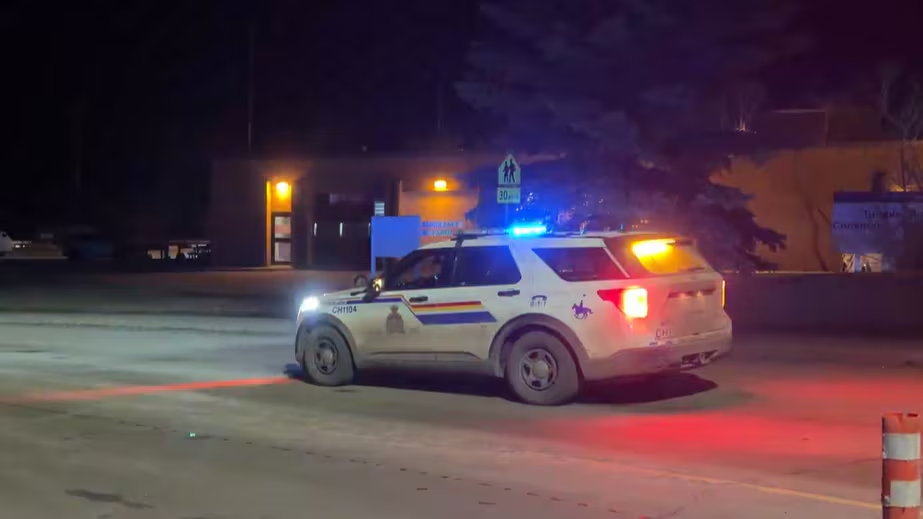
The Royal Canadian Mounted Police disclosed that more than 25 people sustained injuries, including two individuals airlifted to hospital with life-threatening conditions, following the attack at Tumbler Ridge Secondary School in the small mountain community located more than 1,000 kilometers north of Vancouver near the Alberta border.
An active shooter alert was issued at 3:15 p.m. Mountain Time by RCMP, covering an extensive area including Chetwynd and Dawson Creek. Residents were instructed to remain indoors and shelter in place. That alert was lifted at 6:45 p.m. MT after authorities determined no ongoing threat to public safety existed.
Police officers arrived at the school within two minutes of the initial emergency call, British Columbia Premier David Eby disclosed to reporters. They discovered seven people deceased inside the educational facility, including a suspect who appeared to have succumbed to a “self-inflicted injury,” local police detailed in a statement. An eighth person died while being transported to hospital, while two additional individuals were found dead at a residence authorities believe was connected to the attack.
RCMP Superintendent Ken Floyd told reporters that investigators had identified a female suspect but declined to release her name, emphasizing that the shooter’s motive remained unclear. He added that police continue investigating how the victims are connected to the shooter, suggesting the attack may not have involved random target selection.
Six people were found deceased inside the school building, while another died en route to medical facilities. The two people discovered dead at a nearby home represent a separate but connected crime scene that investigators are examining to determine relationships among all victims and the perpetrator.
Tumbler Ridge Mayor Darryl Krakowka expressed profound grief for the community of approximately 2,400 to 2,700 residents, characterizing the town as a “big family” where interconnections run deep. “I broke down,” he acknowledged, describing it as “devastating” to learn how many had perished. “I have lived here for 18 years. I probably know every one of the victims.”
The mayor’s personal knowledge of likely all victims underscores the intimate nature of small communities where tragedies affect virtually every resident either directly through personal relationships or indirectly through social networks. In towns where everyone knows everyone, mass casualty events generate collective trauma that urban communities with greater anonymity may not experience as intensely.
Pastor George Rowe of the Tumbler Ridge Fellowship Baptist Church went to the recreation center where victims’ families awaited information about their loved ones’ fates. “It was not a pretty sight. Families are still waiting to hear if it’s their child that’s deceased and because of protocol and procedure the investigating team is very careful in releasing names,” Rowe recounted.
“The big thing tonight was my having to walk away and the families still waiting to find out. It is so difficult. Other pastors and counselors are there so they are not alone,” he continued, highlighting the agonizing limbo families endure while authorities methodically confirm identities before official notifications.
Rowe once taught at Tumbler Ridge Secondary School and his three children graduated from the institution, providing him intimate familiarity with the facility and community now traumatized by violence. “To walk through the corridors of that school will never be the same again,” he reflected, acknowledging how violent events permanently alter perceptions of previously safe spaces.
The provincial government website lists Tumbler Ridge Secondary School as serving 175 students from Grades 7 to 12, suggesting the attack occurred in a relatively small educational facility where students and staff likely knew one another personally. This intimacy potentially intensifies trauma as survivors process losses of individuals they knew well rather than abstract victims.
Canadian Prime Minister Mark Carney declared in a social media post that he was devastated by the shooting. “I join Canadians in grieving with those whose lives have been changed irreversibly today, and in gratitude for the courage and selflessness of the first responders who risked their lives to protect their fellow citizens,” he wrote.
Carney’s office announced he is suspending a planned trip to Halifax, Nova Scotia and Munich, Germany, where he was scheduled to unveil a long-awaited defense industrial strategy Wednesday before attending the Munich Security Conference. The cancellation demonstrates how mass casualty events compel governmental leaders to abandon routine activities to focus on crisis response and national mourning.
Premier Eby disclosed he had spoken with Carney following what he characterized as an “unimaginable tragedy.” “I know it’s causing us all to hug our kids a little bit tighter tonight,” Eby expressed. “I’m asking the people of British Columbia to look after the people of Tumbler Ridge tonight,” appealing to provincial solidarity with the grieving community.
School shootings remain rare in Canada compared to the United States, where such incidents occur with tragic frequency. Canadian gun control measures—significantly more restrictive than American regulations—have historically limited access to firearms that enable mass casualty attacks, though Tuesday’s violence demonstrates that determined individuals can still obtain weapons and inflict catastrophic harm.
Canada’s government has responded to previous mass shootings with enhanced gun control measures, including a recently expanded prohibition on all firearms it classifies as assault weapons. Whether Tuesday’s tragedy prompts additional legislative action remains uncertain, though the political pattern suggests further restrictions may be considered.
Tuesday’s shooting represents Canada’s deadliest rampage since April 2020, when a gunman in Nova Scotia killed 13 people through shootings and set fires that claimed another nine lives over a 13-hour period. That incident shocked Canada and prompted governmental examination of firearms regulations and law enforcement response protocols.
The 2020 Nova Scotia shooter had acquired firearms illegally, complicating policy responses since existing laws theoretically should have prevented his weapon access. The case illustrated limitations of regulatory approaches when determined individuals exploit black markets or other illicit channels to obtain prohibited items.
North District Chief Superintendent Ken Floyd emphasized in a statement that “this was a rapidly evolving and dynamic situation, and the swift co-operation from the school, first responders, and the community played a critical role in our response.” The rapid police arrival within two minutes likely prevented additional casualties by shortening the timeframe during which the shooter could continue attacking unimpeded.
“Our thoughts are with the families, loved ones, and all those impacted by this tragic incident,” Floyd continued. “This has been an incredibly difficult and emotional day for our community, and we are grateful for the co-operation shown as officers continue their work to advance the investigation.”
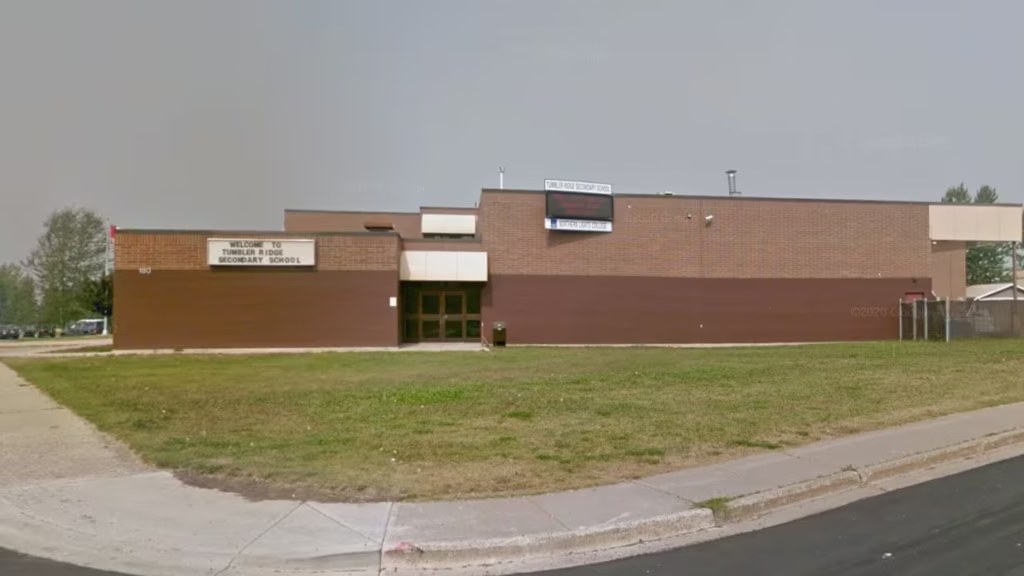
RCMP Major Crime Unit investigators are examining the scene and gathering evidence to construct a comprehensive timeline of events, determine motive, and understand relationships among all individuals involved. The investigation will likely examine the shooter’s background, mental health history, weapon acquisition, and any warning signs that might have been detected through intervention mechanisms.
Tumbler Ridge, situated in the Canadian Rockies approximately 176 kilometers northeast of Prince George, is a former mining community that has diversified economically while retaining its small-town character. The 2021 census recorded a population of about 2,400, though some estimates place current population closer to 2,700.
The town’s remote location and small size create challenges for emergency response and trauma support services. While the two-minute police arrival time demonstrates effective local law enforcement, the community likely lacks extensive mental health resources necessary to address collective trauma following such catastrophic violence.
The airlift of two critically injured victims to advanced medical facilities reflects the limited local healthcare capacity typical of small, remote communities. These patients likely required surgical interventions or intensive care unavailable at Tumbler Ridge’s medical facilities, necessitating dangerous winter helicopter transport to larger urban hospitals.
For families awaiting notification about loved ones’ fates, the careful identification protocols that Pastor Rowe referenced—while necessary to ensure accuracy—extend agonizing uncertainty. The tension between rapid information release and methodical confirmation creates unavoidable suffering for those desperate to know whether their children, spouses or parents survived.
As investigators work to establish motive and reconstruct events, the Canadian public confronts difficult questions about violence prevention, mental health intervention, firearm regulation effectiveness, and school security measures. Each mass casualty event generates renewed debate about whether additional policy responses could prevent future tragedies or whether such incidents represent irreducible risks in any society.
The female suspect’s identity and background will likely emerge in coming days, potentially illuminating warning signs that were missed or ignored before she carried out the attack. Whether she had documented mental health struggles, faced recent crises, or exhibited concerning behaviors observable to family, friends or authorities will inform discussions about intervention opportunities.
For Tumbler Ridge residents, the immediate focus remains on supporting grieving families, treating injured survivors, and beginning the lengthy process of collective healing. The corridors Pastor Rowe said “will never be the same again” represent physical spaces now haunted by violence, requiring both practical decisions about the school’s future use and psychological work to reclaim safe spaces from traumatic associations.
CBC/AP




