

Police clashed for a second consecutive night with groups of youths in the central Tunisian city of Kairouan after the death of a man following a police chase, heightening fears among authorities that localized unrest could spread nationwide ahead of the anniversary of the country’s 2011 revolution.
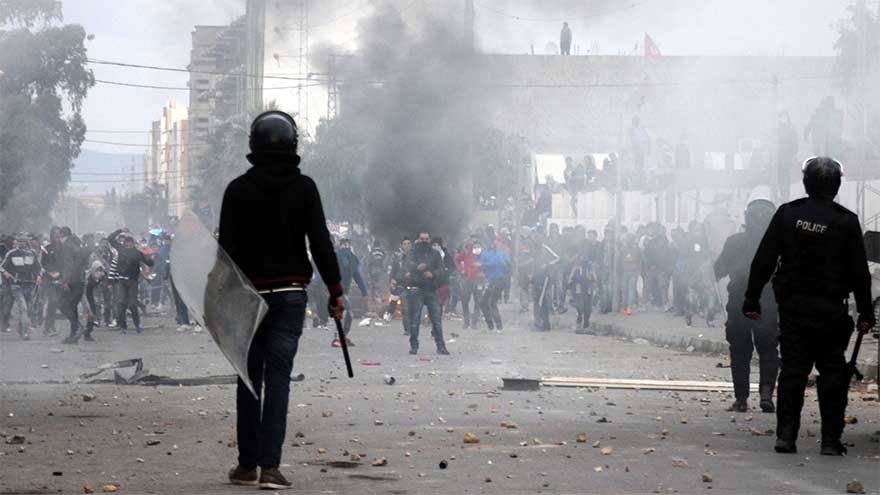
Witnesses said confrontations erupted late Saturday as demonstrators hurled stones, petrol bombs and flares at security forces while setting fire to tyres and blocking streets. Police responded by firing tear gas in an effort to disperse the crowds.
Relatives of the deceased man said he was riding a motorcycle without a license when police pursued him, beat him and transported him to a hospital. The family said he later fled medical care and died Friday from a head injury. Authorities were not immediately available to comment on the allegations.
The man’s relatives warned that protests would intensify unless those responsible were held accountable. In an effort to calm tensions, Kairouan’s governor visited the family Saturday evening and pledged to open an investigation into the circumstances surrounding the death, according to witnesses.
The unrest comes as Tunisia braces for heightened political tensions linked to the January anniversary of the 2011 uprising that toppled longtime autocrat Zine El Abidine Ben Ali and ignited the Arab Spring. Protests have already flared in several parts of the country amid mounting economic hardship, rising unemployment and public anger toward the government.
In the southern city of Gabes, thousands have been demonstrating for weeks, demanding the closure of a chemical plant they blame for environmental damage and health risks. The powerful UGTT labor union has also called for a nationwide strike next month, further raising the stakes for President Kais Saied’s government.
Saied dissolved parliament and began ruling by decree in 2021, saying the move was necessary to dismantle corruption and fix state dysfunction. Opposition parties and rights groups, however, have denounced the move as a power grab that reversed Tunisia’s democratic gains.
Meanwhile, activists and opposition figures from across Tunisia’s fractured political landscape staged a rare unified protest in the capital, denouncing Saied’s rule and demanding the restoration of democratic institutions.
Hundreds marched through central Tunis carrying portraits of jailed politicians, journalists and civil society figures, turning the demonstration into the latest in a series of weekly rallies challenging Saied’s authority. Protesters described the moment as a turning point, with long-divided political groups rallying around shared opposition to what they call one-man rule.
“Today, all opposition is in prison,” protester Noura Amaira said. “The machine of dictatorship has spared no one, so unity in the streets has become a necessity, no longer a choice.”
Rights groups accuse Saied of using the judiciary and security forces to silence dissent, describing Tunisia as an “open-air prison.” Saied has rejected the accusations, saying he is targeting traitors and corrupt elites undermining the state.
A court on Friday sentenced prominent opposition figure Abir Moussi to 12 years in prison, a ruling rights groups said underscored the shrinking space for political dissent. Last month, an appeals court handed down prison terms of up to 45 years to dozens of opposition leaders, lawyers and business figures accused of plotting against the president.
Police have also arrested several high-profile opposition figures in recent weeks, sparking condemnation from international and local human rights organizations. Authorities have additionally suspended the activities of multiple civil society groups over alleged foreign funding.
The clashes in Kairouan reflect a broader pattern of unrest driven by economic frustration and political repression, particularly among young Tunisians who were once the backbone of the 2011 revolution. Analysts say deaths linked to police encounters often act as flashpoints in Tunisia, reviving long-standing grievances over accountability and the use of force.
The convergence of localized unrest, organized labor action and unified opposition protests presents one of the most serious challenges yet to Saied’s rule. While security forces have largely maintained control, the risk of protests spreading beyond isolated cities is growing, especially as symbolic revolutionary anniversaries approach.
With inflation high and public services strained, Tunisia’s leadership faces increasing pressure at home and abroad to ease repression and offer a political roadmap. For now, however, the government has shown little sign of retreat, raising concerns that further confrontations between police and protesters may lie ahead.
Reuters




