

Uganda’s government has ordered a nationwide shutdown of internet services just days before voters head to the polls in a presidential election that is expected to extend President Yoweri Museveni’s nearly four-decade rule, a move officials say is aimed at preventing misinformation but which critics describe as an effort to stifle dissent and limit political mobilization.
Internet access across the East African nation was cut Tuesday on the orders of the Uganda Communications Commission, acting on the direction of the national security committee, authorities said. The blackout comes ahead of Thursday’s vote, in which Museveni, who has ruled Uganda since 1986, is seeking a seventh term in office.
Nyombi Thembo, the executive director of the communications commission, said the decision was taken to prevent what he described as the “weaponization of the internet,” including the spread of misinformation and hate speech during the sensitive election period. Speaking in an interview, Thembo said authorities were concerned that online platforms could be used to incite unrest.
“People wanted to start using the internet to promote hate speech,” Thembo said, adding that he did not know when services would be restored.
Museveni, 81, is widely expected to secure re-election against his main challenger, opposition figure Bobi Wine, a former pop star who has galvanized urban youth with an anti-government message. Wine, whose real name is Robert Kyagulanyi, has accused the government of systematically undermining the electoral process and using state power to suppress opposition activity.
Critics of the longtime president argue the internet shutdown is less about public safety and more about preventing Ugandans from organizing protests or sharing evidence of alleged electoral irregularities should the official results be disputed. Election results are expected to be announced over the weekend.
In an interview conducted Monday at his home outside Kampala, Wine said the electoral commission could not be trusted to conduct a free and fair vote. He described his campaign as a “protest vote” against entrenched power, even as he acknowledged the risks faced by his supporters.
“I told the people of Uganda, they see me beaten, they see me cry, they’ll see me broken but they’ll never see me give up,” Wine said. He was beaten and detained multiple times during his 2021 presidential bid, when Museveni claimed victory amid widespread allegations of fraud and violence.
Internet shutdowns around elections have become an increasingly common tactic across parts of Africa, often justified by governments as a security measure. Rights groups say such blackouts restrict freedom of expression and limit transparency during critical democratic moments. In Tanzania, authorities cut internet access during a disputed election in October, followed by a crackdown on protests and a ban on sharing videos of demonstrations.
In Uganda, the impact of the blackout was felt almost immediately, particularly in the economy, where mobile connectivity underpins daily life. Messaging apps such as WhatsApp and Instagram went dark, while ride-hailing services and online information platforms became inaccessible.
Most critically, mobile money services — a cornerstone of East Africa’s informal and formal economies — were disrupted. Uganda typically records around 40 million mobile money transactions each day, according to data from the Finance Ministry, making the shutdown a significant economic shock.
“It has affected me badly,” said Ariiho Godfrey, a motorbike taxi driver in Kampala who relies on a ride-hailing app to connect with customers. Without internet access, he said, his income dropped sharply overnight.
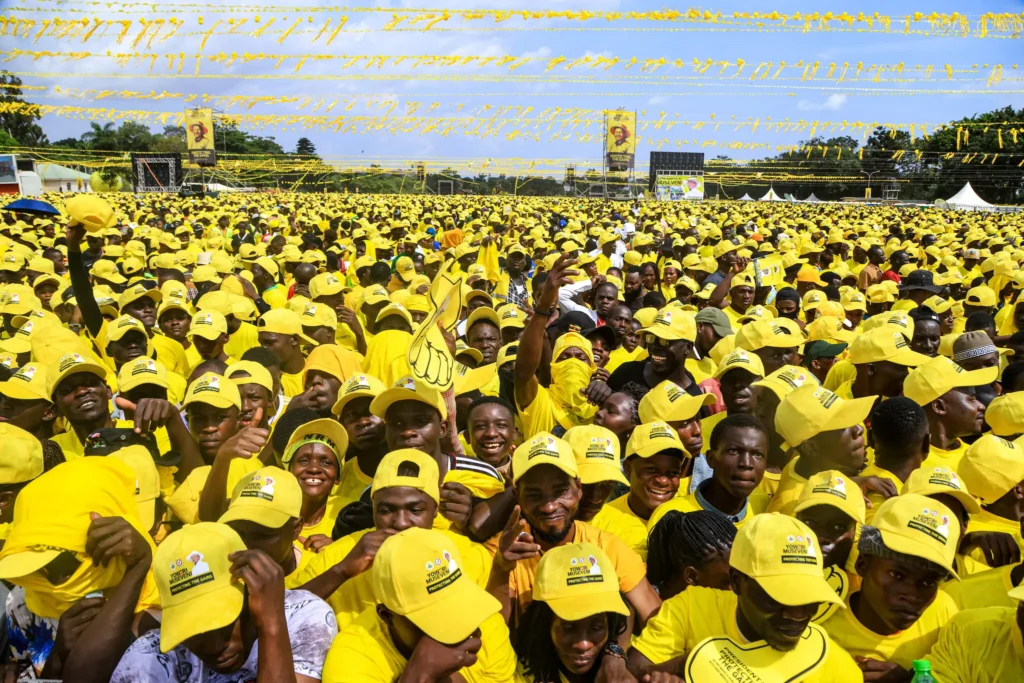
Despite the disruption, Museveni’s campaign machinery remained on full display in the final days before the vote. Tens of thousands of supporters attended his last major rally Tuesday in Kampala, many transported in buses and minivans. Large sound systems blared music as the ruling National Resistance Movement distributed free T-shirts, hats and flags in its signature yellow.
By contrast, Wine’s final rally Monday was heavily restricted by security forces. A tight perimeter of police and soldiers limited access to the event, discouraging attendance. Witnesses said at least one person was chased and beaten by soldiers for waving a national flag — a symbol closely associated with Wine’s campaign and recently banned by authorities.
Museveni rose to power in 1986 as the leader of a guerrilla rebellion and has since consolidated control over Uganda’s political and security institutions. Under his rule, the country has become a key regional military player, deploying troops to eastern Democratic Republic of Congo and South Sudan and serving as the largest contributor to African Union peacekeeping forces in Somalia.
His campaign slogan, “Protecting the Gains,” emphasizes stability and economic progress achieved during his tenure. Yet many Ugandans say the election is less about immediate change and more about the long-term question of succession. Museveni’s son, Gen. Muhoozi Kainerugaba, the commander of Uganda’s armed forces, is widely seen as a potential successor, fueling speculation about dynastic rule.
Wine’s rise in 2021 marked the most serious electoral challenge Museveni has faced in decades. Drawing on music and rhetoric that resonated with younger voters, Wine tapped into widespread frustration over unemployment, corruption and political repression. That election was marred by violence that left dozens dead, and authorities also imposed an internet shutdown at the time.
Uganda has one of the youngest populations in the world. More than a quarter of its estimated 50 million people are between the ages of 18 and 30, a demographic that has become increasingly vocal online and politically active — a factor analysts say helps explain the government’s sensitivity to digital organizing.
The current political climate has been further complicated by the detention of veteran opposition leader Kizza Besigye. Besigye disappeared from neighboring Kenya in 2024 before resurfacing in a military court in Uganda, where he faces charges including terrorism. His detention has drawn condemnation from rights groups and added to concerns about shrinking political space.
While authorities frame the internet shutdown as a preventive security measure, analysts say its broader implications extend beyond election day. The move underscores how digital infrastructure has become a central battleground in modern African politics, where control of information can shape narratives, limit scrutiny and blunt opposition momentum.
Economically, repeated shutdowns risk undermining investor confidence and public trust in digital services, particularly mobile money platforms that millions depend on daily. Politically, critics warn that normalizing internet blackouts erodes democratic norms and entrenches authoritarian practices under the guise of stability.
As Uganda awaits election results, the shutdown has heightened tensions and uncertainty. Whether or not Museveni’s victory is contested, the decision to pull the country offline is likely to deepen debates about governance, succession and the future of political freedoms in one of East Africa’s most influential states.
NewYorkTimes




