

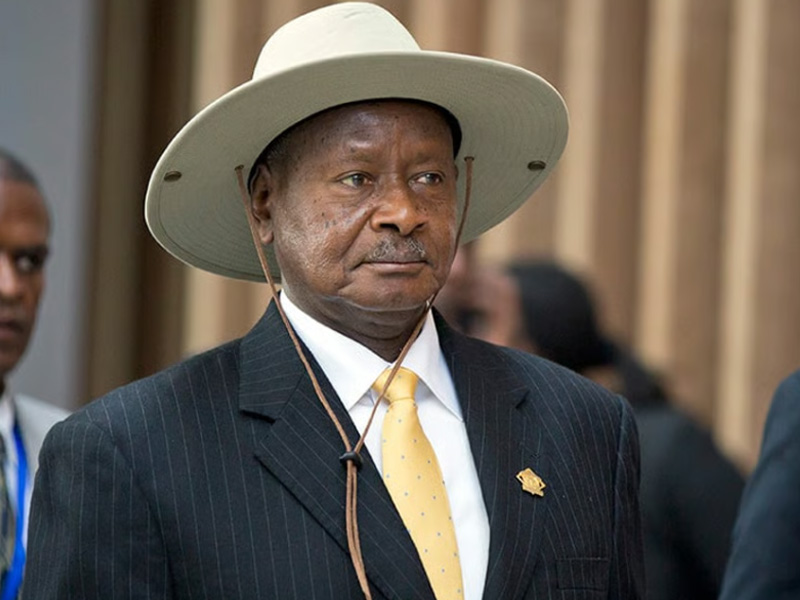
KAMPALA, Uganda — President Yoweri Museveni secured a seventh consecutive term Saturday after official results showed him capturing 71.65 percent of votes in an election overshadowed by a days-long internet blackout, the systematic failure of voting technology in opposition strongholds and fraud allegations from his youthful challenger, who rejected the outcome and called for sustained peaceful protest.
Musician-turned-politician Bobi Wine, whose legal name is Kyagulanyi Ssentamu, received 24.72 percent of votes in final tallies announced by electoral authorities. The 43-year-old opposition leader immediately condemned what he characterized as a fraudulent electoral process and urged Ugandans to demonstrate peacefully until what he termed “the rightful results are announced.”
Wine said he escaped his residence Friday night to avoid arrest by security forces who stormed the property. Police spokesperson Kituuma Rusoke disputed the claim, stating Wine was “not under arrest” and could leave his house freely, though authorities implemented “controlled access” for others attempting to enter the premises to prevent the property’s use for inciting violence.
The election unfolded amid extraordinary disruptions that undermined confidence in the democratic process. Biometric voter identification machines failed Thursday across polling stations, causing substantial delays in urban areas including the capital, Kampala, where opposition support runs strongest. The technological breakdown dealt a significant blow to pro-democracy activists who had long demanded biometric systems to prevent ballot manipulation.
After the machines malfunctioned, polling officials reverted to paper voter registers, abandoning the very technology intended to ensure electoral integrity. The failure will likely form the foundation for legal challenges to the official results, though Wine has not indicated whether he will pursue court remedies that previous opposition candidates have attempted without success.
Uganda’s courts have consistently refused to nullify Museveni’s victories while recommending electoral reforms that never materialize, creating a cyclical pattern where judicial acknowledgment of systemic problems produces no meaningful change. This history of futile legal challenges may explain Wine’s emphasis on popular protest rather than litigation as the primary vehicle for contesting the results.
Museveni endorsed the electoral commission’s decision to use paper records after biometric systems failed, but Wine alleged systematic fraud involving “massive ballot stuffing” and claimed his party’s polling agents were abducted to provide unfair advantage to the ruling party. The allegations paint a picture of coordinated manipulation extending beyond technological failure to active suppression of opposition oversight.
Goodluck Jonathan, former Nigerian president leading the African Union observer mission, told journalists Saturday the delegation found “no evidence of ballot stuffing” at polling stations the team monitored. He urged electoral authorities to test biometric machines in advance to prevent the failures and delays that characterized election day, a recommendation that implicitly acknowledges serious organizational deficiencies while stopping short of endorsing fraud allegations.
Local observers offered sharper criticism. Livingstone Sewanyana, head of the Foundation for Human Rights Initiative, a Kampala civic organization, called the biometric machine failures a red flag. He said the election climate was “characterised by fear and tension among the electorate, and some people just chose not to participate in the process.”
Voter turnout reached just 52 percent, the lowest figure since Uganda restored multiparty politics in 2006. The depressed participation reflects both the intimidating security environment and widespread cynicism about whether voting can produce genuine political change under Museveni’s authoritarian system.
The 81-year-old president has maintained power through decades by systematically rewriting constitutional constraints on his rule. Term limits and age restrictions, the final legal obstacles to indefinite tenure, have been stripped from the constitution, while potential rivals have been imprisoned or marginalized. Museveni has not indicated when he might retire and faces no challengers within senior ranks of his party.
Kizza Besigye, a veteran opposition figure who challenged Museveni four times for the presidency, remains imprisoned on treason charges he characterizes as politically motivated. His continued detention eliminates a experienced opposition voice who might otherwise have unified disparate anti-Museveni factions.
Yusuf Serunkuma, an academic and columnist for the local Observer newspaper, told The Associated Press on Saturday that Wine “didn’t stand a chance” against the authoritarian Museveni, who appoints the electoral commission. “He has quite successfully emasculated the opposition,” Serunkuma said of the president.
Even with Wine’s challenge, Museveni faced “one of the weakest oppositions” in recent times partly because opposition figures lack unity while the president maintains undisputed leadership of his party and commands authority over armed forces, Serunkuma said. This structural imbalance creates insurmountable obstacles for opposition candidates regardless of their popular support.
The internet shutdown, which remained in effect from Tuesday through late Saturday, devastated businesses ranging from sports betting shops to ride-sharing drivers. The Uganda Communications Commission directed service providers to suspend access over an unspecified national security threat, though the directive lacked legal authority absent a declared state of emergency.
Service providers complied despite the order’s questionable legality, demonstrating the government’s practical control over communications infrastructure regardless of formal legal requirements. The shutdown prevented activists from documenting alleged electoral malpractices through social media and hindered opposition efforts to coordinate election monitoring across the country’s 21.6 million registered voters.
Security forces maintained heavy presence throughout the campaign period. Wine said authorities followed him constantly, harassed supporters with tear gas and created an atmosphere of intimidation. He campaigned wearing a flak jacket and helmet due to legitimate fears for his personal safety, images that captured the militarized nature of Uganda’s electoral politics.
Wine told The Associated Press in a recent interview that at least three supporters were killed during campaign events, claiming “the military has largely taken over the election.” The Office of the United Nations High Commissioner for Human Rights in Geneva has cited “widespread repression” including abduction and disappearance of opposition supporters, allegations Ugandan authorities reject while insisting campaigns proceeded peacefully.
Ugandan authorities deployed troops Saturday throughout Kampala, with armored vehicles spreading across the city and soldiers patrolling streets. Military spokesman Col. Chris Magezi characterized the deployment as meant to deter violence, rejecting concerns about anti-democratic mobilization. The visible military presence serves simultaneously as deterrent to protest and reminder of the armed force backing Museveni’s rule.
Wine’s National Unity Platform urged followers to remain near polling stations after voting as part of a “protecting the vote” strategy aimed at preventing rigging. Ugandan law permits voters to gather 20 meters from polling stations, though electoral officials urged citizens to vote and return home, potentially returning later for vote counting.
The dispute over whether voters should stay at polling stations as witnesses animated public debate and raised fears the election could turn violent if security forces chose to enforce the electoral body’s guidance. “The first step is for all of us to stay at the polling stations (while observing the 20-metre distance) and ensure that nothing criminal happens,” Wine wrote Tuesday on X. “We implore everyone to use their cameras and record anything irregular.”
This strategy reflects opposition recognition that formal oversight mechanisms controlled by government-appointed electoral authorities cannot be trusted. By mobilizing supporters as informal monitors, Wine attempted to create accountability through citizen surveillance, though the strategy’s effectiveness was undermined by internet blackouts that prevented real-time documentation sharing.
In a New Year’s Eve address, Museveni recommended security forces use tear gas against what he called “the criminal opposition,” framing peaceful assembly as inherently threatening rather than a democratic right. The characterization exemplifies how Museveni’s government delegitimizes opposition activity as criminal rather than political, justifying repressive responses.
Wine faced similar obstacles when he first challenged Museveni in 2021. Police frequently roughed him up, ripped clothing from his body and jailed dozens of supporters. The pattern of violence and intimidation represents not isolated incidents but systematic strategy to raise the cost of opposition participation beyond what ordinary citizens will endure.
Museveni has ruled Uganda for nearly 40 years without witnessing peaceful presidential power transfer since independence from British colonial rule six decades ago. The absence of democratic succession creates profound uncertainty about Uganda’s political future and raises questions about stability when Museveni eventually leaves office through death or incapacity rather than electoral defeat.
The president has no recognizable successor within senior ranks of the ruling National Resistance Movement, creating a succession vacuum that his son appears positioned to fill. Gen. Muhoozi Kainerugaba, the military’s top commander and Museveni’s presumptive heir, has publicly expressed desire to succeed his father, raising fears of hereditary rule that would further distance Uganda from democratic norms.
Kainerugaba, a four-star general, sparked controversy by writing social media messages widely viewed as offensive, including comments about beheading Wine and hanging Besigye. The inflammatory rhetoric demonstrates either poor judgment or deliberate intimidation, neither quality reassuring for a potential future leader. His position as military chief creates structural conditions enabling a succession that bypasses democratic processes entirely.
The six other presidential candidates who participated in the election received negligible vote shares, reflecting the binary nature of competition between Museveni’s entrenched authority and opposition forces united primarily by opposition to his continued rule rather than coherent alternative vision.
The election’s outcome was never seriously in doubt despite Wine’s energetic campaign and substantial support among younger Ugandans frustrated with decades of Museveni’s rule. The president’s control over electoral machinery, security forces and constitutional framework creates conditions where opposition victories require not merely winning voter support but overcoming systematic obstacles designed to prevent power transfer.
International observers’ relatively mild criticism, focusing on technical failures rather than fundamental legitimacy questions, provides Museveni with sufficient international acceptance to continue governing despite domestic opposition. The African Union delegation’s failure to find ballot stuffing evidence, while noting serious procedural problems, exemplifies how observer missions often validate flawed elections by distinguishing between imperfect processes and outright fraud.
For Wine and his supporters, the path forward involves sustaining protest momentum despite security force intimidation, internet restrictions and the risk that sustained demonstrations will provide justification for even harsher crackdowns. The opposition faces the fundamental challenge confronting movements against entrenched authoritarian rule: how to translate popular dissatisfaction into political change when democratic institutions have been captured by the ruling party.
Museveni’s victory extends his tenure toward five decades in power, a period that will have spanned from Cold War-era politics through the digital age. His ability to adapt authoritarian tactics to changing technological and political environments while maintaining control demonstrates both resilience and the difficulty of dislodging long-serving rulers who have systematically dismantled constraints on their power.
The election confirms Uganda’s trajectory away from democratic norms despite formal maintenance of electoral processes that provide veneer of legitimacy without substantive competition. Whether Wine’s protest call generates sustained movement capable of forcing genuine political change or whether it dissipates amid repression and exhaustion will shape Uganda’s political landscape for years ahead.
AP




