

Ukrainian military intelligence confirmed Thursday the deaths of two Nigerian nationals who were fighting for Russian forces in eastern Ukraine, identifying them as victims of a drone strike during a late November assault on Ukrainian positions in Luhansk Oblast.
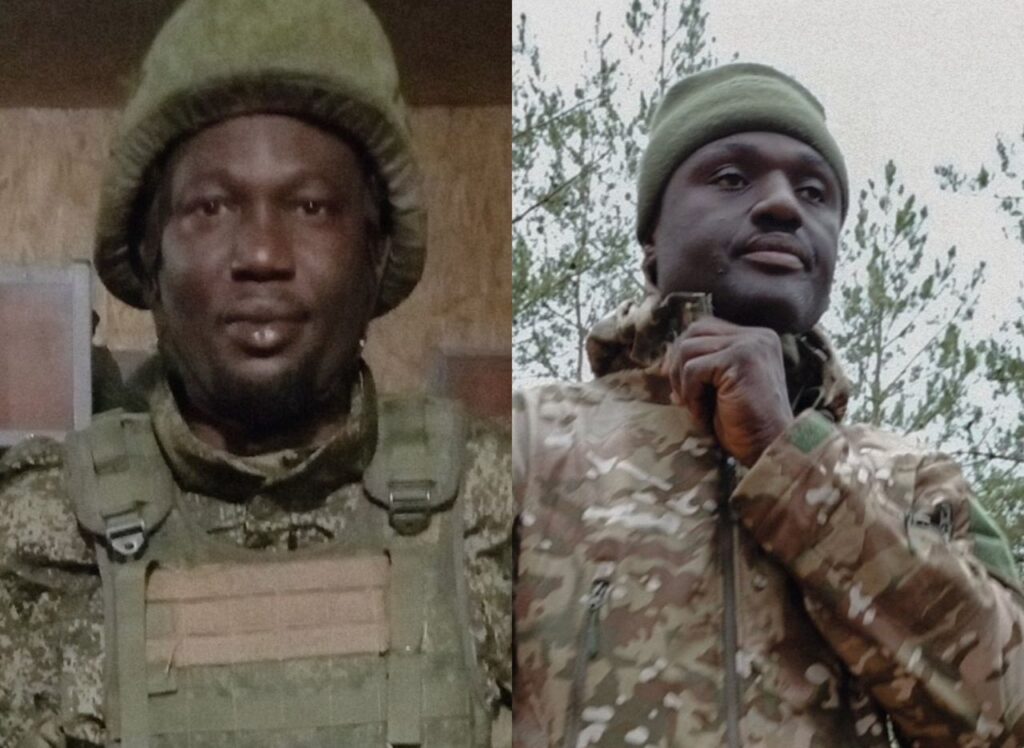
The Main Directorate of Intelligence of Ukraine disclosed that Hamzat Kazeen Kolawole and Mbah Stephen Udoka both served in the 423rd Guards Motor Rifle Regiment of the Russian Federation’s armed forces before being killed in combat operations. The deceased men signed contracts with the Russian military during the second half of 2025—Kolawole on August 29 and Udoka on September 28.
Neither man received substantive military training before deployment to combat zones, Ukrainian intelligence emphasized. Kolawole is survived by a wife and three children in the West African nation, while Udoka’s family circumstances were not immediately disclosed.
The bodies were discovered in Luhansk, an area within the Donbas region of eastern Ukraine that has experienced intense fighting since Russia launched its full-scale invasion in February 2022. The region remains partially under Russian occupation as the conflict continues to devastate local communities and infrastructure.
“Both Nigerians were killed in late November during an attempt to storm Ukrainian positions in the Luhansk region. They never engaged in a firefight — the mercenaries were eliminated by a drone strike,” the intelligence organization stated, highlighting the increasingly lethal role of unmanned aerial systems in contemporary warfare.
Ukrainian Defense Intelligence provided additional detail regarding the circumstances surrounding both men’s recruitment and deployment. The two Nigerian nationals served in the 423rd Guards Motor Rifle Regiment, designated as military unit 91701, part of the 4th Guards Tank Kantemirov Division of the Russian Armed Forces.
“Udoka essentially received no training — just five days later, on Oct. 3, he was enrolled in the unit and sent to temporarily occupied territories of Ukraine the same day,” Ukrainian intelligence disclosed, revealing the extraordinarily abbreviated preparation period before combat deployment.
The five-day gap between Udoka’s September 28 contract signing and October 3 deployment to occupied Ukrainian territory underscores what Ukrainian officials characterize as Russia’s negligent approach to foreign recruit preparation. This minimal training period likely contributed to the men’s vulnerability during combat operations.
Ukrainian intelligence assessed a high probability that Kolawole also received no meaningful military training, noting that documents related to his preparation have not been preserved. This absence of training records suggests either that training never occurred or that Russian military administration failed to maintain proper documentation.
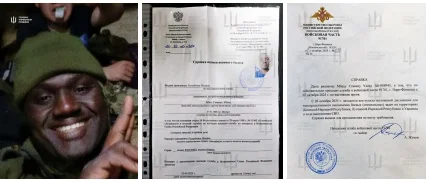
Kolawole, born April 3, 1983, was 42 years old at the time of his death. Udoka, born January 7, 1988, was 37. Both men were killed during late November 2025 while participating in an attempted assault on Ukrainian defensive positions.
“They never entered small-arms combat — the mercenaries were eliminated by a drone strike,” Ukrainian intelligence reiterated, suggesting the men died before engaging Ukrainian forces directly through conventional infantry combat. The drone strike likely occurred as Russian assault forces maneuvered toward Ukrainian positions, eliminating them before close-quarters engagement.
“The number of identified Russian mercenaries from Africa who have been killed is growing,” the Main Directorate of Intelligence stated, positioning these deaths within broader patterns of African recruitment by Russian military and private military contractors.
Ukrainian intelligence issued stark warnings to foreign nationals considering travel to Russia or accepting employment within its territory. “Traveling to Russia is a real chance of ending up in an assault ‘suicide’ detachment and ultimately rotting in Ukrainian soil,” the agency cautioned, using blunt language designed to deter potential recruits from African nations and elsewhere.
Russia has faced persistent accusations of recruiting men from developing nations to fight in its Ukraine war under false pretenses of offering lucrative employment opportunities. Recruits from India, Nepal, Kenya, South Africa and other countries have complained of being deceived by recruiters who promised civilian jobs while actually directing them toward military contracts obligating combat service.
The recruitment patterns suggest systematic exploitation of economically vulnerable populations in nations where employment opportunities remain limited and wages substantially lower than promised Russian compensation. Young men seeking better economic prospects become trapped in military obligations they may not have fully understood when signing contracts in foreign languages.
In July 2025, Ukrainian intelligence disclosed that fighters of the Freedom of Russia Legion—a unit operating under Main Directorate of Intelligence authority—captured a Nigerian national fighting in the 503rd Guards Motor Rifle Regiment of the Russian Armed Forces on the Zaporizhzhya front. This capture provided additional confirmation of Nigerian participation in Russian military operations.
The Main Directorate of Intelligence also emphasized that Russia is expanding its propaganda network throughout Africa to facilitate recruitment and shape continental perceptions of the Ukraine conflict. State media resources—particularly the TASS news agency and RT television channel—are actively employed to promote Kremlin narratives, Ukrainian intelligence added.
Russian propaganda media broadcast in more than 40 African countries across six languages, the intelligence agency calculated, demonstrating the sophisticated information operations supporting physical recruitment efforts. This media presence enables Russia to present military service opportunities while minimizing discussion of casualties and combat conditions.
The Russia-Ukraine conflict has evolved into a grinding war of attrition with both sides experiencing substantial casualties and deploying increasingly sophisticated weapons systems including drones, long-range missiles and electronic warfare capabilities. The war remains largely contained to eastern and southern regions of Ukraine, though periodic strikes occur throughout the country.
Russia’s full-scale invasion has strained global food and energy markets, displaced millions of Ukrainians whose homes and businesses have been destroyed, and created ripple effects throughout international economic and security systems. The conflict shows minimal signs of resolution as both nations maintain incompatible territorial and political objectives.
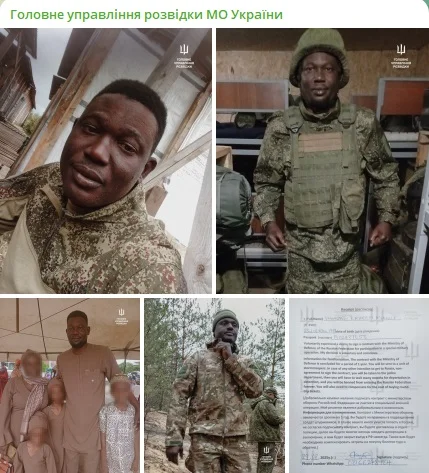
For Nigeria and other African nations, the deaths of citizens fighting in distant conflicts raise difficult questions about governmental responsibilities to protect nationals from predatory foreign recruitment, regulate international labor migration, and provide economic opportunities that reduce vulnerability to exploitative schemes.
The Kolawole and Udoka deaths illustrate the human cost of Russia’s reliance on foreign recruits to sustain military operations amid substantial casualties among Russian contract soldiers and conscripts. By recruiting from economically disadvantaged nations, Russia attempts to maintain force levels without expanding politically sensitive domestic mobilization that could generate internal opposition.
Ukrainian forces’ increasing proficiency with drone warfare—demonstrated by the strike that killed both Nigerian men—represents a significant tactical evolution that has altered battlefield dynamics. Drones provide Ukrainian defenders with surveillance, targeting and strike capabilities that partially offset Russia’s advantages in artillery and manpower.
As the conflict continues, the number of foreign nationals killed fighting for Russia will likely increase, generating diplomatic complications between Moscow and nations whose citizens die in combat they may have been deceived into joining. Whether these deaths will deter future recruitment remains uncertain given the economic pressures driving vulnerable populations toward risky employment opportunities.
AP/VoiceofUkraine




