

Ukrainian maritime drones on Wednesday struck and disabled an oil tanker involved in transporting Russian petroleum as it navigated through Ukraine’s exclusive economic zone in the Black Sea toward the Russian port of Novorossiysk, a Ukrainian official disclosed, marking the third assault in two weeks targeting vessels that Kyiv accuses of helping Moscow circumvent international sanctions and finance its military operations.
The attack represents part of an escalating campaign against Russia’s so-called “shadow fleet”—unregulated vessels which Ukrainian authorities contend are enabling the Kremlin to export substantial quantities of oil and generate war funding despite Western economic restrictions designed to constrain Russia’s energy revenues. The strikes have sent war insurance costs for ships sailing to the Black Sea soaring, with insurers reviewing policies on a daily basis as the conflict in Ukraine increasingly spills into critical maritime shipping lanes.
The Dashan tanker was traveling at maximum velocity with its transponders deliberately switched off when powerful explosions struck its stern section, inflicting critical damage on the vessel, the official at the Security Service of Ukraine (SBU) disclosed. He made no mention of possible casualties in the incident, leaving uncertainty about whether crew members were killed or injured during the explosive assault.
The strike on the Dashan, which operates under European Union and British sanctions and is sailing without a known flag registry, was also confirmed by three maritime security sources with knowledge of the incident. The vessel’s lack of proper registration exemplifies the shadowy nature of operations that enable sanctioned Russian oil to reach international markets despite restrictions.
There was no immediate comment from Russia on the incident, maintaining the Kremlin’s typical pattern of silence following Ukrainian strikes on maritime assets involved in oil transportation.
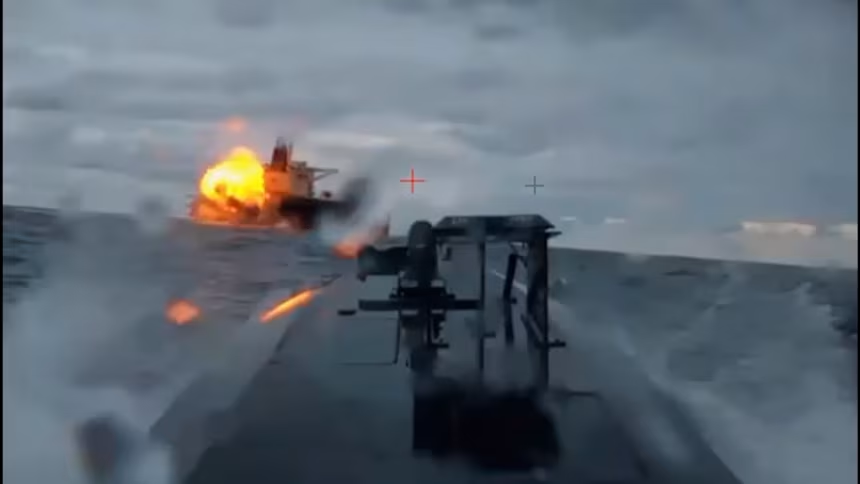
Naval drones could be seen speeding toward the hulking tanker followed by powerful explosions as they reached the vessel, video footage provided by the official demonstrated. The dramatic imagery captured the moment of impact as the unmanned craft executed their mission against the moving target.
Reuters was able to verify it was the Dashan tanker in the video by comparing the deck configuration, cranes and structural features with archival imagery. The location and date were confirmed by the SBU source’s account and ship tracking data that monitors vessel movements across global waterways.
“The SBU continues to take active measures to reduce petrodollar revenues to the Russian budget,” the official declared. “Over the past two weeks, this is the third tanker of the shadow fleet put out of action that had helped the Kremlin circumvent international sanctions,” emphasizing Ukraine’s strategic focus on degrading Russia’s economic capacity to sustain military operations.
Russian President Vladimir Putin, who ordered a full-scale invasion of Ukraine in February 2022, threatened last week to sever Ukraine’s access to the Black Sea in response to the attacks on tankers, which he characterized as piracy rather than legitimate military operations. Putin’s threat represents an escalation of rhetoric regarding Ukraine’s maritime warfare tactics that have increasingly targeted Russia’s energy export infrastructure.
Ukraine has been attacking Russian oil refineries for months, deploying long-range aerial drones to strike deep behind the front lines of Moscow’s war against Ukraine. The strikes on tankers represent a complementary line of attack that targets Russia’s ability to export processed petroleum products rather than simply disrupting refining capacity.
There have been at least seven explosive incidents on other tankers that called at Russian ports since December 2024 at locations including in the Mediterranean Sea. Ukraine is suspected of executing those attacks using limpet mines attached to vessel hulls, maritime security sources indicated, but Kyiv has not confirmed or denied any involvement in those operations, maintaining strategic ambiguity about the scope of its maritime campaign.
CNN documented that Ukraine struck an oil tanker belonging to Russia’s so-called shadow fleet in the Black Sea on Wednesday, according to an official in the Security Service of Ukraine (SBU). A Ukrainian security source conveyed to CNN that Sea Baby maritime drones were utilized in a joint operation coordinated by the SBU and the navy, representing the third assault against Russian tankers in two weeks.
Russia has been employing hundreds of tankers, flying different national flags, to clandestinely ship its oil to customers in defiance of Western sanctions designed to limit Moscow’s energy export revenues. This vast shadow fleet operates through complex ownership structures and flag-of-convenience registrations that obscure the ultimate beneficiaries and complicate enforcement of international restrictions.
The Dashan tanker, which was flying the flag of the Comoro Islands, suffered “critical damage,” with preliminary information indicating the ship was “disabled,” the source revealed. There was no immediate comment from Russia regarding the vessel’s status or the extent of damage sustained in the attack.
Video obtained by CNN shows a Sea Baby drone diving beneath the tanker before a series of explosions in the vessel’s stern area. Thick plumes of smoke then engulf the tanker, creating dramatic visual evidence of the strike’s effectiveness against the large commercial vessel.
It was not immediately clear what cargo the vessel was carrying or whether the strike caused an oil spill that could create environmental hazards in the Black Sea. The potential for ecological damage represents a secondary concern when military operations target petroleum-carrying vessels in sensitive marine environments.
The ship was traveling at top speed through Ukraine’s exclusive economic zone, with its transponder turned off to avoid detection, when it was hit, the SBU source noted. The disabled transponder represents standard practice for shadow fleet vessels seeking to evade monitoring by authorities enforcing sanctions compliance.
The vessel had been moving toward Russia’s Novorossiysk port terminal, a key Russian oil hub responsible for handling substantial volumes of crude oil and refined products destined for international markets, the source added. Novorossiysk represents one of Russia’s most strategically important energy export facilities, making vessels servicing the terminal high-value targets for Ukrainian interdiction efforts.
The port was struck last month, when Ukraine attacked one of Moscow’s largest oil export facilities. The assault, acknowledged by officials from both countries, marked an escalation of Kyiv’s efforts to target a key source of Russian war revenue by directly hitting infrastructure rather than only intercepting vessels at sea.
“The SBU continues to take active measures to reduce oil dollar revenues to the Russian budget,” the source emphasized, framing the maritime campaign as economic warfare designed to constrain Russia’s ability to finance military operations through energy exports.
The Ukrainian military operation follows a similar strike on two Russian shadow fleet tankers in late November. The SBU characterized that strike as dealing a “significant blow to the transportation of Russian oil,” claiming measurable impact on Russia’s ability to move petroleum products to international customers.
The latest Ukrainian assault followed US President Donald Trump’s assertion Tuesday that Moscow has the “upper hand” in its ongoing invasion of Ukraine and that Kyiv is “losing” the war, comments that sparked immediate pushback from Ukrainian and European officials who disputed his characterization of battlefield dynamics.
Multiple Ukrainian and European officials have challenged Trump’s claims, although Ukraine’s military position is acknowledged to be difficult. There are no new US or European assessments to suggest there have been significant changes on the battlefield that indicate Russian President Vladimir Putin’s forces will triumph imminently, the officials conveyed to CNN, contradicting Trump’s bleak assessment of Ukrainian prospects.
Meanwhile, negotiations over a US-proposed peace settlement between Ukraine and Russia are continuing but have not achieved a breakthrough that would end the nearly three-year conflict. The talks represent ongoing diplomatic efforts to find an acceptable resolution while military operations continue on multiple fronts.
US and Ukrainian delegations met virtually Wednesday to discuss plans for the reconstruction and economic development of Ukraine after the war with Russia concludes, Ukrainian President Volodymyr Zelensky disclosed in a post on X. The meeting focused on post-conflict planning even as active combat operations persist across Ukrainian territory.
The US delegation included Treasury Secretary Scott Bessent; Trump’s son-in-law, Jared Kushner; and Larry Fink, chairman and CEO of BlackRock, according to the Ukrainian leader. The high-level participation signals American interest in post-war economic opportunities and reconstruction financing arrangements.
“We discussed key elements for recovery, various mechanisms and visions for reconstruction. There are many ideas that, with the right approach, could succeed in Ukraine,” Zelensky observed, projecting optimism about Ukraine’s economic prospects despite ongoing hostilities.
The Ukrainians also “updated our reflections on the 20 points of the framework document for ending the war,” he noted. Zelensky thanked Trump and his team “for their substantive work and support,” maintaining diplomatic courtesy despite Trump’s controversial recent comments about Ukraine’s battlefield position.
The strategic significance of targeting Russia’s shadow fleet extends beyond immediate tactical impacts to address fundamental questions about sanctions effectiveness and economic warfare strategies. Western sanctions on Russian oil exports have proven difficult to enforce given the emergence of alternative shipping networks operating outside regulated maritime commerce systems. Ukraine’s direct military action against these vessels represents an attempt to achieve through kinetic means what diplomatic and financial pressure has struggled to accomplish.
The shadow fleet phenomenon has frustrated Western policymakers seeking to limit Russia’s oil export revenues without triggering global energy price spikes that could harm their own economies. These vessels, often aging tankers purchased at discount prices and operating through opaque ownership structures, have enabled Russia to maintain substantial oil export volumes despite restrictions that theoretically should have severely constrained its market access.
Maritime insurance markets have responded to the escalating risks by dramatically increasing premiums for vessels operating in the Black Sea region or calling at Russian ports. Some insurers have withdrawn coverage entirely for certain routes, forcing shipowners to seek alternative coverage through less reputable providers or operate without adequate insurance protection, further pushing legitimate operators out of Russian oil trade and leaving the field to shadow fleet vessels willing to accept higher risks.
The use of maritime drones represents a significant evolution in Ukraine’s military capabilities, demonstrating how unmanned systems can project power across maritime domains despite Ukraine’s limited conventional naval assets. The Sea Baby drones, developed domestically by Ukrainian defense enterprises, provide cost-effective means to threaten high-value targets at sea without risking crewed vessels or aircraft that would be vulnerable to Russian air defenses and naval forces.
Putin’s threat to sever Ukraine’s Black Sea access carries significant implications if implemented. Ukraine relies on the Black Sea corridor for agricultural exports that constitute a major portion of its economy and provide critical food supplies to global markets. Any Russian attempt to close off Ukrainian access would likely trigger international response given the broader economic consequences beyond the bilateral conflict.
The environmental risks posed by strikes on oil tankers represent genuine concerns that complicate the tactical calculus. A major oil spill in the Black Sea could cause extensive ecological damage to coastal ecosystems and fisheries that multiple nations depend upon. Ukraine’s apparent calculation is that the economic and military benefits of disrupting Russian oil exports justify the environmental risks, though this position may prove controversial if a catastrophic spill occurs.
The escalating maritime warfare campaign illustrates how the conflict continues evolving with new tactics and targeting priorities emerging as both sides adapt to changing battlefield conditions. Ukraine’s ability to conduct effective operations against Russian economic interests hundreds of kilometers from Ukrainian-controlled territory demonstrates that Kyiv retains offensive capabilities despite being on the strategic defensive across most of the land war’s fronts.
As negotiations continue regarding potential peace frameworks, Ukraine’s maritime campaign against Russian oil infrastructure may serve as bargaining leverage by demonstrating Kyiv’s capacity to impose economic costs on Moscow even if battlefield momentum has shifted. The ability to disrupt Russia’s primary revenue source provides Ukraine with strategic options beyond conventional military operations along the contact line.
CNN/Reuters




