

WASHINGTON (BN24) — The U.S. military is sending the world’s largest aircraft carrier to the waters off South America in the latest escalation and buildup of military forces in the region, the Pentagon announced Friday.
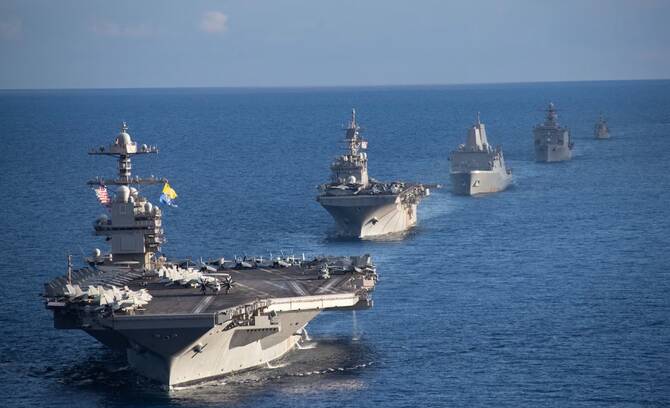
Defense Secretary Pete Hegseth ordered the USS Gerald R. Ford and its strike group to deploy to U.S. Southern Command to “bolster U.S. capacity to detect, monitor, and disrupt illicit actors and activities that compromise the safety and prosperity of the United States,” Pentagon spokesman Sean Parnell said in a social media post.
The deployment will dramatically increase the number of service members and ships dedicated to the Trump administration’s campaign to counter narcotics traffickers in the region.
Parnell said on X that Hegseth “has directed the Gerald R. Ford Carrier Strike Group and embarked carrier air wing to the U.S. Southern Command” area of responsibility. Southern Command is responsible for the Caribbean Sea, Central and South America and the surrounding waters.
The “enhanced U.S. force presence” will “bolster U.S. capacity to detect, monitor, and disrupt illicit actors and activities that compromise the safety and prosperity of the United States homeland and our security in the Western Hemisphere,” Parnell said.
The USS Gerald R. Ford is the Navy’s newest and most advanced aircraft carrier, having been commissioned into service in 2017. At more than eleven hundred feet long with a displacement of one hundred thousand long tons, the carrier is the largest in the world. It is powered by two nuclear reactors and can reach a top speed of thirty-four point five miles per hour, according to the Navy.
The carrier group will join eight U.S. vessels that are already in the region, including three destroyers, one cruiser, a littoral combat ship, an amphibious assault ship and two transport ships.
The Ford is currently in the Mediterranean Sea, a defense official told CBS News, along with three destroyers.
Deploying an aircraft carrier represents a major escalation of military power in a region that has already seen an unusually large U.S. military buildup in the Caribbean Sea and the waters off Venezuela.
News of the decision to send the carrier group to Latin America comes after the U.S. launched another strike on a vessel allegedly operated by the Venezuelan gang Tren de Aragua that Hegseth said was trafficking drugs in the Caribbean Sea.
The secretary said on X that the strike killed all six men who were on board and took place in international waters. He said it was the first strike to take place at night. “The vessel was known by our intelligence to be involved in illicit narcotics smuggling, was transiting along a known narco-trafficking route, and carrying narcotics,” he wrote. Hegseth posted a video, marked unclassified, showing the vessel as it was hit.
This latest strike appears to be the tenth carried out by the Trump administration against alleged drug trafficking boats over the past several weeks, which have now led to more than forty deaths. The first several took place in the Caribbean Sea, but this week the administration’s campaign broadened into the Pacific Ocean.
The U.S. military has conducted its tenth strike on a suspected drug-running boat, Hegseth said Friday, blaming the Tren de Aragua gang for operating the vessel and leaving six people dead in the Caribbean Sea.
The pace of the strikes has quickened in recent days from one every few weeks when they first began to three this week, killing a total of at least forty-three people since September. Two of the most recent strikes were carried out in the eastern Pacific Ocean, expanding the area where the military has launched attacks and shifting to where much of the cocaine from the world’s largest producers is smuggled.

The aircraft carrier deployment represents the most significant military escalation in the region since the Trump administration began its aggressive counter-narcotics campaign. The addition of the Ford strike group will provide the U.S. military with enhanced surveillance, intelligence-gathering and strike capabilities across a vast maritime area.
The carrier strike group typically includes the aircraft carrier, guided-missile destroyers, guided-missile cruisers and an attack submarine, along with embarked aircraft squadrons. The Ford can carry more than seventy-five aircraft and has a crew of approximately four thousand five hundred sailors.
The deployment comes amid escalating tensions with Venezuela, where President Donald Trump has authorized CIA covert operations and disclosed plans to potentially oust President Nicolas Maduro. Trump said Venezuelan leader Maduro offered “everything” including the country’s natural resources to secure a deal with the United States.
The military buildup in Latin America has raised concerns among legal experts and Democratic lawmakers who question whether the strikes on suspected drug boats adhere to international laws of war. The Trump administration argues it is engaged in a war with narcoterrorist groups from Venezuela, making the strikes legitimate.
Admiral Alvin Holsey, who leads U.S. Southern Command, announced Thursday he would step down at the end of this year, two years ahead of schedule, in a surprise move amid the escalating Venezuela tensions. Sources indicated there had been tension between Holsey and Hegseth over operations in the Caribbean.
Less than a week ago, the Pentagon announced its counter-narcotics operations in the region would not be led by the Miami-based Southern Command but by II Marine Expeditionary Force, a unit capable of rapid overseas operations based at Camp Lejeune in North Carolina. That decision surprised U.S. military observers, since a combatant command like Southern Command would normally lead high-profile operations.
The expanded military presence in Latin American waters reflects the Trump administration’s determination to combat drug trafficking through aggressive military action. The deployment of an aircraft carrier provides capabilities far beyond traditional counter-narcotics operations, including air superiority, strike operations and command and control functions.
Critics have questioned the legal basis for strikes that have killed more than forty people, many of whom were never confirmed to be armed or engaged in hostile actions. The administration maintains the operations target narcoterrorist organizations that pose a direct threat to U.S. national security.
The Ford deployment will significantly expand U.S. military presence in waters where China and Russia have also increased their naval activities in recent years. The carrier provides a powerful symbol of American military might and commitment to the region.




