

Three United States military aircraft transporting troops and equipment have landed in northeastern Nigeria, marking the opening phase of a broader American security deployment aimed at strengthening Nigeria’s fight against insurgent groups.
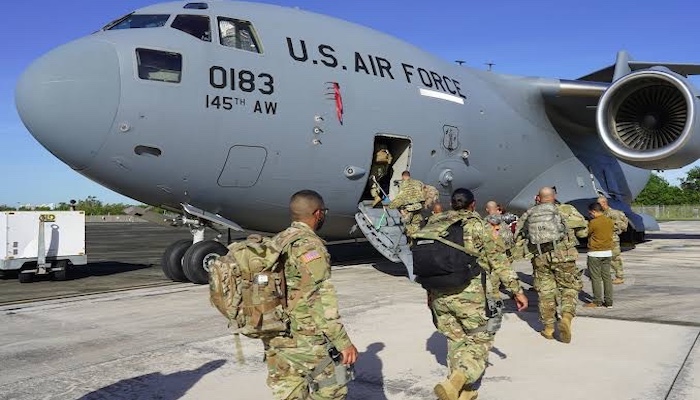
The first aircraft touched down Thursday night in Maiduguri, the capital of Borno State, a region that has endured years of militant violence. By Friday evening, two additional planes had arrived, with personnel and cargo being unloaded at the airbase, according to accounts published by The New York Times and confirmed by defense sources in both countries.
A U.S. Defense Department official, speaking to The New York Times on condition of anonymity because of operational sensitivities, indicated that these flights represent the initial wave of C-17 cargo aircraft bound for three separate locations across Nigeria. Additional aircraft carrying personnel and matériel are scheduled to arrive over the weekend, with further rotations expected in the weeks ahead.
The deployment follows earlier indications that up to 200 U.S. military personnel — including intelligence analysts, advisers and trainers — would be sent to Nigeria. The American presence is intended to bolster targeted counterterrorism efforts, particularly in the country’s northeast, where armed insurgent groups have mounted sustained campaigns of violence.
Maj. Gen. Samaila Uba, spokesperson for Nigeria’s Defence Headquarters, emphasized in remarks to both The Wall Street Journal and The New York Times that U.S. troops will not take part in direct combat operations. Nigerian forces will retain full command authority over missions conducted on sovereign territory, he said.
“These personnel do not serve in a combat capacity and will not assume a direct operational role,” Uba conveyed to The New York Times. He underscored that operational decisions remain solely with Nigeria’s military leadership.
Senior officers within Nigeria’s Defence Headquarters, who discussed the matter separately with Punch newspaper correspondents, indicated that the aircraft carried ammunition and other logistical supplies provided by the United States. One officer, who requested anonymity due to lack of authorization to speak publicly, characterized the deliveries as part of broader bilateral security cooperation following high-level talks between Abuja and Washington.
Another senior official described the shipments as routine replenishment of ammunition stocks following recent military operations. He noted that collaboration between the two governments, coordinated in part through Nigeria’s Office of the National Security Adviser, has intensified in response to persistent insecurity.
Online flight trackers and social media users also observed U.S. aircraft activity. An X account operated by a user identifying as a counterterrorism analyst stated that a U.S. Air Force C-130J-30 transport aircraft landed at Kaduna International Airport after departing Ghana. The post speculated that Kaduna’s military depot could serve as a training hub for U.S. advisers working with Nigerian forces.
Separately, another X user who monitors military aviation activity wrote that significant equipment appeared to be delivered to the Maiduguri Airbase by U.S. C-130 and C-17 aircraft. Nigerian defense officials have not publicly confirmed specific equipment details.
The Director of Defence Media Operations, Maj. Gen. Michael Onoja, did not respond to requests for comment at the time of publication.
The arrival of U.S. aircraft comes amid sustained pressure from President Donald Trump, who has repeatedly criticized Nigeria’s government over what he has described as insufficient protection of Christian communities from extremist violence. In 2025, Trump warned that the United States would consider further action if Nigeria failed to curb deadly attacks.
The United States subsequently designated Nigeria as a Country of Particular Concern and conducted an airstrike targeting Islamic State-affiliated militants in Sokoto State on Christmas Day of that year. Since then, security engagement between the two countries has expanded.
The broader deployment aligns with ongoing U.S.-Nigeria bilateral discussions focused on counterterrorism cooperation, intelligence sharing and capacity building. While American officials have framed the mission as advisory and logistical in nature, it signals a notable deepening of military ties between the two nations.
The arrival of U.S. military aircraft in Maiduguri represents more than a routine logistical transfer; it marks a strategic recalibration in U.S.-Nigeria security relations. For years, Washington’s role in Nigeria’s counterinsurgency efforts remained largely confined to intelligence support and limited advisory programs. The visible landing of multiple U.S. cargo planes in a conflict-prone region underscores a more robust and overt partnership.
Borno State has long been at the epicenter of Nigeria’s insurgency, with militant groups exploiting porous borders and remote terrain. By positioning American advisers and equipment closer to operational theaters, the United States appears to be prioritizing rapid-response coordination and enhanced training capabilities.
However, the deployment also carries political implications. Nigeria’s government must balance domestic sensitivities about foreign military presence with the practical need for international assistance. Public perception of sovereignty remains a delicate matter, particularly in regions where historical memories of external intervention run deep.
For the Trump administration, the move reinforces a broader narrative of assertive engagement against extremist threats abroad, especially where religious persecution concerns have been raised. Linking security cooperation to the protection of vulnerable communities may strengthen political backing in Washington while reshaping bilateral diplomacy.
Operationally, the advisory role outlined by Nigerian officials suggests that American personnel will focus on intelligence fusion, logistics coordination and specialized training. Such roles, while officially non-combat, often place advisers near active conflict zones. Ensuring clear command structures and delineation of responsibilities will be essential to avoid mission creep or misunderstandings.
Regionally, expanded U.S.-Nigeria security collaboration could influence counterterrorism dynamics across West Africa, where insurgent networks often span national boundaries. Neighboring countries may seek similar partnerships or reassess their own security alignments in response.
Ultimately, the landing of three U.S. military aircraft in Nigeria signals a deepening alliance at a moment when security challenges remain acute. Whether the deployment translates into measurable improvements in stability will depend on sustained coordination, political consensus and the effectiveness of joint operational planning in the months ahead.
Lindaikeji/Punchng




