

WASHINGTON (BN24) — The United States imposed sanctions Friday on Colombian President Gustavo Petro, intensifying a growing feud between President Donald Trump and one of Washington’s longtime Latin American allies. The move followed Trump’s public accusations that Petro has failed to curb cocaine production and allowed drug cartels to thrive.
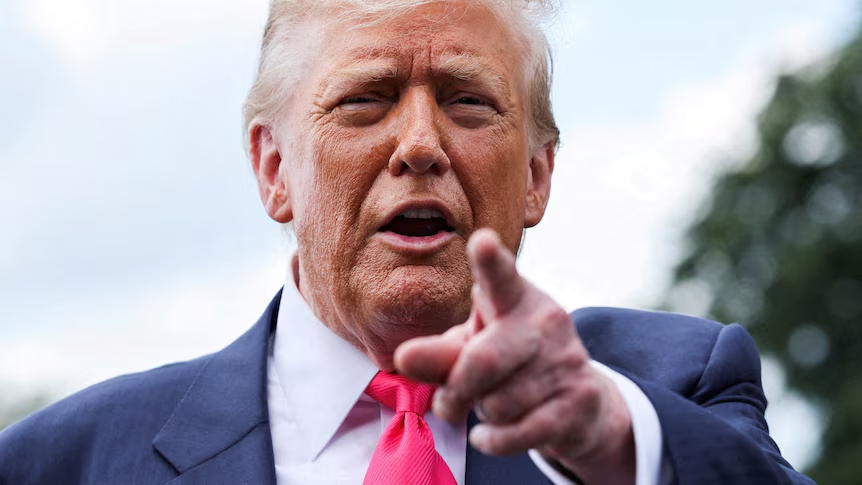
The unprecedented sanctions target Petro personally, along with his wife, son, and Colombia’s Interior Minister Armando Benedetti, under U.S. authorities that allow punitive measures against those allegedly involved in international narcotics trafficking. The decision marks a major rupture in decades of close U.S.-Colombian cooperation on anti-drug efforts.
“Since President Gustavo Petro came to power, cocaine production in Colombia has exploded to the highest rate in decades, flooding the United States and poisoning Americans,” Treasury Secretary Scott Bessent said in a statement. “President Petro has allowed drug cartels to flourish and refused to stop this activity. Today, President Trump is taking strong action to protect our nation and make clear that we will not tolerate the trafficking of drugs into our nation.”
The sanctions, among the harshest ever imposed on a sitting Colombian president, place Petro on a short list of sanctioned world leaders that includes those of Russia, Venezuela, and North Korea.
Petro, a leftist and former guerrilla, fired back on X, calling the move “a complete paradox.” He wrote, “Fighting drug trafficking for decades, and effectively, has brought me this measure from the government of the very society we helped so much to stop their cocaine consumption. But not one step back, and never on our knees.”
The confrontation erupted after Petro accused the U.S. of “murder” for firing at a civilian boat off the Venezuelan coast that he said belonged to “a humble family,” not a rebel group. Trump responded by labeling Petro “an illegal drug leader,” accusing him of shielding traffickers and undermining regional stability.
Benedetti, who was also sanctioned, denounced the U.S. measures as politically motivated, saying he was targeted merely for defending Petro. “This proves the U.S. anti-drug fight is a sham,” he said on X.
“This is the harshest sanction ever against a sitting Colombian president and his family,” said Sergio Guzman of Colombia Risk Analysis. “If this is the targeted pressure the U.S. has been planning, then the impact will fall directly on Petro’s inner circle rather than the Colombian economy.”
The rift comes amid escalating tensions between Washington and several Latin American governments. U.S. forces have stepped up operations in the southern Caribbean, striking vessels in international waters that American officials claim are drug smuggling routes—though those claims have been disputed by regional leaders.
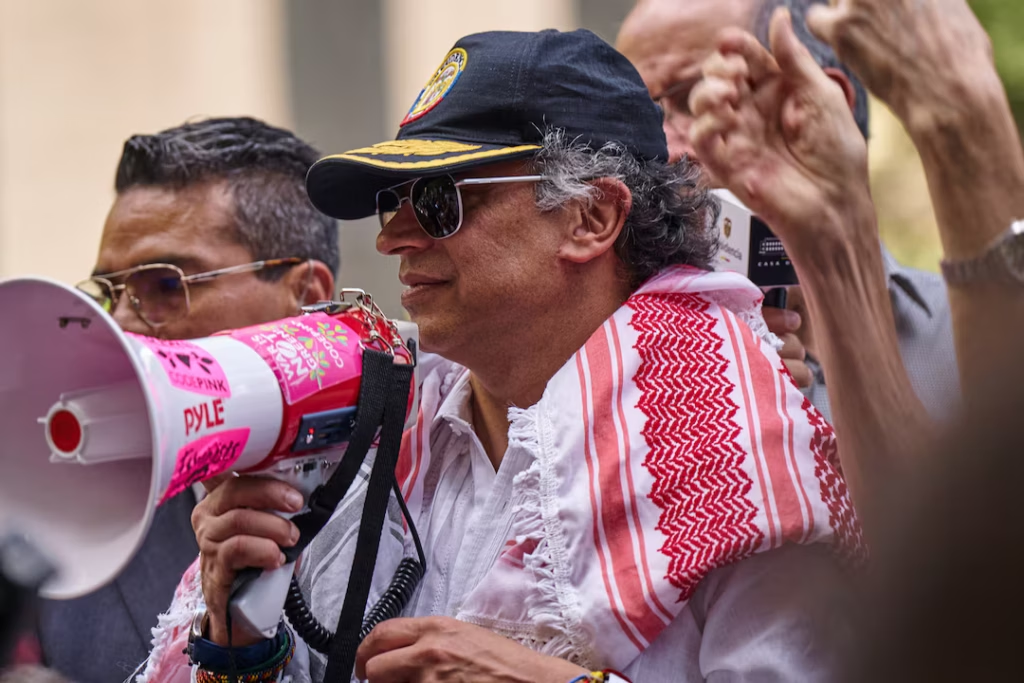
Trump and Petro have clashed repeatedly since Trump returned to office in January, with disagreements over anti-narcotics strategy and regional security widening the gap. Last weekend, Trump threatened to impose higher tariffs on Colombian imports and confirmed Wednesday that all U.S. funding to the country had been suspended.
In a separate statement Friday, the State Department said Secretary of State Marco Rubio would not certify Colombia’s counter-narcotics efforts, a move that could block additional U.S. assistance.
Petro’s government insists it has made measurable progress in combating drug production. Colombia’s foreign ministry said the country seized more cocaine under Petro than in any previous administration and claimed coca crop expansion has dropped from 43% in 2021 to just 3% in 2024. “President Petro reiterated the importance of the United States basing its assessments on accurate data regarding Colombia’s fight against drugs,” the ministry said in a statement.
Despite those assurances, the Trump administration maintains that Petro’s policies have emboldened traffickers. “We will no longer subsidize failure,” Trump said earlier this week. “Colombia must take real action or face real consequences.”
The sanctions underscore a dramatic realignment in U.S.-Colombia relations, shifting from decades of partnership in anti-narcotics operations to open confrontation between the two governments.




