

(AP)– The United States will dispatch the world’s largest aircraft carrier to the Middle East to reinforce another already stationed there, a person familiar with deployment plans disclosed Friday, positioning additional American firepower behind President Donald Trump’s efforts to coerce Iran into negotiations over its nuclear program.
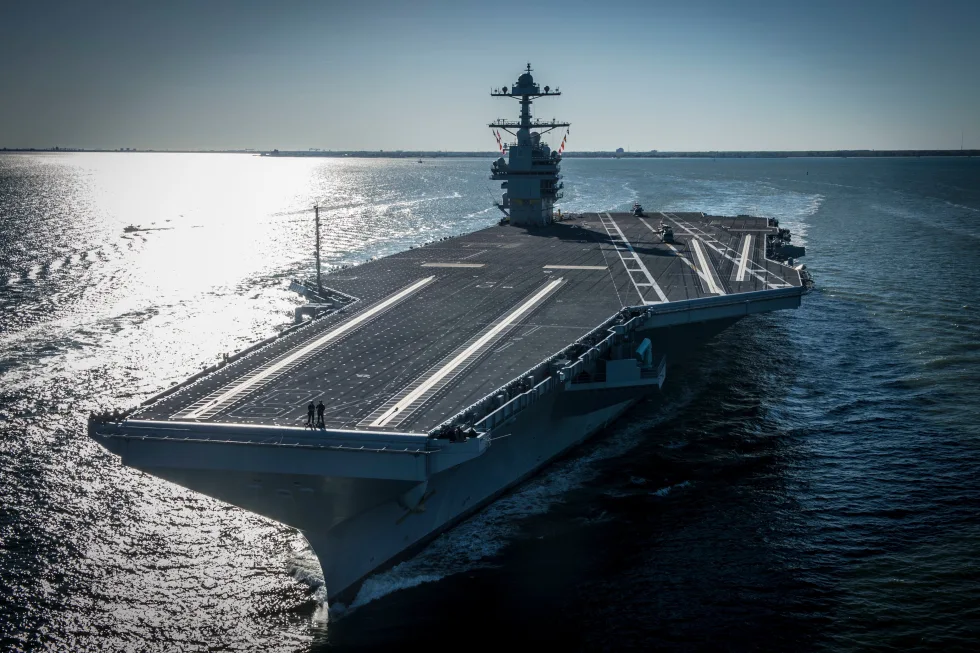
The USS Gerald R. Ford’s planned Middle East deployment arrives after Trump suggested just days earlier that another round of talks with Iranian officials was imminent. Those negotiations failed to materialize despite one of Tehran’s senior security officials visiting Oman and Qatar this week and exchanging messages with U.S. intermediaries attempting to facilitate dialogue.
Gulf Arab nations have cautioned that any military strike could spiral into another regional conflict in a Middle East still recovering from the Israel-Hamas war in the Gaza Strip. Meanwhile, Iranians are beginning to conduct 40-day mourning ceremonies for the thousands killed in Tehran’s brutal suppression of nationwide protests last month, intensifying internal pressure facing the sanctions-battered Islamic Republic.
The Ford’s deployment, first disclosed by The New York Times, will position two carriers and their accompanying warships in the region. The USS Abraham Lincoln and its accompanying guided-missile destroyers are already operating in the Arabian Sea, providing substantial naval power projection capabilities.
The individual who confirmed the deployment to The Associated Press did so on condition of anonymity to discuss military movements that had not been publicly announced by the Pentagon.
The deployment marks a rapid turnaround for the Ford, which Trump sent from the Mediterranean Sea to the Caribbean last October as the administration assembled massive military presence preceding last month’s surprise raid that captured then-Venezuelan President Nicolás Maduro. The carrier had been designated part of the Venezuela strike force before being redirected toward the Middle East.
The redeployment also appears inconsistent with Trump’s national security strategy, which emphasized the Western Hemisphere over other global regions. The strategic pivot back to the Middle East suggests Iran tensions have become the administration’s dominant foreign policy priority despite previous hemispheric focus.
Trump warned Iran Thursday that failure to reach agreement with his administration would prove “very traumatic.” Iran and the United States held indirect talks in Oman last week, though those discussions produced no apparent breakthrough on nuclear program constraints or sanctions relief.
“I guess over the next month, something like that,” Trump responded when questioned about his timeline for striking a deal with Iran regarding its nuclear program. “It should happen quickly. They should agree very quickly.”
Trump told Axios earlier this week that he was contemplating sending a second carrier strike group to the Middle East, a consideration that has now materialized into concrete deployment orders. The announcement follows lengthy Wednesday talks with Israeli Prime Minister Benjamin Netanyahu, during which Trump said he insisted to Israel’s leader that negotiations with Iran needed to continue.
Netanyahu is urging the administration to pressure Tehran to scale back its ballistic missile program and terminate its support for militant organizations including Hamas and Hezbollah as components of any nuclear agreement. These demands substantially expand the scope of potential negotiations beyond nuclear constraints alone.
The USS Ford commenced deployment in late June 2025, meaning the crew will have been deployed eight months by mid-February. While the duration of the ship’s Middle East assignment remains unclear, the redeployment establishes conditions for an unusually long deployment that could strain crew morale and operational readiness.
The White House did not immediately respond to requests for comment regarding the deployment decision or its strategic implications.
Iran confronts still-simmering domestic anger over its wide-ranging suppression of dissent throughout the Islamic Republic. That rage may intensify in coming days as families of the deceased begin marking traditional 40-day mourning periods for loved ones. Online videos have already shown mourners gathering in different parts of the country, holding portraits of their dead.
One video purportedly depicted mourners at a graveyard in Iran’s Razavi Khorasan province, home to Mashhad, on Thursday. There, with a large portable speaker, people sang the patriotic song “Ey Iran,” which dates to 1940s Iran under Shah Mohammad Reza Pahlavi’s rule. While initially prohibited after the 1979 Islamic Revolution, Iran’s theocratic government has subsequently played it to generate nationalist support.
“Oh Iran, a land full of jewels, your soil is full of art,” they sang. “May evil wishes be far from you. May you live eternal. Oh enemy, if you are a piece of granite, I am iron.”
The Pentagon has deployed numerous U.S. military assets into the Middle East over recent weeks, including aircraft carrier groups with their thousands of troops, as Trump indicates he maintains the possibility of strikes against Iran if diplomatic efforts fail.
“We have a lot of very big, very powerful ships sailing to Iran right now, and it would be great if we didn’t have to use them,” Trump declared Thursday, framing military buildup as leverage for diplomatic breakthrough rather than inevitable conflict.
Trump initially threatened military action if Iran executed mass numbers of prisoners or killed peaceful demonstrators, but later claimed that Iran halted the hangings of 800 detained protesters. Iran’s top prosecutor subsequently characterized Trump’s claim as “completely false,” disputing both the planned execution numbers and any American influence over judicial decisions.
Trump asserted this week that Iran must conclude a nuclear program agreement. He suggested that if the Islamic Republic refuses, he would order an attack “far worse” than last year’s U.S. strikes on Iranian nuclear sites—a threat intended to convey escalating consequences for continued intransigence.
The aircraft carrier USS Abraham Lincoln and three guided-missile destroyers are positioned in the Arabian Sea, U.S. Central Command confirmed. The carrier strike group departed the South China Sea last week and arrived in the Middle East on Monday, joining three other U.S. Navy destroyers in the region—two currently sailing near the Strait of Hormuz and another in the Red Sea.
The carrier strike group’s arrival brought approximately 5,700 additional service members to the region. The United States maintains several bases in the Middle East, including Al Udeid Air Base in Qatar, which hosts thousands of American troops and serves as forward headquarters for U.S. Central Command.
The aircraft carrier deployment follows the Trump administration’s earlier shift of resources from the region to the Caribbean Sea as part of a pressure campaign against former Venezuelan President Nicolás Maduro that culminated in last month’s capture operation.
The USS Gerald R. Ford—the world’s largest aircraft carrier—was ordered in October to sail from the Mediterranean Sea to the Caribbean alongside several destroyers. The carrier USS Nimitz, which helped conduct June strikes on Iran’s nuclear sites, also departed the region in October as resources concentrated on Venezuela operations.
Central Command disclosed via social media that Air Force F-15E Strike Eagles now maintain presence in the Middle East, noting the fighter jet “enhances combat readiness and promotes regional security and stability.” Similarly, the U.K. Ministry of Defense announced last week it deployed Typhoon fighter jets to Qatar “in a defensive capacity,” demonstrating allied coordination in regional military buildup.
Analysts monitoring flight-tracking data have identified dozens of U.S. military cargo planes heading to the region, suggesting substantial equipment and supply movements supporting expanded operations. The activity parallels last year’s deployments when the United States positioned air defense hardware including Patriot missile systems anticipating Iranian counterattacks following bombing of three key nuclear sites. Iran launched over a dozen missiles at Al Udeid Air Base days after those strikes.
Defense Secretary Pete Hegseth emphasized Thursday that the U.S. military “will be prepared to deliver whatever the president expects,” one day after Trump warned he wants progress toward a nuclear program deal and that “time is running out.”
“They have all the options to make a deal,” Hegseth stated at a Cabinet meeting, referencing Iran. “They should not pursue nuclear capabilities.”
Hegseth cited the military raid capturing then-Venezuelan President Nicolás Maduro in his Iran warning, asserting the military was ready to deliver Trump’s demands “just like we did this month.” This invocation of successful Venezuela operations serves as implicit threat that similar decisive action could target Iranian leadership or facilities.
Secretary of State Marco Rubio characterized the increasing military presence as an effort “to defend against what could be an Iranian threat against our personnel.” He explained during Wednesday congressional testimony that maintaining forces capable of “if necessary, preemptively preventing attacks against thousands of American servicemen and other facilities in the region and our allies” represented prudent precaution.
Trump declared Thursday night that his message to Iran was “no nuclear” and “stop killing protesters,” linking nuclear negotiations to human rights concerns about Tehran’s violent suppression of dissent.
Iran suppressed nationwide protests sparked by economic hardships that broadened into challenges against theocratic governance. Activists calculate at least 6,479 people were killed in the crackdown, though precise casualty figures remain difficult to verify given governmental information restrictions.
The Trump administration and European Union this week imposed new sanctions targeting high-ranking Iranian officials over the violent suppression, demonstrating coordinated Western pressure on Tehran combining military deployments with economic penalties.
The dual-carrier deployment represents substantial American military commitment to the Middle East despite Trump’s previous rhetoric emphasizing disengagement from costly overseas military commitments. Whether this pressure campaign succeeds in compelling Iranian concessions or escalates into military conflict will significantly shape regional stability and Trump’s foreign policy legacy.
AP




