

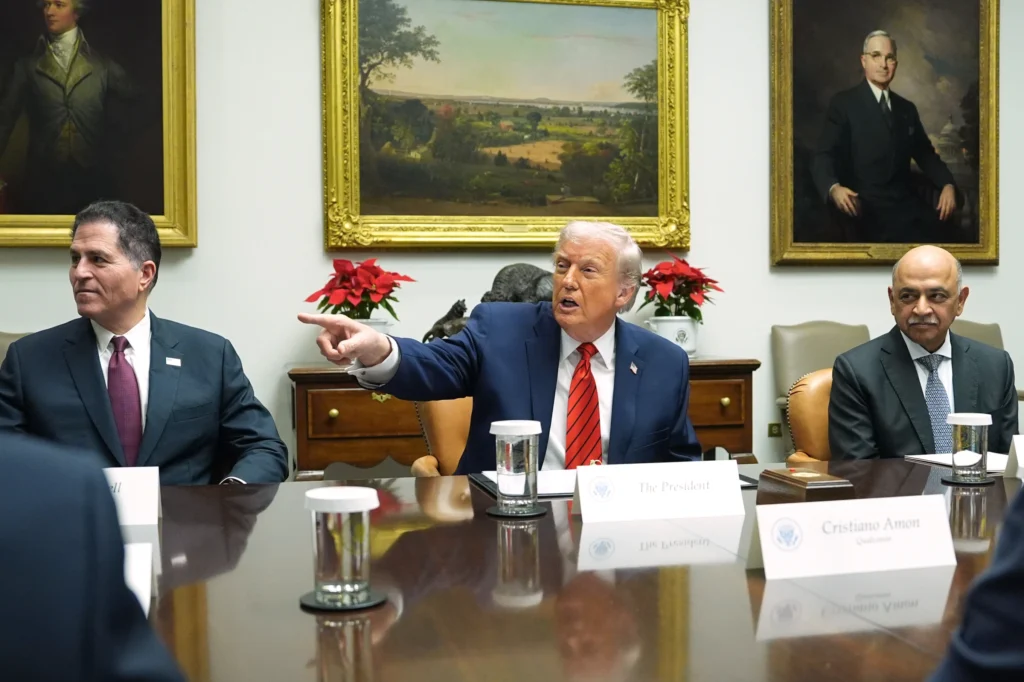
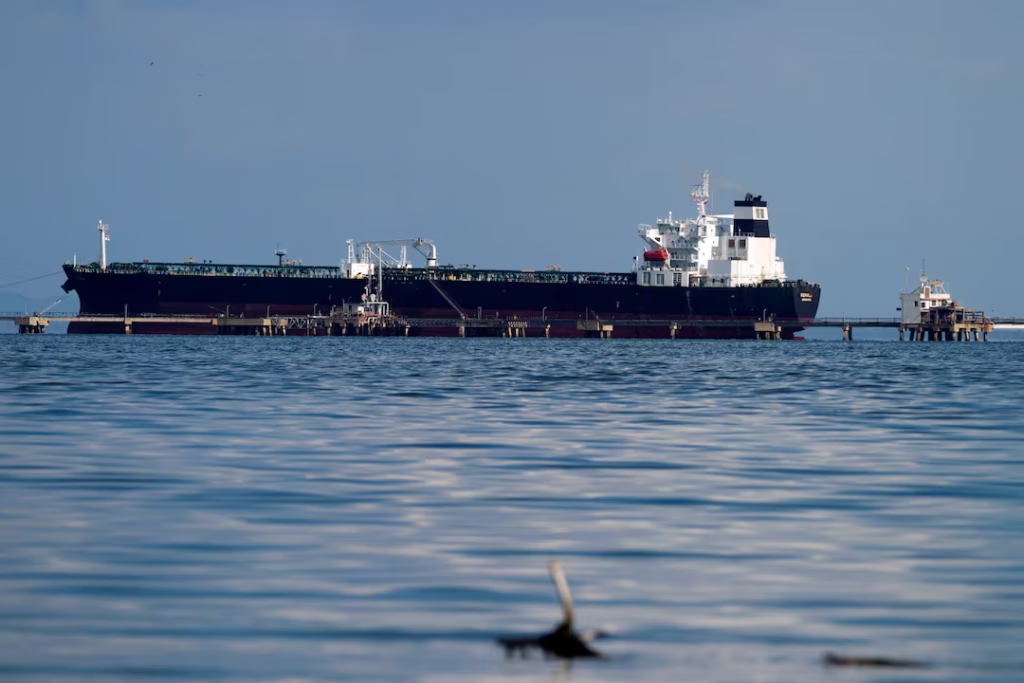
President Donald Trump said Wednesday that the United States has seized an oil tanker off the coast of Venezuela, a move that marks a significant intensification of his administration’s effort to squeeze President Nicolás Maduro. The interdiction, Trump said, comes as Washington expands a pressure strategy that has already included narcoterrorism charges against Maduro and an expanding military footprint in the region.
A U.S. official, speaking anonymously because of the sensitivity of the operation, told The Associated Press that the seizure was carried out by the U.S. Coast Guard with support from the U.S. Navy. The official did not disclose whether the tanker was carrying cargo, which flag it was flying, or the precise location of the interception.
The operation occurred just a day after a pair of U.S. Navy F/A-18 fighter jets flew over the Gulf of Venezuela in what public flight-tracking platforms showed to be one of the closest American military flyovers to Venezuelan territory since the beginning of Trump’s campaign against Maduro. Trump has repeatedly hinted that land operations could follow, though he has provided no further detail.
Maduro, speaking hours later at a government-organized demonstration in Caracas, did not mention the tanker seizure but delivered one of his most combative speeches in months. Surrounded by senior loyalists, he said Venezuela was “prepared to break the teeth of the North American empire if necessary,” insisting that only the ruling movement could “guarantee peace, stability, and the harmonious development of Venezuela, South America, and the Caribbean.” He added that “the only president who has the preparation, the history, and the unwavering support of the people and the armed forces … is named Nicolás Maduro.”
Reuters reported that the tanker believed to have been seized is the Skipper, according to Vanguard, a British maritime risk management firm. The vessel had previously been sanctioned by Washington for alleged involvement in Iranian oil shipments when it operated under the name Adisa. Reuters also noted that oil markets reacted immediately, with Brent crude edging up 27 cents to settle at $62.21 a barrel and U.S. West Texas Intermediate increasing 21 cents to close at $58.46.
Three U.S. officials told Reuters, again on condition of anonymity, that the Coast Guard oversaw the operation. Venezuela’s government did not immediately respond to requests for comment.
The seizure occurs at a moment when Venezuela has been exporting more than 900,000 barrels per day, its third-highest monthly average this year, buoyed by increased naphtha imports used to dilute its extra-heavy crude. Even with those gains, Venezuela has been forced to sharply discount its oil to compete with sanctioned barrels from Russia and Iran in the Chinese market.
Commodity analyst Rory Johnston told Reuters that the tanker seizure adds “yet another geopolitical/sanctions headwind hammering spot supply availability,” though he suggested the immediate market impact may be limited because “these barrels were already going to be floating around for a while.”
Washington’s move also comes against the backdrop of a sweeping U.S. maritime strike campaign that has killed more than 80 people in at least 20 strikes on suspected drug-smuggling vessels since early September.
Critics, including several lawmakers, have questioned the legality of the operations, arguing that the administration has offered limited public evidence that the boats targeted were carrying narcotics or posed immediate threats. Concerns grew after reports that U.S. forces conducted a second strike that killed two survivors after the initial attack on one vessel.
A Reuters/Ipsos poll released Wednesday found broad opposition among Americans to the boat-strike campaign, including significant dissent among Trump’s own Republican base. Trump has repeatedly framed the operations as part of an “armed conflict” with drug traffickers and said last week, in a sweeping strategy document, that reasserting U.S. dominance in the Western Hemisphere would remain a top foreign policy priority.
The U.S. tanker seizure deepens a standoff already infused with geopolitical, economic and domestic political consequences. For Trump, the action showcases an aggressive enforcement posture that aligns with his broader foreign policy message of reclaiming influence across the Western Hemisphere. But it also risks raising the stakes with a government that has long framed U.S. actions as attempts at regime change. The overlapping operations—the air patrol, the maritime strikes, and now a tanker seizure—signal a dramatic expansion of military and law-enforcement activity around Venezuelan waters.
The seizure also threatens to tighten the pressure on Venezuela’s fragile oil sector, the backbone of its economy. While Maduro has managed to increase exports modestly through discounted deals and strategic alliances, U.S. interference in maritime flows signals a new phase where Washington may attempt to disrupt the logistical infrastructure that keeps Venezuela’s oil moving. This approach could impose short-term costs on global markets, which remain sensitive to volatility around crude supply routes, particularly involving sanctioned producers.
For Maduro, the event provides an opportunity to rally domestic supporters around nationalist rhetoric. His fiery speech in Caracas underscores how the government will use such U.S. actions to reinforce a narrative of external aggression. Yet analysts caution that the risk of miscalculation is rising. Expanded U.S. interdictions and Trump’s public hints of “coming” land operations could increase the chances of confrontation in the Caribbean, especially with Venezuelan forces on heightened alert.
The seizure also intensifies legal and congressional scrutiny over U.S. operations. Lawmakers alarmed by the boat-strike campaign may view this latest move as part of an unchecked escalation conducted with limited transparency. As the 2025 political season accelerates, Trump’s Venezuela strategy—combining military projection, sanctions and high-risk interdictions—will likely become a flashpoint in debates over presidential authority, regional security and the balance between counter-narcotics policy and international law.




