

VATICAN CITY (BN24) — The Vatican on Tuesday announced it will not take part in the “Board of Peace” initiative launched by U.S. President Donald Trump, asserting that the United Nations remains the proper institution to address international conflicts and humanitarian crises.
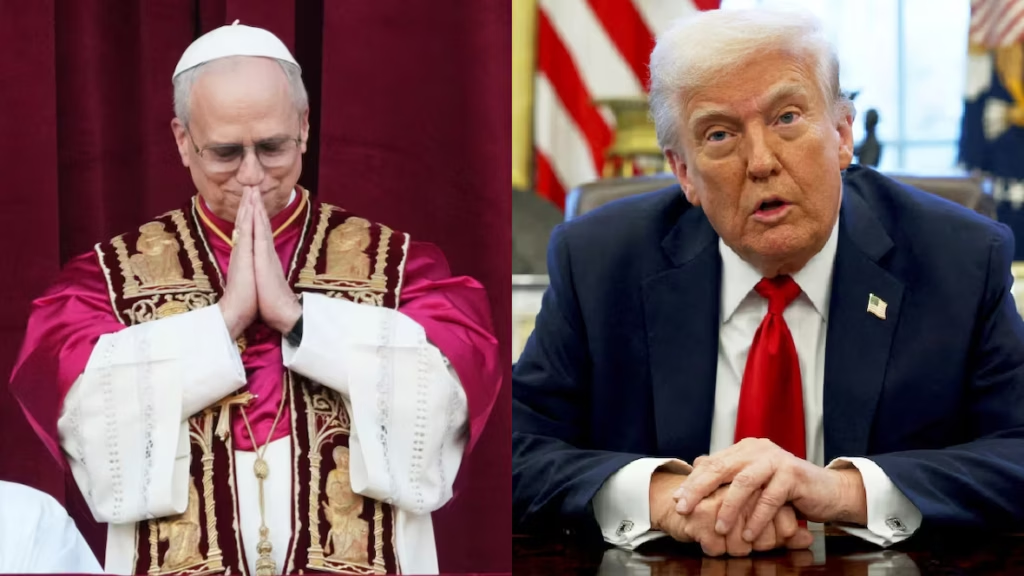
The decision came despite a January invitation extended to Pope Leo XIV to join the body, which Trump initially unveiled at the World Economic Forum in Davos, Switzerland. Vatican Secretary of State Cardinal Pietro Parolin made clear that the Holy See would refrain from participation, emphasizing the unique diplomatic nature of the Vatican.
“The Holy See will not participate in the Board of Peace because of its particular nature, which is evidently not that of other states,” Parolin said.
He underscored that responsibility for managing global crises rests primarily with the United Nations. “For us, there are some critical issues that should be resolved,” Parolin said, adding that “at the international level, it is above all the UN that manages these crisis situations. This is one of the points on which we have insisted.”
Trump introduced the “Board of Peace” during the annual gathering in Davos, presenting it as a new platform to address geopolitical instability. The initiative was initially framed as a supervisory mechanism for Gaza’s interim governance following the most recent conflict in the region. The U.S. president later broadened its proposed scope, saying the board with himself as chair would expand to address conflicts worldwide.
According to organizers, at least 19 countries have signed the board’s founding charter since its unveiling. Among them are Argentina, Hungary, Saudi Arabia, Russia and the United Arab Emirates.
However, participation from Western democracies has been limited. Italy and the European Union have indicated that representatives may attend in observer capacities, but neither has formally joined. Several other Western governments have remained absent, citing concerns that the initiative could sideline or weaken the authority of the United Nations.
Vatican’s Position Reflects Diplomatic Tradition
The Holy See’s decision aligns with its longstanding multilateral diplomatic approach. For decades, the Vatican has championed the UN as the primary venue for international conflict resolution, humanitarian coordination and peacekeeping efforts.
Cardinal Parolin’s remarks reflect that institutional continuity. By declining participation, the Vatican signaled reluctance to endorse alternative structures that operate outside established global frameworks. While Parolin did not elaborate extensively on the “critical issues” he referenced, his emphasis on the UN suggests apprehension about parallel diplomatic mechanisms that might complicate international consensus-building.
Pope Leo XIV, the first U.S.-born pontiff, has previously voiced criticism of several policies advanced by Trump since the president returned to office. Though the Vatican did not directly link its decision to those criticisms, the development underscores a nuanced relationship between the Holy See and Washington.
‘Board of Peace’ Draws Mixed International Reaction
Since its announcement in Davos, the Board of Peace has generated both interest and skepticism. Supporters argue that it represents a pragmatic forum capable of acting swiftly in crises where UN mechanisms can be slowed by political gridlock, particularly in the Security Council.
Critics, however, contend that the initiative risks fragmenting global governance by establishing a parallel body without universal legitimacy. Concerns have also emerged over leadership structure, given Trump’s role as chair, and whether the board’s decision-making authority would overlap with or challenge UN mandates.
The initiative’s expansion beyond Gaza governance to broader global conflicts has further fueled debate. Observers note that such an enlargement of scope raises questions about operational capacity, jurisdictional clarity and adherence to international law.
Broader Implications for Global Governance
The Vatican’s refusal carries symbolic weight beyond the immediate diplomatic exchange. As a sovereign entity with global moral influence, the Holy See’s engagement in international initiatives often signals legitimacy and encourages broader participation. Its decision to abstain may reinforce hesitation among other nations weighing formal involvement.
From a geopolitical perspective, the episode highlights ongoing tensions between multilateral institutions and emerging ad hoc coalitions. The UN, established in the aftermath of World War II, remains the cornerstone of international governance. Yet frustrations over perceived inefficiencies have led some leaders to propose alternative frameworks.
Analysts say the Vatican’s stance could strengthen arguments in favor of reforming existing institutions rather than creating new ones. Calls for UN reform — particularly regarding Security Council veto powers have intensified in recent years. Advocates argue that modernization could address many of the frustrations that give rise to parallel initiatives.
At the same time, the Board of Peace’s roster of signatories illustrates shifting alliances in global diplomacy. The inclusion of countries spanning Latin America, Eastern Europe, the Middle East and Eurasia suggest that some governments view the initiative as an opportunity to recalibrate diplomatic influence.
For now, the Board of Peace remains in its formative stages. It is unclear how frequently it will convene or what formal authority it will wield. Meanwhile, the Vatican’s position reaffirms its commitment to established multilateral channels and its cautious approach to new geopolitical constructs.
Whether Trump’s initiative gains broader traction or remains limited to a subset of participating states may depend on its ability to demonstrate effectiveness without undermining existing international norms. The Holy See’s decision ensures that any evolution of the Board of Peace will proceed without one of the world’s most influential moral and diplomatic voices at the table.





