

LISBON, Portugal (BN24) — A Champions League match between Real Madrid and Benfica was suspended for nearly 10 minutes Tuesday after Vinícius Júnior accused an opponent of directing a racial slur at him during Madrid’s 1-0 victory at the Estádio da Luz.
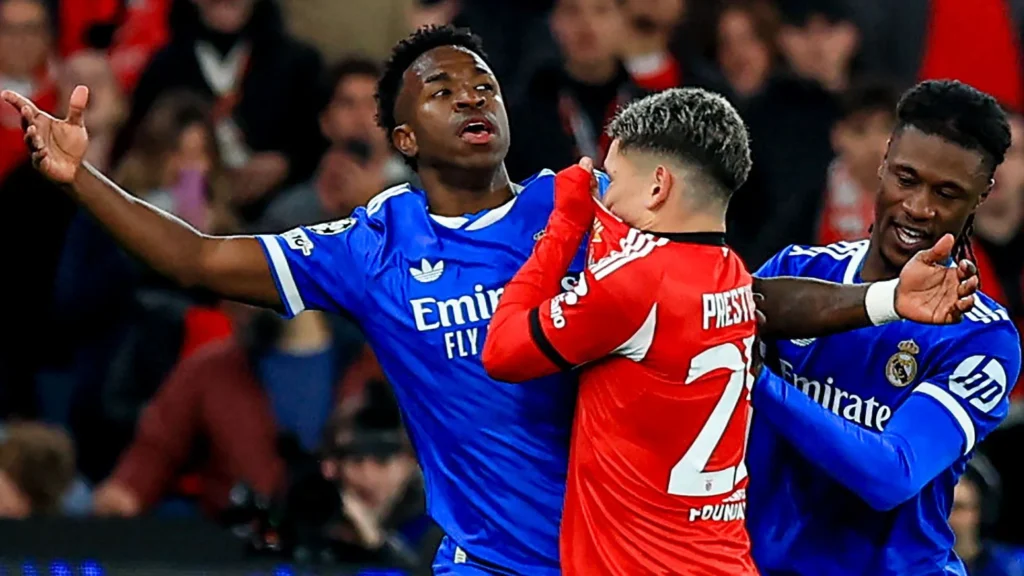
The interruption came moments after Vinícius curled a right-footed shot into the top corner in the 52nd minute, putting the Spanish club ahead. As the Brazil forward celebrated near the corner flag, sections of the home crowd responded by jeering and throwing objects toward Madrid players.
French referee François Letexier halted play, crossing his arms above his head to activate UEFA’s anti-racism protocol after Vinícius approached him with a complaint.
Television footage captured Vinícius pointing toward Benfica midfielder Gianluca Prestianni and informing the referee that the Argentine player had called him a “monkey.” Prestianni had confronted Vinícius moments earlier, speaking while covering his mouth with his jersey.
Vinícius, who has faced repeated incidents of racist abuse in Spain and elsewhere during his career, then moved toward the sideline and sat in the dugout as teammates gathered around him. Some Madrid players briefly appeared to consider leaving the field.
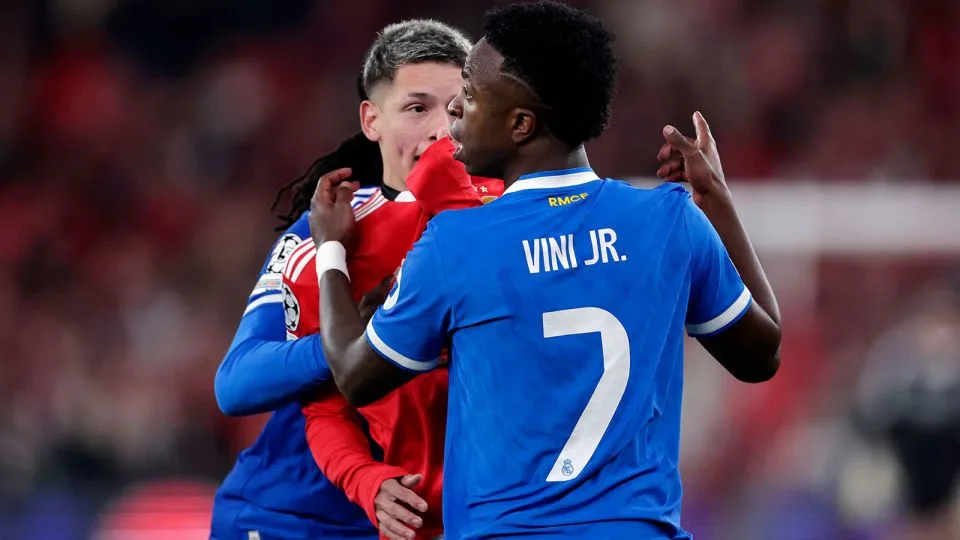
Forward Kylian Mbappé and midfielder Aurélien Tchouaméni later indicated that the team discussed whether to abandon the match but ultimately chose to continue. Mbappé said he consulted Vinícius before play resumed.
“What’s happened tonight is a disgrace to football,” Madrid defender Trent Alexander-Arnold said after the game. “It’s overshadowed the performance, especially after such an amazing goal. Vini has been subjected to this a few times throughout his career, and for it to happen tonight and ruin the night for us as a team is a disgrace. There’s no place for it in football or society. It’s disgusting.”
The referee allowed the match to proceed in the 60th minute. Prestianni was not cautioned and remained on the field until the 81st minute, when he was substituted to applause from home supporters. Vinícius was loudly jeered for the remainder of the match and was struck by a thrown bottle late in the contest near the sideline. Letexier requested a stadium announcement warning fans against throwing objects onto the pitch.
Madrid midfielder Federico Valverde said teammates who were nearby heard an offensive remark. “The players who were near said that he said something ugly, that shouldn’t be said,” Valverde said. “If you cover your mouth to say something it’s because you are saying something that is not nice. I’m proud of my teammates who defended Vini and of Vini.”
Benfica players disputed the allegation. Midfielder Leandro Barreiro said Prestianni described the exchange as typical on-field provocation without racial intent. “He said it was a normal provocation between players during a match,” Barreiro said. “He said it was nothing racist.”
Benfica coach José Mourinho, speaking to Amazon Prime, declined to declare which account he believed after conversations with both players. He criticized Vinícius’ goal celebration near the home supporters, suggesting it inflamed tensions.
“Unfortunately he was not just happy to score that astonishing goal,” Mourinho said. “When you score a goal like that, you celebrate in a respectful way.”
Mourinho added that Benfica’s most celebrated historical figure, Eusébio, was Black and implied he found it difficult to understand why incidents involving Vinícius recur in multiple stadiums. “There is something wrong because it happens in every stadium,” Mourinho said. “The stadium where Vinicius played something happened. Always.”
Madrid coach Álvaro Arbeloa was seen speaking with Vinícius during the stoppage.
After the match, Vinícius posted a photograph on Instagram of his celebration near the corner flag and wrote: “Racists are, above all, cowards. They need to cover their mouths with their shirts to show how they are weak. … Nothing that happened today is new to me in my life and in my family’s life. I was shown a yellow card for celebrating a goal. I still don’t know why.”
The Brazilian Football Confederation expressed support on social media, declaring that Vinícius was “not alone” and emphasizing that racism is a crime with no place in soccer. The federation described his decision to report the incident as an example of courage and dignity.
Mbappé, who was seen confronting Prestianni during the heated exchanges, voiced frustration. “We can’t accept that a player who plays in Europe’s top competition behaves like that,” Mbappé said. “He shouldn’t keep playing in the competition. Let’s see what happens now.”
The referee appeared to indicate during the review that he had not personally heard the alleged remark.
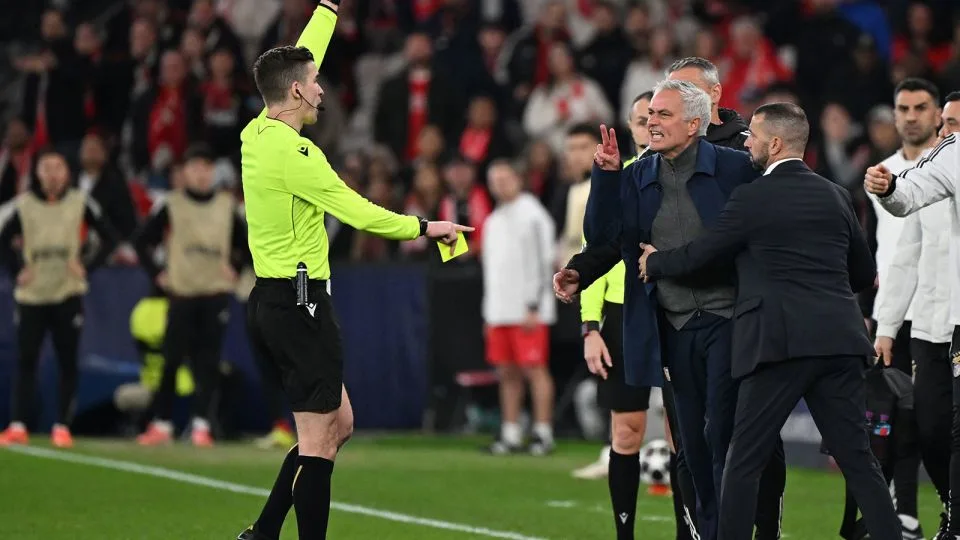
The controversy overshadowed Madrid’s narrow victory, secured by Vinícius’ curling finish. Tensions escalated further in the closing minutes when Mourinho, a former Madrid coach, was sent off in the 86th minute for dissent. He later suggested that certain Madrid players were not being cautioned despite fouls that could have triggered suspensions through card accumulation.
The episode in Lisbon once again places European soccer’s anti-racism framework under scrutiny. UEFA’s protocol which includes match suspension and potential abandonment is designed to send a visible message. Yet repeated incidents involving high-profile players like Vinícius suggest that enforcement and deterrence remain inconsistent across competitions and venues.
Vinícius has become a focal point in broader debates about racism in European sport. His willingness to publicly confront alleged abuse has drawn both praise and criticism, reflecting polarized responses among supporters and commentators. The tension between expressive goal celebrations and crowd hostility illustrates how quickly competitive friction can escalate into something more troubling.
For clubs and governing bodies, the challenge lies not only in punishing confirmed offenders but in reinforcing preventive measures. The fact that players briefly contemplated leaving the field underscores how close the sport can come to more dramatic protest actions.
As investigations proceed, the incident is likely to renew calls for stronger sanctions and clearer accountability mechanisms. Whether disciplinary authorities pursue action against individuals or clubs may shape perceptions of how seriously European soccer addresses racism at its highest level.
For now, the match result stands, but the debate it reignited may carry far greater consequences than the three points secured on the field.





