

WASHINGTON — More than 8,000 flights scheduled for weekend departure were cancelled as a major winter storm bore down across the United States, threatening 140 million people with widespread heavy snow and a catastrophic ice band stretching from east Texas to North Carolina that forecasters warned could produce hurricane-level damage.
At least 3,400 flights were delayed or cancelled Saturday, the flight tracking website FlightAware disclosed, with more than 5,000 additional flights called off for Sunday as airlines preemptively grounded operations ahead of the storm’s worst impacts.
Approximately 140 million people from New Mexico to New England faced winter storm warnings as the system combined bitter Arctic cold with heavy precipitation, Al Jazeera conveyed. Forecasters emphasized that damage, particularly in areas struck by ice accumulation, could rival destruction typically associated with hurricane strikes.
Snow fell over portions of Texas, Oklahoma and Kansas on Friday ahead of a winter storm expected to converge with Arctic cold and engulf much of the country over the weekend.
“This is a mean storm,” Jacob Asherman, a meteorologist at the U.S. Weather Prediction Center in Maryland, told Reuters. He characterized it as the biggest so far this season regarding both intensity and geographic scope.
Life-threatening wind chill readings plunged below minus 45 degrees Celsius (minus 50 degrees Fahrenheit) in the Dakotas and Minnesota. Asherman warned that exposure to such cold without proper clothing “can lead to hypothermia very, very quickly.”
The worst conditions were predicted for portions of Louisiana, Mississippi and Tennessee, where ice up to an inch thick was likely to coat tree limbs, power lines and roadways, Asherman said. Such accumulations create conditions where infrastructure failures can persist long after the storm passes as ice-laden branches and power lines continue falling.
Governors in more than a dozen states sounded alarms about turbulent weather ahead, declaring emergencies or urging residents to remain home. Texas Governor Greg Abbott told residents on X that the state Department of Transportation was pretreating roads and urged, “Stay home if possible.”
Utility companies prepared for widespread power outages given that ice-coated trees and power lines can continue collapsing long after storms conclude, potentially leaving communities without electricity for days during dangerously cold conditions.
President Donald Trump said via social media Friday that his administration was coordinating with state and local officials and that the Federal Emergency Management Agency was “fully prepared to respond” to the developing crisis.
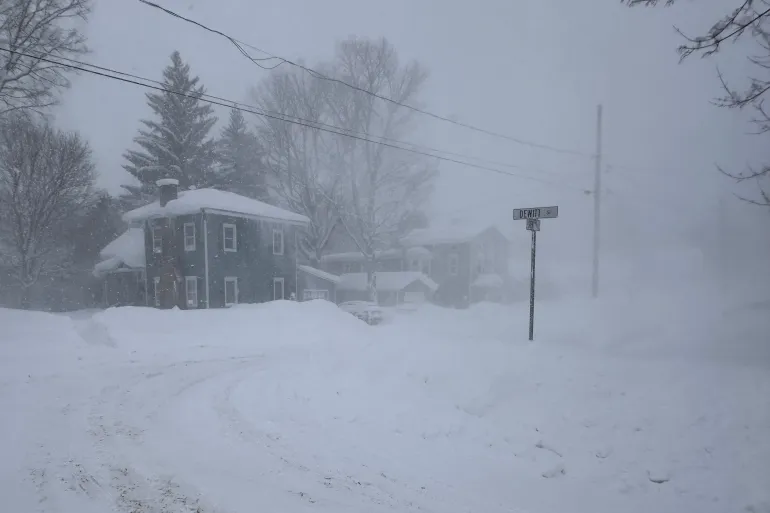
By Friday night, the storm’s leading edge was sending freezing rain and sleet into parts of Texas while snow and sleet fell in Oklahoma. The Associated Press disclosed that after sweeping through the South, the storm was expected to move into the Northeast, depositing approximately one foot (30 centimeters) of snow from Washington through New York and Boston, the National Weather Service predicted.
The storm represents the first major test for New York City Mayor Zohran Mamdani, who assumed office just weeks ago. He told local news station NY1 on Friday that the city’s sanitation workforce would transform into “the nation’s largest snow-fighting operation” ahead of heavy snowfall expected Sunday.
The combination of heavy snow in northern regions and catastrophic ice in a band through the South creates a multi-hazard scenario that complicates emergency response and evacuation planning. While snowfall disrupts transportation and requires plowing operations, ice accumulation presents more insidious dangers through infrastructure damage that can cascade for days after precipitation ends.
The predicted ice thickness of up to one inch exceeds thresholds where tree branches and power lines fail under accumulated weight. When ice-laden branches fall onto additional power lines or when lines snap under their own weight, electrical grid failures can spread across wide areas, particularly in regions where overhead distribution systems predominate.
The comparison to hurricane damage reflects the potential for prolonged power outages, extensive tree damage and infrastructure failures that require weeks of repair work. Unlike hurricanes, which impact relatively narrow coastal zones, the ice band’s trajectory through multiple southern states threatens simultaneous failures across a region stretching more than 1,000 miles.
The flight cancellations compound travel disruptions already affecting millions during a weekend when many Americans might be attempting post-holiday travel or routine weekend trips. The 8,000-plus cancelled flights represent hundreds of thousands of stranded passengers facing uncertain rebooking prospects as airlines prioritize safety over schedule adherence.
FlightAware’s tracking data indicates airlines made preemptive cancellation decisions rather than waiting for conditions to deteriorate, a strategy designed to minimize passenger inconvenience by providing advance notice rather than last-minute groundings. However, the cancellations still leave travelers scrambling for alternative arrangements during a period when hotel availability and ground transportation options may be constrained.
The Arctic cold extending into the northern Plains creates life-threatening conditions independent of precipitation. Wind chill values approaching minus 50 degrees Fahrenheit can cause frostbite within minutes of exposure on unprotected skin, creating risks for anyone whose vehicle becomes disabled or who must travel outdoors for emergency purposes.
The storm’s timing over a weekend when many state and local government offices operate with reduced staffing complicates coordination efforts. Emergency management agencies must mobilize personnel and resources during off-hours while communicating rapidly evolving threat information to populations that may not be monitoring official channels as closely as during weekday hours.
For utility companies, the ice storm warning triggers prepositioning of repair crews from unaffected regions, stockpiling of replacement equipment like transformers and power poles, and coordination with mutual aid networks that can provide additional personnel if damage exceeds local capacity. However, the storm’s geographic extent limits available mutual aid as utilities across multiple states face simultaneous emergencies.
The National Weather Service’s characterization of the ice band as “catastrophic” represents its highest-level warning language, reserved for situations where infrastructure failures and life safety threats reach extreme levels. Such terminology signals to emergency managers and the public that standard winter storm preparations may prove inadequate given the severity of expected impacts.
As the storm system advances through the weekend, the evolution from Texas ice to Northeast snow will create a sequential threat pattern where southern states face infrastructure damage on Saturday while northern regions prepare for heavy snowfall Sunday. This progression taxes national emergency response resources as multiple regions require assistance simultaneously rather than sequentially.
For the 140 million Americans under winter storm warnings, the weekend brings disrupted travel plans, potential power outages lasting days, dangerous road conditions and life-threatening cold that collectively represent one of the most significant winter weather events in recent years affecting such a broad swath of the country.




