

WASHINGTON (BN24) — Ukraine’s future could hinge on a hastily assembled meeting Monday at the White House as Ukrainian President Volodymyr Zelensky brings with him an extraordinary cadre of European leaders to show U.S. President Donald Trump a united front against Russia.
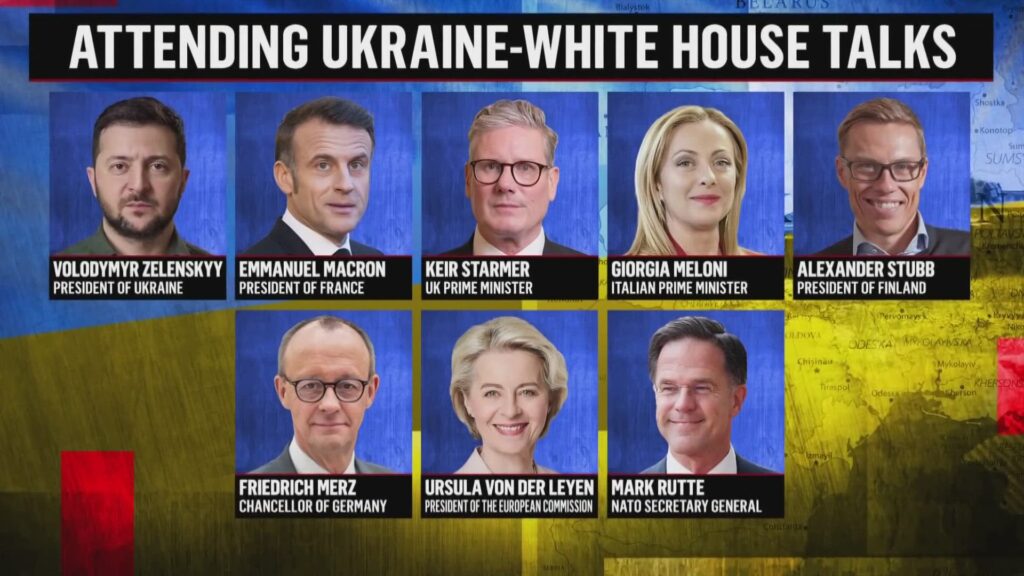
The European political heavyweights were excluded from Trump’s summit with Russian President Vladimir Putin last Friday in Alaska, and they are now looking to safeguard Ukraine and the European continent from any widening aggression from Moscow. By arriving as a unified group, they hope to avoid diplomatic setbacks like Zelensky’s February meeting in the Oval Office, where Trump publicly berated the Ukrainian leader for not showing sufficient gratitude for American military aid.
Monday’s unprecedented gathering represents both the progress and potential distress emerging from the Alaska meeting, as many of Europe’s most influential leaders descend on Washington with the explicit goal of protecting Ukraine’s interests in what constitutes a rare and sweeping show of diplomatic force.
“It’s important that America agrees to work with Europe to provide security guarantees for Ukraine, and therefore for all of Europe,” Zelensky posted on social media platform X.
The night before the critical meeting, however, Trump appeared to place responsibility on Zelensky to agree to territorial concessions and suggested that Ukraine could not regain Crimea, which Russia annexed in 2014, setting off an armed conflict that eventually led to Moscow’s broader 2022 invasion.
“President Zelensky of Ukraine can end the war with Russia almost immediately, if he wants to, or he can continue to fight,” Trump wrote Sunday night on social media. “Remember how it started. No getting back Obama given Crimea (12 years ago, without a shot being fired!), and NO GOING INTO NATO BY UKRAINE. Some things never change!!!”
Zelensky appeared to respond with his own post late Sunday, declaring, “We all share a strong desire to end this war quickly and reliably.” He emphasized that “peace must be lasting,” unlike the situation after Russia seized Crimea and part of the Donbas in eastern Ukraine eight years ago, when “Putin simply used it as a springboard for a new attack.”
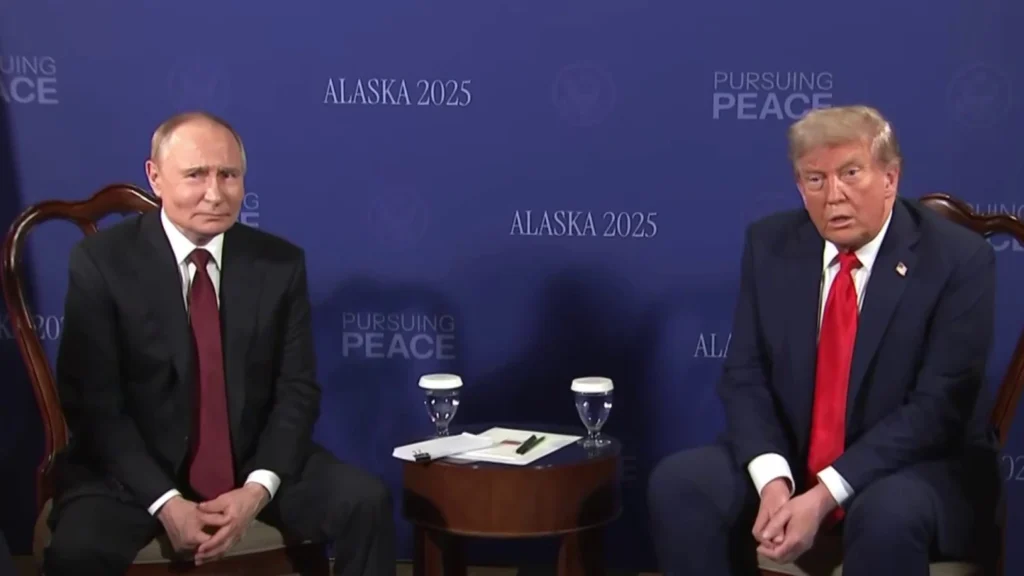
The Alaska summit between Trump and Putin yielded possible framework terms for ending the Ukraine war, though it remained unclear whether the discussed conditions would ultimately prove acceptable to either Zelensky or Putin. Upon arrival in Washington, Zelensky reiterated in another social media post his commitment to ending the conflict while ensuring durability.
“We all equally want to end this war quickly and reliably. And the peace must be lasting,” he stated, expressing hope that together with the United States and European nations, Ukraine could compel Russia toward “true peace.”
Planning to join Zelensky in the American capital are European Commission President Ursula von der Leyen, French President Emmanuel Macron, British Prime Minister Keir Starmer, German Chancellor Friedrich Merz, Italian Premier Giorgia Meloni, Finnish President Alexander Stubb and NATO Secretary-General Mark Rutte.
Central to their discussions are possible NATO-like security guarantees that Ukraine would require for any peace agreement with Russia to prove durable. While Putin opposes Ukraine’s NATO membership outright, Trump’s team claims the Russian leader remains open to allowing allies to defend Ukraine if it comes under future attack.
Trump briefed Zelensky and European allies shortly after the Putin meeting, though details from those discussions emerged in fragmented ways that appeared to irritate the U.S. president, who had chosen not to outline specific terms when appearing publicly with Putin afterward.
“BIG PROGRESS ON RUSSIA,” Trump posted Sunday on social media. The president also criticized media coverage of his Putin summit, stating on Truth Social: “I had a great meeting in Alaska.”
Following the Alaska encounter, Trump declared that a ceasefire was not necessary for peace negotiations to proceed, representing a sudden shift toward a position favored by Putin. Secretary of State Marco Rubio said Sunday that while a ceasefire remained possible, “the best way to end this conflict is through a full peace deal.”
European officials confirmed that Trump informed them Putin continues seeking control of the entire Donbas region, despite Ukraine controlling a significant portion of that territory. Trump’s special envoy, Steve Witkoff, indicated the United States and its allies could offer Ukraine a NATO-like commitment to defend the country if attacked as a potential security guarantee.
“How that’s constructed, what we call it, how it’s built, what guarantees are built into it that are enforceable, that’s what we’ll be talking about over the next few days with our partners who are coming in from overseas,” Rubio told NBC’s “Meet the Press.”
Rubio described such a commitment as something that “would be a very big move” by Trump, expecting the delegations to “spend six, seven hours talking about these things, maybe more, and try to get to a point where we have something more concrete.”
Monday’s meeting will likely prove extremely challenging for Zelensky, according to an official close to the ongoing negotiations who spoke on condition of anonymity. The Ukrainian president needs to prevent a scenario where he receives blame for blocking peace talks by rejecting Putin’s maximalist demands regarding the Donbas, demands Zelensky has repeatedly stated he cannot accept because they violate Ukraine’s constitution and could create launching points for future Russian attacks.
If confronted with pressure to accept Putin’s territorial demands, Zelensky would likely need to employ the diplomatic skill he has demonstrated repeatedly throughout the conflict. Ukrainian leadership seeks a trilateral meeting including Zelensky, Trump and Putin to discuss sensitive matters, including territorial issues.
The gathering also serves as a test of America’s relationship with its closest allies after the European Union and United Kingdom accepted Trump’s tariff increases partly to secure his support on Ukraine. After enduring public criticism from Trump and Vice President JD Vance in February, Zelensky worked systematically to repair relations with the United States.
Constant diplomatic communication and a 15-minute meeting at the Vatican in April during Pope Francis’ funeral helped restore the relationship. Trump appeared at that time to be influenced by Zelensky’s conditions for peace, though Trump maintains his primary concern remains ending the war, an ambition that led him to dismiss the need for a ceasefire following his Putin meeting.
European allies have also collaborated with Trump, reaching an agreement in July for NATO members to purchase weapons from the United States for Ukraine. Ahead of Monday’s meeting, France’s Macron emphasized the importance of strengthening Ukraine’s military capabilities and demonstrating to Putin that Europe interprets his actions as threats to other nations.
“If we are weak with Russia today, we’ll be preparing the conflicts of tomorrow and they will impact the Ukrainians and — make no mistake — they can impact us, too,” Macron warned.
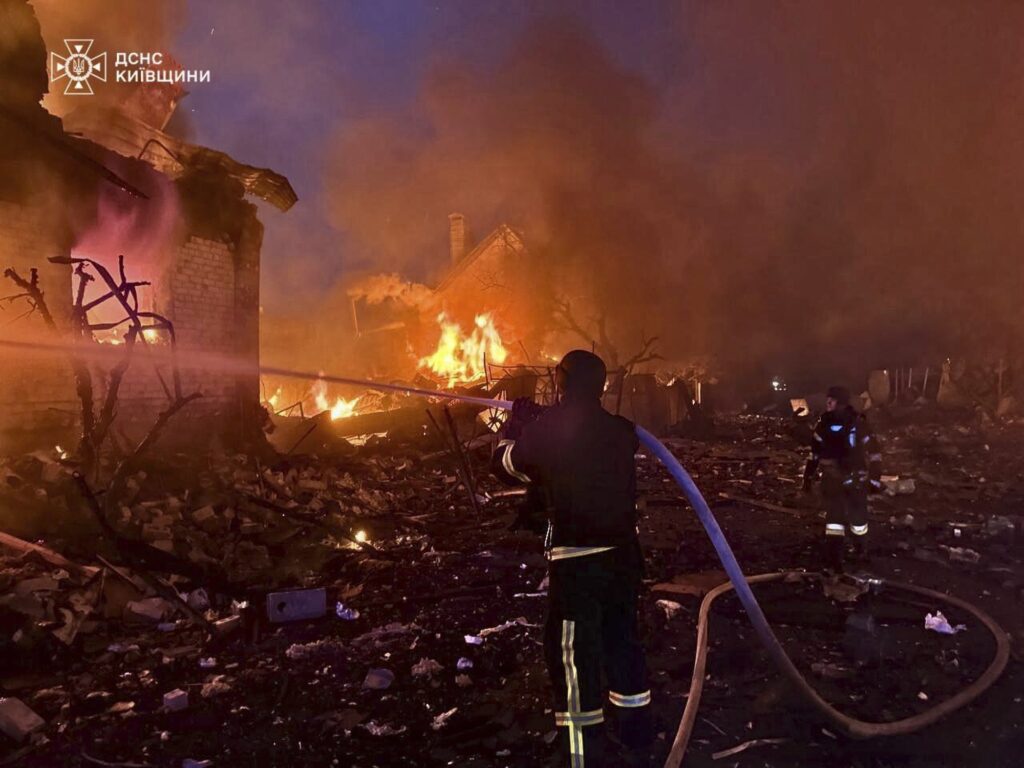
Meanwhile, Russian forces continued their assault on Ukraine with missiles and drones. A Russian drone strike on Kharkiv, Ukraine’s second-largest city, killed six civilians late Sunday, including a toddler and a 16-year-old, according to local officials. The attack also injured 20 people, including six children.
Russian aerial attacks also targeted the northeastern Sumy region and the southern Odesa region. In Zaporizhzhia, a southeastern city, 17 people were injured in Monday’s attack, according to regional head Ivan Fedorov.
Ukraine’s Air Force reported that Russia launched a total of four Iskander-M ballistic missiles and 140 Shahed and decoy drones across Ukraine overnight, with 88 drones either intercepted or jammed by Ukrainian defenses.




