

The U.S. military announced Saturday the deaths of two American service members and the disappearance of a third following an Iranian drone and missile attack on a base in Jordan on Friday, marking the most significant direct casualties inflicted by Iranian fire since the war’s opening days and signaling a dangerous new phase in a conflict that shows no signs of resolution.
The announcement came as Iran’s supreme leader issued a stark public warning, the interim ceasefire deal collapsed entirely, and the battle for control of the Strait of Hormuz intensified across multiple fronts simultaneously.
What We Know So Far
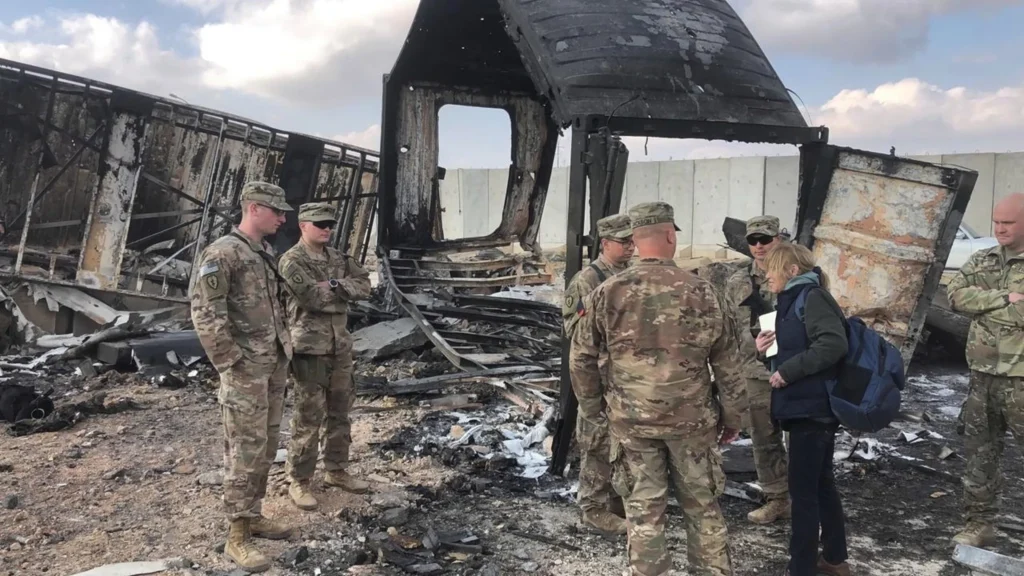
U.S. Central Command confirmed the two deaths occurred on July 17 as American and partner forces responded to an Iranian ballistic missile and drone attack in Jordan. A third service member remains missing in action. Four additional troops were medically evacuated to hospitals in Jordan but have since been discharged. Others evaluated for minor injuries returned to duty, NBC confirmed.
The identities of the two killed were withheld pending family notification. Their deaths brought the total number of U.S. service members killed since the war began to 16, with more than 420 wounded, Reuters confirmed.
Defense Secretary Pete Hegseth posted on X: “Godspeed, heroes. Their sacrifice only stiffens our resolve.”
Jordan confirmed its forces had intercepted Iranian missiles and drones targeting American military positions on its territory. Iran’s Revolutionary Guard claimed at least two U.S. fighter aircraft were destroyed in the attack on the Al Azraq base, Iranian state television reported. NBC said it could not independently verify the claim.
Kuwait sustained some of the most severe damage of the day. The Kuwait Petroleum Corporation confirmed one of its oil facilities was hit in what it described as repeated Iranian attacks, causing significant damage and injuries. The Revolutionary Guard separately claimed it struck the U.S. military support center at Camp Arifjan and destroyed a radar facility at Ali Al Salem Air Base in Kuwait. A water desalination plant was also hit, forcing power generation units offline, Kuwait authorities confirmed. It was the second attack against a desalination plant in Kuwait in two days. The country depends on desalination for 90 percent of its drinking water, the Associated Press noted.
Kuwait briefly closed its airspace due to missile threats. Kuwait Airways announced it was rescheduling most flights to and from the capital. Several firefighters and oil sector workers were injured responding to fires sparked by the strikes.
The Revolutionary Guard additionally claimed it targeted a site at Bahrain’s Sheikh Isa Air Base where U.S. combat aircraft were gathered, and struck an intelligence data center in the country. Air raid sirens sounded multiple times in Bahrain throughout the day and in Saudi Arabia in the morning, their governments confirmed. Saudi Arabia’s early warning system issued alerts urging residents in Al-Kharj and Yanbu to seek shelter. Al-Kharj hosts a military base with U.S. troops and Yanbu operates a key oil export terminal on the Red Sea. Two people briefed on the matter told Reuters an Iranian missile attack had triggered the alerts, the first strike on Saudi Arabia in more than three months.
Iraq said it shot down attack drones over the city of Irbil.
U.S. Central Command confirmed its seventh consecutive night of strikes against Iran, hitting surveillance sites, military logistics infrastructure, underground weapons storage, and maritime capabilities. American airstrikes destroyed the Bonji desalination plant in Iran’s southern Hormozgan province, cutting off water supplies to approximately 10,000 people, Iranian state news agency IRNA confirmed. A desalination plant on Qeshm Island inside the strait was also damaged. Overnight strikes hit two tunnels and three bridges, disrupting a main highway toward Bandar Abbas, Iran’s main port near the narrowest point of the strait, IRNA confirmed.
Iran’s Health Ministry said Saturday that 50 people had been killed and more than 500 wounded in American strikes over the past three weeks, including eight killed in a bridge strike on Friday.
Oil prices rose more than four percent on Friday to their highest level in more than a month, Reuters confirmed, adding immediate economic pressure to a conflict whose political costs are mounting ahead of November’s U.S. congressional elections.
What Authorities Are Saying
In a written statement carried by Iranian state media and the official accounts of Iran’s supreme leader, Mojtaba Khamenei broke his public silence with a direct warning to Washington. Khamenei, whose whereabouts have remained unknown since the war began, accused the United States of repeated violations of the interim ceasefire agreement and declared that Trump’s signature on that deal was “utterly worthless and devoid of credibility.”
“Now that the American enemy is seeking to escalate the conflict thereby incurring even heavier costs and further humiliation, it should know that the noble nation of Iran and the Resistance Front have unforgettable lessons in store for it,” the statement said, Reuters confirmed. The warning extended beyond Iran itself to encompass the network of regional armed proxies Khamenei described as the Axis of Resistance.
Iran’s deputy foreign minister Kazem Gharibabadi told state television that Tehran was suspending its commitments under the interim deal. “The U.S. has violated its commitments under the deal and now Iran is no longer implementing them,” Gharibabadi said, the Associated Press confirmed.
Iranian Foreign Ministry spokesperson Esmaeil Baghaei accused Washington of seeking unilateral control over the Strait of Hormuz in violation of decades of established international maritime practice.
The secretary general of the Gulf Cooperation Council, Jasem Mohamed al-Budaiwi, accused Iran of war crimes for targeting civilian infrastructure and water desalination facilities across member states.
The United States issued a global travel alert in response to the rising tensions across the region.
There was no immediate word on renewed mediation efforts from Pakistan or Qatar, both of which had played central roles in brokering the interim agreement that Iran has now formally suspended.
Why This Matters
The deaths of two American service members by direct Iranian fire on a sovereign Jordanian military base represent a qualitative escalation that goes beyond the exchange of strikes that has characterized the past week of fighting.
Previous American troop deaths in the conflict had occurred under more ambiguous circumstances, through helicopter accidents, strikes on bases attributed to Iranian-backed proxies, or incidents that could be framed as indirect Iranian aggression. Friday’s deaths in Jordan, where Iran’s Revolutionary Guard directly struck a base hosting U.S. forces with ballistic missiles and drones, removes that ambiguity entirely.
The political pressure this creates on the Trump administration is substantial. Trump won his second term partly on a platform that included skepticism of prolonged Middle Eastern military engagements. He now faces a seventh consecutive night of strikes, American troops killed in Jordan, a collapsed ceasefire, and an Iranian supreme leader threatening escalation from an undisclosed location. November’s congressional elections are approaching and fuel prices, already elevated, rose four percent on Friday alone.
The attacks on desalination infrastructure in both Kuwait and Iran add a humanitarian dimension that carries its own escalatory logic. Kuwait depends on desalination for 90 percent of its drinking water. Iran’s strikes on Kuwaiti water plants and the American destruction of Iranian desalination facilities in Hormozgan province place civilian populations directly in the crosshairs of a conflict that both sides continue to frame in military terms.
The battle for the Strait of Hormuz, through which a fifth of the world’s crude oil passed before the war, has hardened into a contest of attrition. The United States has reimposed its naval blockade on Iranian ports and redirected or disabled several vessels attempting to transit without authorization. Iran continues to fire on ships it says are violating its routing requirements. Shipping transits fell to a three-week low, according to an international tracking service, a measure of how comprehensively the waterway that once underpinned global energy security has been transformed into an active combat zone.
What Happens Next
With the interim deal formally suspended by Iran and Khamenei warning of unforgettable lessons from both Tehran and its regional proxy network, the diplomatic pathway to de-escalation has narrowed significantly. The specific threat that Iran’s armed proxies across Lebanon, Iraq, Yemen, and elsewhere may intensify operations against American forces and American allies widens the potential geographic scope of the conflict beyond what has occurred so far.
Trump faces a direct choice between further military escalation aimed at compelling Iranian concessions on the strait and the nuclear program, and a diplomatic reopening that would require concessions his domestic political position makes difficult to offer publicly. His pattern of threatening civilian infrastructure while maintaining that a deal remains possible reflects the tension between those two imperatives.
For American families awaiting the identification of the two service members killed Friday, and for the family of the service member still missing in Jordan, Saturday’s announcements mark a personal dimension of this conflict that no strategic analysis can fully encompass.
The U.S. military said it was withholding identities until families had been notified. That process, and the grief it carries, is unfolding even as strikes continue and the search for the missing service member proceeds.
AP/Reuters/NBC




