

Iran warned Sunday that it could completely shut down the Strait of Hormuz and expand attacks on regional infrastructure after President Donald Trump threatened U.S. strikes on Iranian power plants if the critical shipping lane is not reopened within 48 hours.
The escalating exchange between Washington and Tehran marked a significant intensification in the conflict, now entering its fourth week, with both sides signaling potential strikes on essential energy and industrial systems.
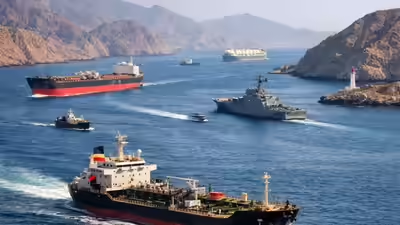
Iranian officials indicated the strategically vital waterway would be closed entirely if the United States follows through on its warning. The strait, which connects the Persian Gulf to global markets, carries roughly one-fifth of the world’s oil supply and a significant share of liquefied natural gas shipments.
President Trump said in a social media post late Saturday that the United States would destroy Iranian power infrastructure if shipping traffic is not restored, warning that the largest facilities would be targeted first. U.S. officials have maintained that Iran’s infrastructure supports its broader military operations.
In response, Iranian parliament speaker Mohammad Bagher Qalibaf said any attack on Iran’s infrastructure would prompt retaliatory strikes on critical systems across the region, including energy networks and desalination facilities, which are essential for water supplies in Gulf countries.
Iran’s representative to the International Maritime Organization said navigation through the strait would remain possible for vessels not considered hostile, indicating Tehran would control access. Iranian authorities have already allowed certain shipments, including those bound for China and parts of Asia, to pass through under specific conditions.
Shipping traffic through the strait has slowed dramatically in recent days as threats and attacks on vessels have disrupted tanker movements. Major oil producers have reduced output amid growing difficulty exporting crude.
The diplomatic standoff unfolded alongside intensified military exchanges between Iran and Israel.
Iran launched missile attacks targeting areas near Israel’s primary nuclear research region in the Negev Desert, striking the cities of Dimona and Arad. The strikes caused extensive damage to residential buildings and injured dozens, according to emergency responders.
Israeli Prime Minister Benjamin Netanyahu visited the affected area and described the outcome as fortunate given the scale of destruction, noting that adherence to air raid warnings likely prevented fatalities.
Israel’s military acknowledged that some missiles penetrated its air defense systems, marking a notable shift in the conflict. It was the first confirmed instance of Iranian projectiles reaching areas near the country’s nuclear research facilities.
At least 64 people were taken to hospitals following the strike in Arad. In northern Israel, a separate attack attributed to the militant group Hezbollah killed one person, according to Israeli authorities.
Israel’s military leadership said operations would continue, warning that the conflict is ongoing and could intensify further.
The International Atomic Energy Agency said it had not received reports of damage to Israel’s nuclear facilities or any abnormal radiation levels following the strikes.
The conflict has extended beyond immediate battle zones. Iranian forces targeted the joint U.S.-U.K. military base at Diego Garcia in the Indian Ocean, though the attack was unsuccessful, according to British officials.
Military analysts suggested the attempted strike could indicate longer-range capabilities than previously assessed, possibly involving modified launch systems.
The United States has increased its military presence in the region, deploying additional amphibious ships and thousands of Marines, officials told The Associated Press.
Elsewhere in the Gulf, countries reported continued attacks. Saudi Arabia said it intercepted multiple drones targeting its eastern oil-producing region, while alerts were issued in the United Arab Emirates.
The conflict has also disrupted global energy markets. Damage to key infrastructure, including facilities in Qatar’s Ras Laffan Industrial City, has reduced output and contributed to rising fuel costs worldwide.
In an effort to ease pressure, the Trump administration temporarily lifted some restrictions on Iranian oil already at sea. However, analysts say the move does not significantly increase supply, limiting its impact on stabilizing prices.
The human toll continues to rise. Iranian state media reported more than 1,500 deaths in Iran since the conflict began. In Israel, at least 15 people have been killed by Iranian missile strikes, with additional fatalities reported in the West Bank.
U.S. officials said at least 13 American service members have been killed, along with numerous civilians across Gulf nations.
Regional violence has also spread to Lebanon, where Hezbollah claimed responsibility for a strike that killed a man in the northern Israeli town of Misgav Am. Israeli forces have responded with airstrikes and expanded operations along the border.
Lebanese authorities said Israeli strikes have killed more than 1,000 people and displaced over 1 million residents. On Sunday, Israeli forces destroyed a major bridge connecting southern Lebanon to central regions, further damaging infrastructure.
The growing confrontation over the Strait of Hormuz represents a pivotal moment in the conflict, with far-reaching global consequences. The waterway is one of the most critical chokepoints in the global energy system, and any prolonged closure could disrupt supply chains and trigger sharp increases in oil and gas prices.
Iran’s strategy appears to center on leveraging its geographic control over the strait to counter U.S. military and economic pressure. By threatening selective access, Tehran is signaling that it can influence global energy flows while maintaining limited trade with key partners.
President Donald Trump’s warning suggests a shift toward targeting economic infrastructure, a move that could significantly escalate the conflict. Strikes on power plants would directly affect civilian systems and could provoke broader retaliation across the region.
The missile strikes near Israel’s nuclear research area highlight a parallel escalation on the battlefield. The ability to penetrate air defenses in sensitive areas may signal evolving tactics or capabilities, raising concerns about future attacks.
At the same time, the widening scope of the conflict—from the Gulf to the Indian Ocean and the Israel-Lebanon border—underscores the risk of a broader regional war. Increased military deployments and infrastructure targeting raise the likelihood of miscalculation.
If the Strait of Hormuz remains disrupted, the economic impact could extend well beyond the Middle East, affecting fuel prices, shipping routes and global markets. The situation places mounting pressure on international actors to stabilize maritime security while avoiding further escalation.
Arabnews





