

A Colombian Air Force transport plane carrying more than 120 people crashed shortly after takeoff in the country’s remote Amazon region on Monday, killing at least 34 people and leaving dozens injured, officials said.
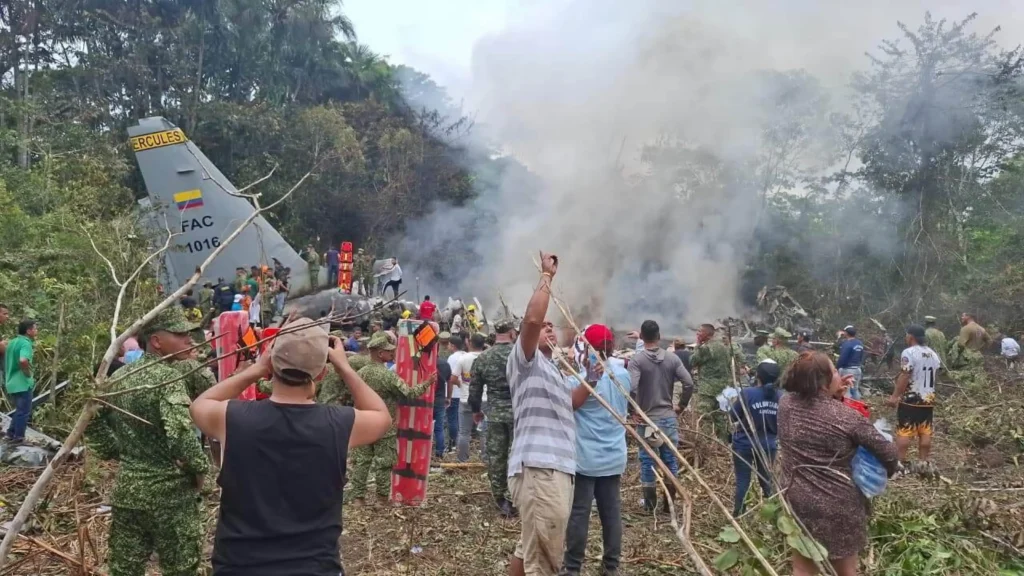
The aircraft, identified as a Hercules C-130 military transport plane, went down near Puerto Leguizamo in Putumayo Department, a sparsely populated area bordering Peru and Ecuador. Authorities described the crash as one of the deadliest aviation disasters involving Colombia’s military in recent years.
Governor Jhon Gabriel Molina said at least 34 people were confirmed dead, about 70 were injured and more than 20 remained unaccounted for as rescue operations continued.
“These figures could change as we gather more information,” Molina said in remarks carried by local media.
Defense Minister Pedro Sánchez said the aircraft crashed shortly after departing from Puerto Leguizamo, where it had been transporting troops within the region.
Preliminary accounts suggest the plane encountered problems during takeoff. Emergency responders said the aircraft may have struck the ground near the end of the runway before losing control. As it descended, part of the aircraft reportedly clipped a tree before crashing and catching fire.
The impact triggered an intense blaze, complicating rescue efforts and raising concerns about possible onboard equipment contributing to the fire.
The aircraft was carrying mostly military personnel, with earlier reports indicating about 110 soldiers and 11 crew members were on board, though officials said they were still working to reconcile discrepancies in passenger numbers.
The crash site, located in dense jungle terrain, has been difficult for emergency crews to access. Local residents were among the first to respond, helping to pull survivors from the wreckage before military units arrived.
Videos shared by local media showed injured individuals being transported on motorcycles along dirt roads, highlighting the urgency and challenges of the rescue operation.
Authorities said survivors were initially treated at small clinics in Puerto Leguizamo before being airlifted to larger hospitals in other cities, including the capital, Bogotá.
The Colombian Air Force said dozens of people were rescued with injuries, though many remained in serious condition.
Officials said the cause of the crash remains under investigation. Defense Minister Sánchez stated there were no immediate indications that the aircraft had been attacked by armed groups, which are active in parts of the region.
Aviation experts said investigators will likely examine mechanical performance, flight conditions and crew response during takeoff.
The aircraft involved is part of a fleet of Hercules C-130 planes widely used for military transport operations. Colombia has operated such aircraft for decades, often deploying them in remote regions as part of ongoing security missions.
A spokesperson for Lockheed Martin, which manufactures the aircraft, said the company is prepared to assist Colombian authorities in the investigation.
President Gustavo Petro expressed condolences to the victims and their families while calling attention to longstanding concerns about military equipment.
Petro said efforts to modernize the country’s military have faced bureaucratic delays and emphasized the need for urgent reforms.
“I will not allow further delays when lives are at stake,” he said in a statement, adding that officials unable to meet the challenge should be replaced.
The crash has also drawn reactions from political leaders ahead of Colombia’s upcoming presidential election, with calls for a thorough and transparent investigation.
The Hercules C-130 has been a cornerstone of military transport operations worldwide since its introduction in the 1950s. In Colombia, the aircraft plays a critical role in moving troops and supplies across difficult terrain, particularly in areas affected by the country’s long-running internal conflict.
Recent years have seen increased scrutiny of military aviation safety across the region. In a separate incident earlier this year, a similar aircraft operated by Bolivia’s air force crashed in a populated area, resulting in multiple fatalities.
The crash underscores the operational risks associated with military aviation in challenging environments such as Colombia’s Amazon region. Aircraft like the C-130 are designed for rugged conditions, but factors such as short runways, unpredictable weather and heavy payloads can increase the likelihood of critical failures during takeoff and landing.
The early stage of flight—particularly takeoff—is one of the most vulnerable periods, as aircraft have limited altitude and speed to recover from mechanical or aerodynamic issues. Any malfunction during this phase can quickly escalate into a catastrophic event.
The remote location of the crash further complicates emergency response efforts. Delays in reaching the site can affect survival rates for injured passengers and hinder the preservation of evidence needed for investigators.
The incident also brings renewed attention to the condition and maintenance of military aircraft fleets. While officials have indicated the plane may have undergone prior inspections, the investigation will need to determine whether mechanical failure, human error or environmental factors played a role.
Beyond the immediate tragedy, the crash is likely to intensify debate over defense spending, maintenance standards and modernization efforts within Colombia’s armed forces. Ensuring the reliability of transport aircraft is critical not only for military operations but also for the safety of personnel who rely on them.
As investigators continue their work, the findings will be closely watched both within Colombia and internationally, given the widespread use of similar aircraft in military fleets around the world.





