

Iranian gunboats opened fire on a tanker moving through the Strait of Hormuz after Tehran reinstated limits on maritime traffic in the key waterway, British authorities said Saturday.
The United Kingdom Maritime Trade Operations reported that two vessels linked to Iran’s Revolutionary Guard targeted the tanker while it was transiting the narrow channel. The agency said the ship and its crew were safe but did not identify the vessel or provide details about its destination.
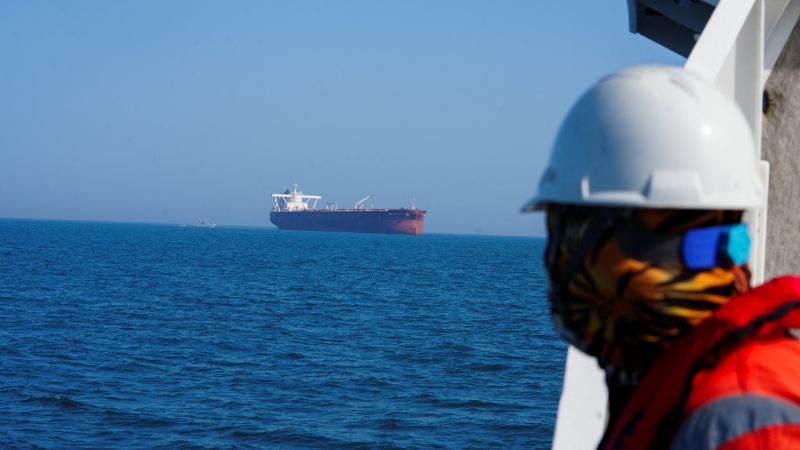
The incident followed an announcement from Iran that it was restoring restrictions on shipping through the strait in response to continued U.S. measures against Iranian ports and vessels. Iranian authorities have tightly controlled access to the waterway during the recent conflict, allowing passage only to ships granted approval.
In a separate development hours later, a container ship was struck by what officials described as an “unknown projectile” roughly 25 nautical miles northeast of Oman, according to the British maritime monitoring agency. The impact damaged several containers on board, though no injuries, fires or environmental damage were reported.
Authorities said they are reviewing the incident and have not attributed responsibility. The strike marked the second reported security event in the strait within the same day.
The two incidents occurred as tensions escalated following renewed enforcement of shipping limits by Iran. The restrictions came after Donald Trump said the United States would maintain its blockade affecting Iranian maritime activity, intensifying a standoff over access to one of the world’s most critical energy routes.
Shipping activity in the area appeared to shift in response to the developments. Vessel tracking data indicated that several ships approaching the strait reversed course amid uncertainty about safe passage. Some tankers carrying liquefied natural gas and crude oil, originally bound for ports in India, remained in the Gulf rather than continuing through the chokepoint.
Other vessels subject to U.S. sanctions were observed passing through the strait earlier in the day and reaching the Gulf of Oman without interference, though analysts said their movements could still be affected by evolving restrictions.
The Strait of Hormuz is one of the most important shipping corridors in the world, handling a significant share of global oil and gas exports. Any disruption to traffic in the area can have immediate implications for energy markets and international trade.
During a brief period when Iran eased restrictions earlier, several vessels were able to transit the waterway, but the renewed controls have reintroduced uncertainty for commercial shipping operators.
The latest incidents highlight the fragile security environment in the Strait of Hormuz and the risks associated with competing restrictions imposed by Iran and the United States. The firing on a tanker, even without casualties, signals a willingness to use force to enforce maritime limits, raising concerns among shipping companies and governments.
The second incident involving a container ship struck by a projectile adds another layer of uncertainty. Without clear attribution, such events can increase tension and the risk of miscalculation. In heavily trafficked waterways, even isolated incidents can disrupt operations as ship operators prioritize safety.
Iran’s strategy appears to involve controlled enforcement of access to the strait. By limiting which vessels can pass while avoiding a full closure, Tehran maintains leverage without triggering an immediate global crisis. However, the use of armed vessels to enforce these rules increases the risk of escalation, particularly if foreign ships or naval forces are involved.
From the U.S. perspective, maintaining a blockade while seeking to ensure freedom of navigation creates a complex dynamic. Efforts to restrict Iranian shipping can provoke countermeasures that affect international traffic, placing pressure on allies and trading partners that rely on the route.
The reaction of shipping companies—turning vessels away from the strait—demonstrates how quickly market behavior can shift in response to perceived risk. Even temporary disruptions can lead to delays, increased costs, and higher insurance premiums, all of which can ripple through global supply chains.
The presence of sanctioned vessels moving through the area without interference suggests that enforcement may not be uniform, adding further uncertainty. This inconsistency can complicate decision-making for operators trying to assess risk and compliance.
Looking ahead, the situation in the Strait of Hormuz will likely remain volatile as long as broader tensions persist. Any additional incidents, particularly those involving damage or casualties, could prompt a stronger international response and increase the likelihood of direct confrontation.
For now, the combination of military activity, shifting restrictions, and unclear enforcement underscores the strategic importance of the waterway and the challenges of maintaining stability in a region critical to global energy supplies.
CNN/AP





