

Two American nationals were among 19 suspected communist fighters killed during a series of clashes with Philippine troops in a central province, authorities said, as officials raised concerns about possible foreign recruitment into the country’s long-running insurgency.
The fighting unfolded April 19 in the coastal town of Toboso in Negros Occidental province, where government forces engaged suspected members of the New People’s Army, the armed wing of a communist movement that has battled the state for decades. The violence was first disclosed earlier in the week and later detailed by the National Task Force to End Local Communist Armed Conflict.
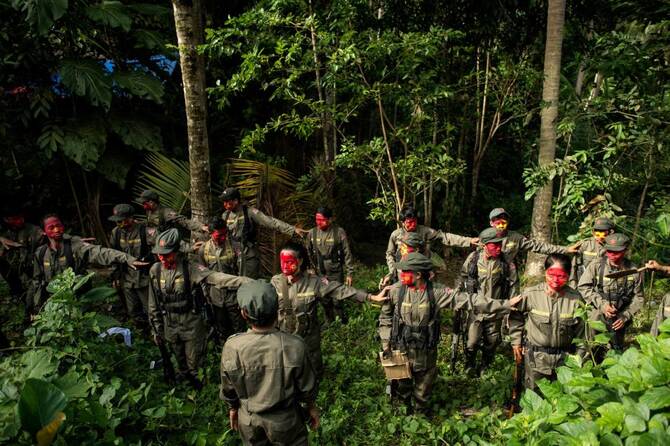
Task force officials identified the two Americans as Lyle Prijoles and Kai Dana-Rene Sorem. They were among 17 other suspected guerrillas killed in the confrontation, according to Undersecretary Ernesto Torres Jr., the task force’s executive director.
Torres said the two Americans arrived in the Philippines in March and were believed to have traveled to Negros Occidental before being killed in the April 19 encounter. He did not provide further details about their activities prior to the clash.
“These developments highlight the serious risks faced by foreign nationals who become involved in armed conflicts,” Torres said, noting that the presence of Americans in a combat zone raises concerns about how individuals may be drawn into dangerous situations far from home.
He added that all 19 fatalities have been identified and their remains returned to their families.
The U.S. Embassy in Manila did not immediately comment on the deaths.
Philippine military officials said the clash began after residents alerted authorities to the presence of suspected insurgents in the area. Troops were dispatched and came under fire, prompting a gunbattle that left one soldier wounded. Among those killed was a rebel commander who had a government bounty placed on him.
Security forces recovered 24 firearms at the scene and detained an unspecified number of fleeing fighters, the task force said.
Officials also issued a warning to people of Filipino descent living in the United States, urging caution against online or community-based efforts that could encourage support for or involvement with insurgent groups. Authorities described such outreach as part of a recruitment pattern that could expose individuals to significant danger.
The New People’s Army has been designated a terrorist organization by both the Philippine and U.S. governments. At its height, the group was estimated to have tens of thousands of fighters and operated across large parts of the country. Years of military operations, internal divisions, and surrenders have significantly reduced its numbers, with security officials now estimating fewer than 1,000 active members.
Despite the decline, sporadic violence continues, particularly in rural areas where government presence is limited and long-standing grievances persist.
Human rights organizations have challenged the official account of the Negros Occidental clashes, calling for an independent investigation. The National Union of People’s Lawyers said the incident may have involved civilian casualties, including a student leader from a state university, local advocates for farmers, and a community journalist.
The group urged international observers to closely monitor the situation, arguing that the violence reflects broader concerns about the conduct of military operations in the countryside.
“The circumstances surrounding these deaths require careful scrutiny,” the organization said, pointing to what it described as a pattern of potential violations of humanitarian standards in conflict-affected areas.
The conflicting accounts underscore the challenges of verifying details in remote regions where armed encounters often occur without independent witnesses. Government officials maintain that the operation targeted armed insurgents, while rights advocates argue that the possibility of civilian involvement cannot be dismissed without further investigation.
The clashes come against the backdrop of a decades-old insurgency that has resisted multiple attempts at resolution. Peace negotiations facilitated by Norway collapsed during the administration of former President Rodrigo Duterte after both sides accused each other of continuing attacks despite ongoing talks.
Since then, the Philippine government has focused on a military-led approach to ending the insurgency, combining security operations with programs aimed at encouraging fighters to surrender. While officials say these efforts have weakened the movement, sporadic violence continues to claim lives.
The reported presence of foreign nationals in an active combat zone highlights a less visible dimension of modern insurgencies: the potential for international involvement, whether through ideological alignment, personal connections, or online influence. While authorities frame the issue as a matter of recruitment, the broader context suggests a complex mix of motivations that can draw individuals into conflicts far from their home countries.
At the same time, the incident underscores ongoing tensions between security operations and human rights concerns. In regions where insurgent groups operate alongside civilian populations, distinguishing combatants from noncombatants remains a persistent challenge. Allegations of civilian casualties, if substantiated, could further complicate the government’s efforts to maintain public trust and international support.
The declining strength of the insurgency may suggest progress from a military standpoint, but the continued outbreaks of violence indicate that underlying social and economic issues remain unresolved. Without addressing those root causes, analysts warn that the conflict could persist in a lower-intensity but enduring form.
The deaths of the two Americans may also prompt closer scrutiny of cross-border dynamics, particularly how individuals become connected to foreign conflicts. Governments may face increasing pressure to monitor and address pathways that could lead citizens into dangerous environments abroad.
theindependent





