

WASHINGTON — King Charles III stood before a joint session of the United States Congress Monday and delivered a carefully calibrated appeal for enduring alliance, invoking shared democratic values and centuries of intertwined national destiny at a moment when the bond between Britain and America has frayed to its most strained point in generations — strained by war, tariff disputes, and a deepening diplomatic chill that the monarch’s four-day state visit was implicitly designed to address without appearing to do so.
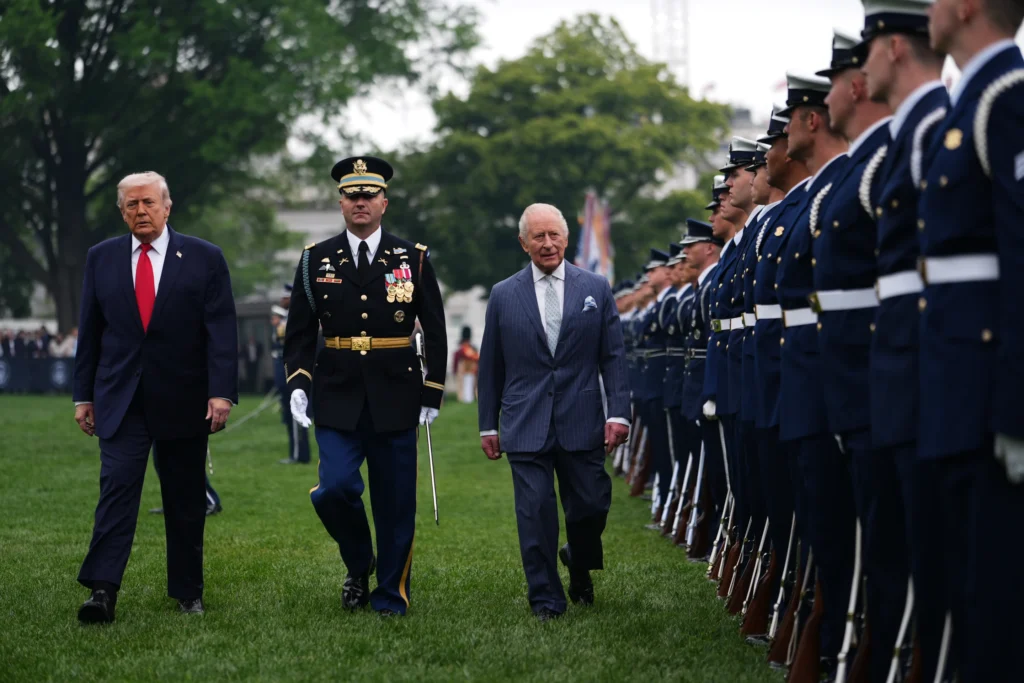
Speaking to assembled lawmakers from both parties in the chamber where American democracy has conducted its most consequential debates, Charles acknowledged what he called “times of great uncertainty” while insisting that the two nations’ fates remained permanently bound together regardless of whatever turbulence their governments currently navigated.
“Whatever our differences, whatever disagreements we may have, we stand united in our commitment to uphold democracy, to protect all our people from harm, and to salute the courage of those who daily risk their lives in the service of our countries,” the king told Congress.
The address made Charles only the second British monarch ever to speak before a joint session of Congress. His mother, Queen Elizabeth II, delivered a comparable address in 1991, similarly centered on democratic solidarity and the historic depth of the Anglo-American bond.
A Visit Freighted With Diplomatic Weight
The state visit arrived against a backdrop that few in either capital were willing to describe publicly as anything other than difficult. President Donald Trump has leveled sustained public criticism at British Prime Minister Keir Starmer over Britain’s refusal to participate in the initial wave of U.S.-Israeli military strikes against Iran — a rupture that analysts have characterized as the lowest point in the so-called special relationship since the 1956 Suez Crisis, when Washington actively opposed London’s attempt to seize the Suez Canal by force.
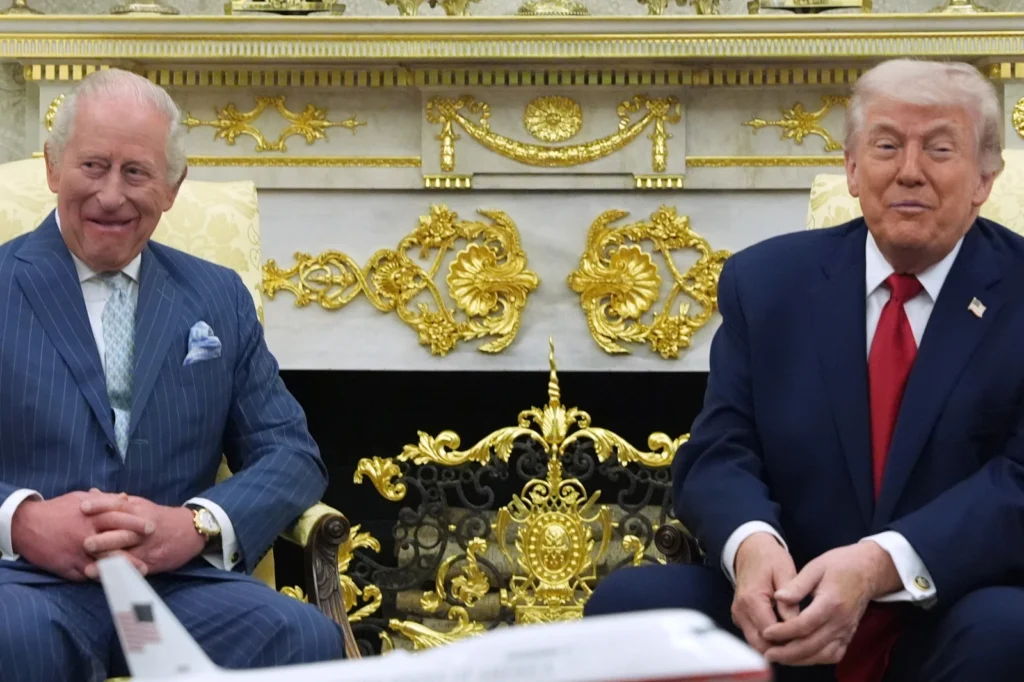
Before his congressional address, Charles met privately with top Republican and Democratic lawmakers and joined Queen Camilla for a closed-door session with Trump at the White House. Trump characterized the meeting positively, calling it “really good” and “a real honor,” and separately told the BBC in a phone interview conducted last week that he believed the king’s visit could help restore warmer ties between the two governments. “Absolutely, the answer is yes,” Trump said when asked whether the royal visit might repair the relationship, adding of the king: “He’s a brave man, and he’s a great man.”
The state dinner hosted by Trump at the White House Monday evening marked the ceremonial centerpiece of the visit, a ritual display of alliance that both governments have a clear interest in projecting even as their working relationship grinds through one of its most contentious periods.
The Special Relationship Under Examination
The term “special relationship” — first coined by Winston Churchill to describe the unique intelligence-sharing, military coordination, and cultural kinship binding Britain and the United States — has faced pointed scrutiny in recent weeks. The Financial Times disclosed Tuesday that Britain’s current ambassador to Washington, Christian Turner, told a group of British high school students visiting the United States in February that the phrase carried “a lot of baggage” and was “quite nostalgic.” Turner went further, suggesting that the United States probably reserved its singular bond for Israel rather than Britain.
A Foreign Office spokesperson moved quickly to contain the fallout, characterizing Turner’s remarks as private and informal and explicitly disavowing them as any reflection of official British government policy. Turner had hosted a garden party for Charles and Camilla at the British Embassy shortly after the royal couple’s arrival in Washington on Monday — an occasion that underscored the awkward proximity of his earlier candor to the pageantry now surrounding him.
Britain has for decades anchored its international identity in significant measure around its relationship with Washington, a tradition sustained by a succession of prime ministers — Winston Churchill with Franklin D. Roosevelt, Margaret Thatcher with Ronald Reagan, Tony Blair with George W. Bush — who cultivated personal chemistry with their American counterparts into strategic leverage. Starmer, by contrast, has found himself the target of repeated Trump rebukes, a dynamic that Charles navigated delicately in his congressional address by quoting his prime minister while carefully framing the citation within a broader appeal to institutional permanence.
“As my Prime Minister said last month: ‘Ours is an indispensable partnership. We must not disregard everything that has sustained us for the last 80 years. Instead, we must build on it,'” Charles told Congress, threading a passage of political endorsement into what was formally a nonpolitical address.
Former British Ambassador to Washington Nigel Sheinwald, who held the post from 2007 to 2012, offered perhaps the clearest articulation of what the visit was and was not intended to accomplish. Speaking to Reuters, Sheinwald pushed back against the idea that Charles had arrived in Washington to patch a bilateral rupture at the governmental level. The visit’s purpose, he argued, ran deeper than any current disagreement between administrations.
“Pretty much more than any other visit, this is about the long term. This is about the fundamentals of the relationship between our peoples, our countries,” Sheinwald told Reuters.
250 Years of Interlinked Destiny
Charles’ address coincided with the 250th anniversary of American independence from Britain — a historical milestone that lent the occasion an added layer of symbolic resonance. That the country which once fought a revolutionary war to sever itself from the British Crown was now receiving that Crown’s living embodiment with full state honors in its legislative chamber captured something essential about how thoroughly the relationship between the two nations had been transformed over two and a half centuries.
“For all that time,” Charles told Congress, “our destinies have been interlinked.”
The formulation was deliberate. Charles is constitutionally barred from engaging in partisan politics and has consistently maintained a posture of careful neutrality on matters that could entangle the monarchy in governmental disputes. Yet the choice to appear before Congress during a period of open tension between London and Washington — and to quote Starmer directly — reflected a calibrated willingness to use the monarchy’s singular soft-power standing in service of national interest
The Crown as Diplomatic Instrument
The state visit illuminated a dynamic that has characterized British foreign policy at its most resourceful: the deployment of the monarchy as a diplomatic asset that transcends the transactional friction of day-to-day governmental relations. Prime ministers come and go, trade disputes rise and subside, and military coalitions form and fracture — but the image of a British king addressing the American Congress in the Capitol Rotunda projects a continuity and gravity that no bilateral summit communiqué can replicate.
For Trump, who has made no secret of his personal admiration for the British royal family, the visit offered something valuable as well: a moment of ceremonial grandeur that reinforced his own brand as a leader commanding the attention of world figures, even as his administration’s confrontational posture toward London has complicated the alliance at the operational level.
Whether Charles’ visit translates into any measurable warming between the two governments on the substantive disagreements over Iran, trade, or the terms of their security partnership remains genuinely uncertain. Sheinwald’s framing — that this was about the long term, about peoples rather than policies — may prove prophetic, or it may prove to be the diplomatic equivalent of a gracious understatement masking a relationship that requires more than royal pageantry to repair.
What is beyond dispute is that Charles accomplished what he came to do: he stood in the most visible forum American democracy offers, spoke without flinching about the bonds his nation shares with this one, and reminded an audience that has grown accustomed to thinking of the Atlantic alliance in purely transactional terms that some relationships are measured in centuries rather than in any single administration’s ledger.
AP





