

Ugandan authorities have detained more than 200 foreign nationals in a sweeping security operation targeting suspected human trafficking networks and cybercrime activity, officials said Tuesday, as the government intensifies efforts to curb illegal migration.
The Ministry of Internal Affairs said at least 231 individuals were taken into custody beginning Monday in coordinated raids across multiple locations. The operation focused on groups of foreign nationals living in northern Uganda and in a tightly controlled residential compound in the capital, Kampala.
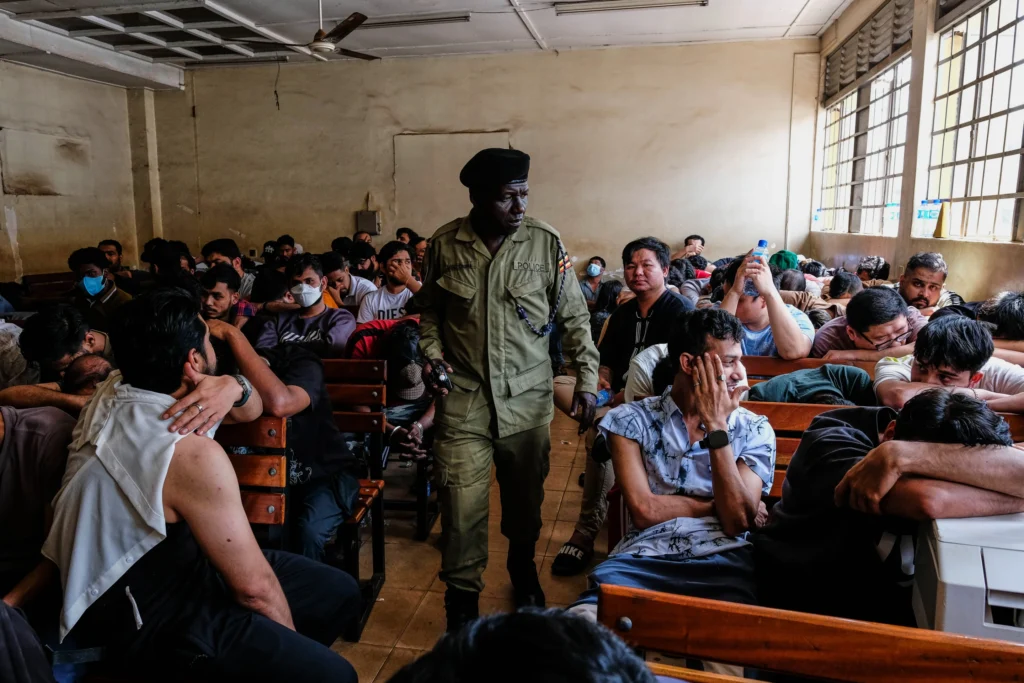
Officials said the Kampala compound housed 169 people from several countries, including Pakistan, India, Bangladesh, Ghana, Myanmar, Ethiopia, Sri Lanka, Cambodia and Malaysia. Authorities described the facility as a restricted environment with its own internal services, including dining areas, and designed in a way that limited residents’ movement.
Thirty-six women were among those found at the site, the ministry said.
A separate operation in northern Uganda targeted a group of Nigerian nationals. Authorities said both actions were driven by intelligence suggesting that large numbers of foreign nationals were residing and working in the country without proper documentation.
In a statement, the ministry indicated that many of those detained did not possess valid passports or legal permits. Officials also disclosed that some individuals told investigators they had been brought into Uganda under false promises of employment.
“Some individuals have claimed they were trafficked into Uganda with promises of employment,” the ministry said. “Others were engaged in cyber-scamming activities, while a number were found with materials that may indicate involvement in additional criminal conduct.”
Simon Peter Mundeyi, a spokesperson for the Ministry of Internal Affairs, told The Associated Press that those detained fall into three main categories: suspected victims of human trafficking, individuals believed to be involved in criminal operations, and people who had overstayed their visas without engaging in illegal activity.
Mundeyi said authorities are working to separate victims from suspected organizers. Those identified as trafficking victims or immigration violators without criminal involvement will be assisted in returning to their home countries, though they will be required to cover their travel expenses. Individuals believed to be key figures in trafficking or cybercrime operations are expected to face prosecution and possible deportation after legal proceedings.
Authorities have not disclosed how long the investigation will take or whether additional arrests are expected.
Uganda has long been regarded as a relatively open destination for migrants and refugees, particularly from neighboring countries affected by conflict, including Congo, Burundi and South Sudan. The country hosts hundreds of thousands of displaced people and has maintained relatively flexible visa policies for visitors from across Africa and beyond.
All factual details, including the number of detainees, locations of the operations, and official statements, were provided by Uganda’s Ministry of Internal Affairs and comments made by spokesperson Simon Peter Mundeyi to The Associated Press.
The large-scale detentions highlight growing concerns across Africa about the intersection of human trafficking, illegal migration, and cybercrime networks. Uganda’s operation reflects a broader regional trend in which authorities are increasingly targeting organized groups that exploit vulnerable individuals under the guise of employment opportunities.
The discovery of a controlled residential compound in Kampala raises questions about how such operations can function undetected. Facilities designed to restrict movement suggest a level of organization often associated with trafficking rings or coordinated cybercrime hubs, where victims may be isolated and pressured into illegal activities such as online fraud.
The mention of cyber-scamming is particularly significant. Across several parts of Africa and Asia, authorities have uncovered networks where trafficked individuals are forced to participate in online scams targeting victims globally. These operations often rely on deceptive recruitment practices, bringing individuals into foreign countries with promises of legitimate work before coercing them into criminal activity.
Uganda’s response also illustrates the challenge governments face in distinguishing between victims and perpetrators. In many cases, individuals involved in such operations may have initially entered as victims but later become participants under duress. This complicates legal and humanitarian responses, requiring careful screening and coordination with international partners.
The government’s decision to require non-criminal detainees to fund their own return travel could draw scrutiny from human rights organizations. While it reflects a practical approach to managing resources, it may place additional burdens on individuals who were already vulnerable or exploited.
At the same time, the crackdown may signal a shift in Uganda’s immigration enforcement strategy. While the country has traditionally maintained an open-door policy, particularly toward refugees, increasing concerns about transnational crime could lead to tighter controls and more frequent operations targeting undocumented migrants.
The international dimension of the arrests, involving individuals from multiple continents, underscores the global nature of trafficking and cybercrime networks. These systems often span several countries, making enforcement efforts dependent on cross-border cooperation and intelligence sharing.
As investigations continue, the outcome of this operation may influence how Uganda and other countries in the region approach similar threats. It could also prompt calls for stronger oversight, improved victim protection mechanisms, and greater international collaboration to address the root causes of trafficking and exploitation.





