

A man armed with a knife sprinted down a north London street Wednesday targeting Jewish pedestrians in broad daylight, stabbing two men before turning on police officers in what Scotland Yard characterized as a suspected terrorist attack — the most visceral episode yet in an escalating campaign of antisemitic violence that has shaken Britain’s Jewish community and drawn condemnation from heads of state on two continents.
The two victims, a 76-year-old man and a 34-year-old man, were both hospitalized in stable condition following the assault. Officers subdued the attacker with a Taser stun gun after he attempted to stab responding police, though no officers sustained injuries. A 45-year-old British national born in Somalia was taken into custody, treated at a hospital for his own injuries, and subsequently transferred to a London police station where he remained under questioning on suspicion of attempted murder as of Wednesday evening.
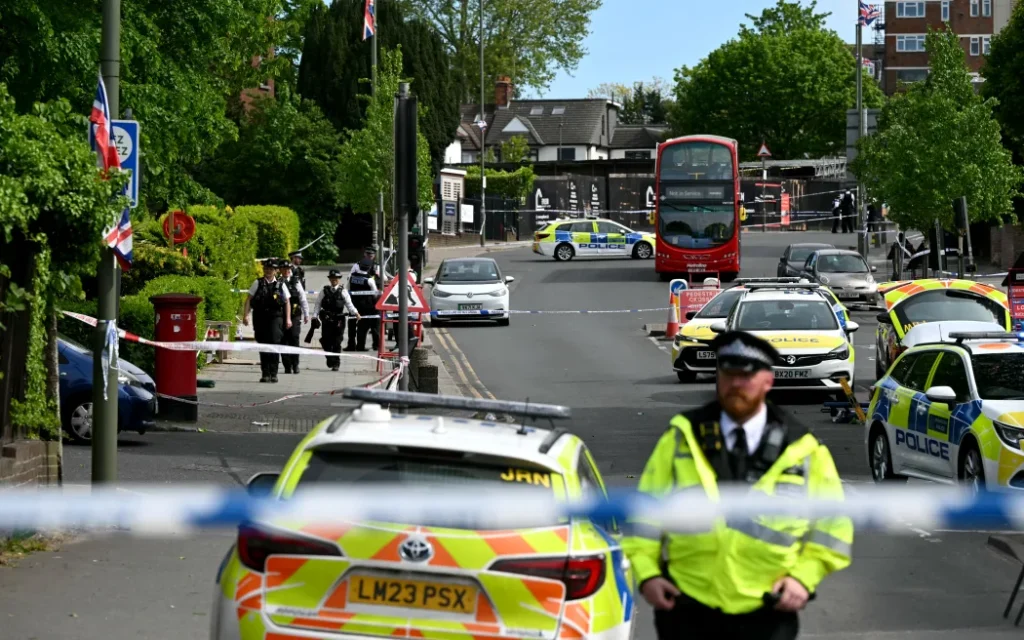
Metropolitan Police Commissioner Mark Rowley disclosed that the suspect carried a documented history of serious violence and mental health issues. Detectives are also investigating whether the same man was involved in a separate knife-related altercation in southeast London earlier the same morning, during which another person suffered minor wounds.
Unverified footage circulated on social media appeared to capture a man wearing a traditional Jewish skullcap being attacked at a bus stop. Subsequent footage showed officers wrestling repeatedly with the suspect in an effort to disarm him. The scenes, raw and disturbing, spread rapidly across platforms and amplified a sense of alarm that had been building for weeks across London’s Jewish neighborhoods.
A Community Under Siege
Wednesday’s stabbings did not emerge from a vacuum. They arrived as the culmination of a sustained and intensifying pattern of attacks on Jewish targets across the British capital that authorities and community leaders have struggled to contain. Over the preceding month, arsonists struck Jewish ambulances, attempted to torch synagogues, and carried out a series of fire attacks on Jewish-linked premises concentrated in and around Golders Green — a north London neighborhood home to one of Britain’s largest Jewish communities — and near the Israeli Embassy in west London. More than two dozen people have been arrested in connection with those incidents.
Last October, two people and their attacker were killed after a man drove a vehicle into a synagogue in Manchester. The cumulative toll has pushed Britain’s approximately 290,000 Jewish citizens into a state of heightened anxiety that community leaders say is now indistinguishable from genuine fear.
Metropolitan Police Commissioner Rowley acknowledged that reality without deflection. “It is completely understandable why Jewish Londoners feel afraid. Jewish communities are understandably angry. There have been too many attacks,” he told reporters at the scene.
His candor did not insulate him from the anger that had been building. A crowd gathered at the scene heckled Rowley as he spoke, shouting that he had failed and demanding his resignation — a confrontation that captured the degree to which institutional reassurances have ceased to carry weight with people who feel targeted in their own neighborhoods.
International Condemnation, Iranian Shadows
The attack drew immediate and pointed responses from foreign leaders. Israeli President Isaac Herzog called for urgent action, warning that it had become “dangerous to openly walk the streets as a Jew” in London. Israeli Prime Minister Benjamin Netanyahu also condemned the assault. A spokesperson for King Charles confirmed that the monarch was “being kept fully informed and is naturally deeply concerned, in particular about the impact for the Jewish community.”
Prime Minister Keir Starmer, who described the stabbing as “utterly appalling,” acknowledged in a statement that the violence was part of a recognizable and unacceptable pattern. “Let’s be frank, this is not an isolated incident. There have been a series of antisemitic attacks,” Starmer said. He pledged further government funding for security protecting Jewish communities and committed to confronting what he characterized as “malign state actors” operating within or directing violence from outside Britain’s borders.
That phrase carried specific weight. British detectives are actively examining whether the string of arson incidents over the past month carries possible Iranian fingerprints, amid warnings from senior security officials that Tehran has sought to deploy criminal intermediaries to conduct hostile operations on British soil. Just one day before Wednesday’s stabbings, the British government summoned the Iranian ambassador to account for what it characterized as “unacceptable and inflammatory” commentary posted by the Iranian Embassy on social media.
A pro-Iranian organization calling itself Harakat Ashab al-Yamin al-Islamiyya, which had previously asserted involvement in some of the London arson attacks and similar incidents across Europe, claimed responsibility on social media for Wednesday’s stabbings as well. Scotland Yard has previously said it was assessing such online claims but has not confirmed their authenticity. Rowley addressed the broader pattern directly: “We know that some individuals are being encouraged, persuaded or paid to commit acts of violence on behalf of foreign organisations and hostile states.”
Britain’s Chief Rabbi Ephraim Mirvis challenged the government to move beyond statements. Words, Mirvis said, were no longer adequate to confront the “hatred” now manifesting in attacks on Jewish Londoners. The government, he argued, owed the community concrete and visible protection.
A Global Surge Reaching British Streets
The violence in London is part of a wider international deterioration in the safety of Jewish communities that accelerated sharply following the Hamas assault on Israel in October 2023, which triggered the ongoing war in Gaza and unleashed a global wave of antisemitic incidents. In December of last year, a gunman opened fire at a Hanukkah celebration at Bondi Beach in Australia, killing 15 people in one of the deadliest antisemitic attacks in the country’s history.
Britain has not been immune to that global current. The concentration of incidents in London — a city that has historically prided itself on its diversity and tolerance — has made the erosion of Jewish safety in the capital feel particularly acute to those who have watched the pattern develop.
When Terrorism and Policy Collide
Wednesday’s attack forces a convergence of several deeply uncomfortable questions for the British government simultaneously. The first is operational: whether existing security resources, community policing strategies, and intelligence-sharing arrangements are sufficient to detect and prevent attacks that appear to be growing both in frequency and in severity. The answer, judging by the accumulating evidence on London’s streets, is plainly that they are not.
The second is geopolitical. If British investigators confirm Iranian state involvement in directing or financing the campaign of violence against Jewish targets, the implications extend far beyond domestic law enforcement. Britain is simultaneously managing a delicate diplomatic posture toward Tehran, navigating its relationship with Washington over the Iran war, and attempting to reassure a Jewish community that questions whether its government grasps the existential dimension of what they are experiencing.
The third is social. Antisemitism in Britain has historically drawn from multiple ideological sources — far-right nationalism, certain strands of Islamist extremism, and more diffuse currents of hostility that resist easy categorization. The current wave, concentrated in a post-Gaza political environment, carries a particular charge that makes political consensus on how to respond correspondingly difficult to achieve.
Starmer’s government has promised more resources and signaled a willingness to name foreign state actors as contributors to domestic violence — a rhetorical escalation that, if followed by substantive action, could mark a turning point in how Britain approaches the protection of its Jewish citizens. What that action looks like in practice, and whether it arrives before more blood is shed on London’s streets, is the question that Britain’s Jewish community is now asking with unmistakable urgency.





