

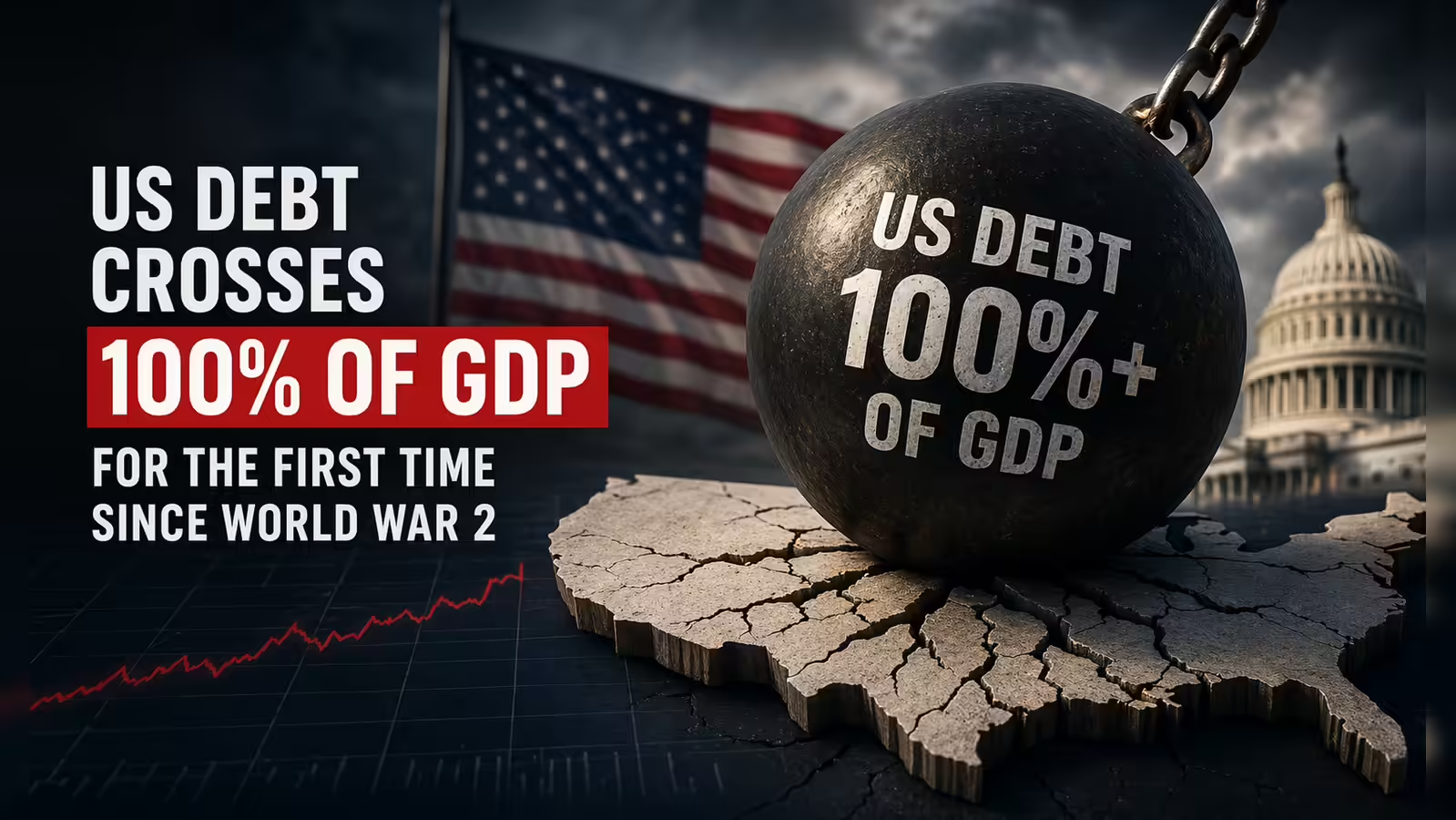
WASHINGTON (FoxBusiness)— The United States national debt has crossed a threshold not seen since the final convulsions of World War II, surpassing the total size of the American economy for the first time in nearly eight decades — a milestone that fiscal analysts warn represents not merely a number on a ledger but a structural shift in the nation’s financial trajectory with consequences that will extend across generations.
Data released by the Bureau of Economic Analysis showed that the national debt held by the public reached $31.27 trillion as of March 31, while nominal gross domestic product for the 12-month period ending in March stood at $31.22 trillion. The gap, though narrow in absolute terms, pushed the public debt-to-GDP ratio above 100 percent — the metric economists regard as the most meaningful gauge of a government’s debt burden because it excludes obligations held within government accounts and isolates the debt that must be financed through external borrowing.
The last time the United States crossed that threshold was in 1946, when the federal government was in the process of drawing down the extraordinary wartime spending that had financed victory in the most destructive conflict in human history. The all-time record debt-to-GDP ratio of 106 percent, set that same year, now stands within measurable reach. The nonpartisan Congressional Budget Office projects the United States will surpass that postwar record by 2030, when debt held by the public is estimated to reach 108 percent of GDP. A decade beyond that, the projection climbs to 120 percent.
Those figures have arrived against a separate but compounding backdrop: the gross national debt — a broader measure that includes obligations held in government trust funds — has already blown past $39 trillion. Treasury Department data showed the gross debt reached $39,016,762,910,245 as of March 17, crossing the $39 trillion threshold roughly five months after the $38 trillion level was breached in late October 2025, which itself had followed the $37 trillion milestone by just two months in mid-August.
The Machinery Driving the Surge
The acceleration of American debt accumulation is not the product of any single policy decision or economic shock but rather the compounding interaction of several structural forces that have been building for years and show no sign of self-correcting.
An aging population is steadily increasing mandatory federal outlays on Social Security and Medicare, programs whose expenditure growth is driven by demographic arithmetic rather than annual congressional appropriations. Interest expenses — the cost of servicing existing debt — have swelled alongside both rising interest rates implemented to combat inflation and the sheer growth of the debt stock itself. The Congressional Budget Office has projected that interest costs will constitute the fastest-growing line item in the federal budget for the foreseeable future, with servicing expenses estimated to total nearly $100 trillion over the next three decades.
Michael A. Peterson, chief executive of the nonpartisan Peter G. Peterson Foundation, characterized the pace of accumulation as categorically unsustainable. “At the current growth rate, we will hit a staggering $40 trillion in national debt before this fall’s elections,” Peterson told Fox Business. “Borrowing trillion after trillion at this rapid pace with no plan in place is the definition of unsustainable.” He argued that the debt’s direct cost to ordinary Americans — through interest rate pressures, reduced income growth, and the compounding burden passed to younger generations — should place the issue at the center of the current political debate rather than at its margins.
A Bipartisan Abdication, Not a Wartime Emergency
Perhaps the most pointed dimension of the current moment, as fiscal analysts frame it, is the contrast between the circumstances that produced the previous debt peak and those driving today’s trajectory. The 106 percent debt-to-GDP ratio recorded in 1946 was the direct consequence of financing a global war that consumed the resources of every major industrial power on earth. The emergency was real, the borrowing was purposeful, and the subsequent decline in the ratio was rapid as the economy expanded and wartime spending was curtailed.
Maya MacGuineas, president of the nonpartisan Committee for a Responsible Federal Budget, drew that contrast with deliberate sharpness. “This time, the borrowing isn’t borne from a seismic global conflict, but rather a total bipartisan abdication of making hard choices,” MacGuineas said in a statement responding to the Bureau of Economic Analysis data.
Her assessment cut across partisan lines in a manner that has become increasingly rare in Washington’s fiscal debates. Both major parties, she argued, have contributed to the structural imbalance through a combination of tax reductions, spending expansions, and a shared unwillingness to accept the political costs of bringing revenues and expenditures into closer alignment. The result is a debt trajectory that the CBO projects will grow faster than the underlying economy in every year of its current 10-year window — a dynamic that, left unaddressed, creates a self-reinforcing cycle in which interest costs consume an ever-larger share of federal revenues, leaving less capacity for investment, defense, or the social programs that a majority of Americans regard as foundational.
“The higher we allow our debt to grow, the more we erode our own prosperity and that of future generations,” MacGuineas added. “Rising debt compromises affordability by slowing income growth, pushing up interest rates, and increasing inflationary pressures. Debt squeezes our budgets with massive interest costs. It exposes us needlessly to challenges from geopolitical rivals. And without corrective action, rising debt could spark a devastating fiscal crisis.”
MacGuineas called on lawmakers to reject new borrowing and to offset any new spending or tax reductions by a factor of more than two to one — a standard that would require genuine sacrifice rather than the familiar pattern of deficit-financed accommodation that has characterized fiscal policymaking across multiple administrations of both parties. To stabilize and ultimately reduce the debt-to-GDP ratio, she argued, the country would need to reduce projected budget deficits by approximately $10 trillion.
“One option among many is to follow the bipartisan momentum towards bringing deficits down to 3% of GDP, which would help bring the debt below 100% of GDP over time,” MacGuineas said. “What’s most important is turning this pattern of inaction around. There is no time to lose.”
Geopolitical Dimensions of a Fiscal Crisis
The implications of America’s debt trajectory extend beyond domestic economics into the country’s capacity to sustain its international posture. A government that devotes an ever-larger share of its federal budget to debt servicing has proportionally less available for defense, foreign assistance, diplomatic engagement, and the other instruments through which it projects power and influence. Fiscal analysts have long noted that adversarial states — China in particular — track American debt dynamics with strategic interest, recognizing that fiscal constraint can impose limits on military readiness and global commitments that no external pressure could achieve as efficiently.
Peterson framed the issue in precisely those terms, arguing that placing the debt on a sustainable path was not merely an economic exercise but a national security imperative. “America faces complex and critical challenges, both at home and abroad, and putting our debt on a sustainable path will support a stronger, more secure future,” he said.
The Political Will Problem
The technical solutions to America’s debt trajectory are not particularly mysterious. Budget analysts across the ideological spectrum have sketched combinations of revenue increases, spending restraints, and entitlement reforms that would, modeled in isolation, bend the curve toward sustainability. The obstacle is not analytical — it is political.
Every meaningful deficit-reduction measure requires a constituency to accept something it prefers not to accept: higher taxes, reduced benefits, delayed retirement eligibility, or curtailed spending on programs with vocal advocates. In an era of sharply polarized politics, divided government, and electoral cycles that reward short-term positioning over long-term stewardship, the incentive structure consistently pushes toward accommodation rather than discipline.
The crossing of the 100 percent debt-to-GDP threshold arrives at a moment when Congress is actively debating new spending and tax measures that the CBO projects would add substantially to the deficit rather than reduce it. The gap between the severity of the fiscal challenge as described by nonpartisan analysts and the trajectory of actual legislative behavior has perhaps never been wider.
Whether the symbolic weight of crossing the World War II threshold — the inescapable reminder that the last time America was here, it was fighting for civilizational survival rather than managing ordinary political disagreements — is sufficient to shift that calculus remains the open question. History offers little grounds for optimism that milestones alone produce discipline. But the arithmetic of compound interest and demographic inevitability is patient in a way that political cycles are not, and the reckoning that today’s inaction defers will eventually arrive on terms far less forgiving than those currently available.





