

An 18-year-old man walked into a small-town Kentucky bank just before 2 p.m. Thursday, shot and killed two employees within seconds of entering, rifled through the teller drawers, and walked out — setting off a multiagency manhunt that stretched through the night and ended only after a chase topping 130 miles per hour on a Lexington interstate left his silver BMW in ruins and him in federal custody.
Brailen Weaver now faces federal charges of armed bank robbery, use of a firearm in a crime of violence, and causing death with a firearm, the U.S. Attorney’s Office for the Eastern District of Kentucky announced Friday. Kentucky Attorney General Russell Coleman separately confirmed his office would pursue state murder charges, ensuring Weaver confronts accountability on two legal fronts simultaneously. Weaver is scheduled to make his initial federal court appearance Monday in Lexington.
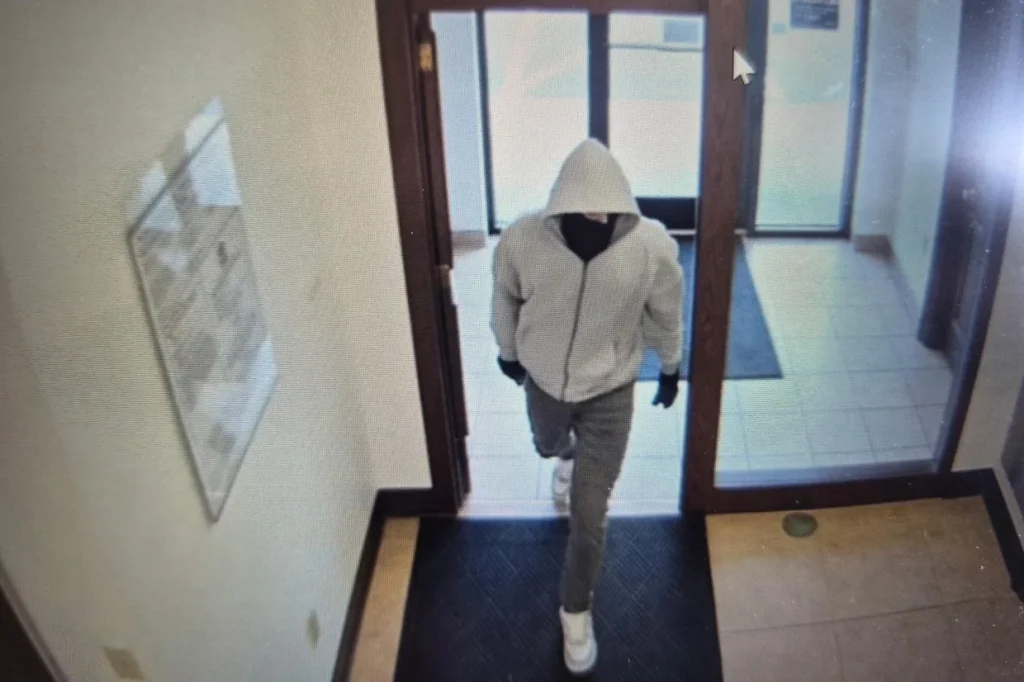
According to an FBI affidavit filed in federal court Friday, Weaver entered a U.S. Bank branch in Berea — a city of roughly 16,000 people situated about 36 miles south of Lexington — wearing a black mask and black gloves. He immediately shot and killed a male victim upon entering, then fatally shot a female bank teller. He proceeded to check multiple drawers before fleeing the building. Investigators have not confirmed whether he left with any money.
The names of the two victims were not immediately released. U.S. Bank expressed grief in a statement, saying it was “deeply saddened by the tragic event that took the lives of two of our employees” and pledged to support the victims’ families and colleagues while cooperating fully with law enforcement.
A Digital Trail and a Nightlong Pursuit
The investigation moved quickly. Surveillance footage captured a silver BMW sedan in connection with the robbery, and agents matched the vehicle to a Facebook listing posted by Weaver, the affidavit said. Investigators also cross-referenced clothing worn by the suspect in bank surveillance footage against photographs of Weaver on his social media accounts, establishing a link that tightened as the hours passed.
Then Weaver appeared to hand investigators another thread. At approximately 8 p.m. Thursday — roughly six hours after the shooting — he posted an image to social media depicting an alien holding a large quantity of cash, according to court documents. Whether the post was a taunt, a lapse in judgment, or simply the behavior of an 18-year-old who had not grasped the speed of the net closing around him, it contributed to the digital evidence trail that federal prosecutors now hold.
FBI agents located Weaver’s BMW on Interstate 75 in Somerset, Kentucky, that night. He refused to stop. The pursuit that followed pushed speeds above 100 mph on the interstate before Weaver exited toward Lexington, where the chase accelerated further — exceeding 130 mph, according to the affidavit — before he lost control and crashed the vehicle. A firearm was recovered from the car. Weaver fled on foot into the darkness but was apprehended at approximately 3 a.m. Friday.
The search had drawn extraordinary resources. The FBI, the Bureau of Alcohol Tobacco Firearms and Explosives, the Lexington Police Department, Kentucky State Police, and multiple county sheriff’s offices all participated. Law enforcement personnel went door to door canvassing for surveillance footage and witness accounts. Helicopters, drones, and tracking dogs were deployed across the search corridor. Nearby schools were placed on lockdown Thursday as the suspect remained at large, with students barred from boarding buses and required to be retrieved by their parents.

Federal and State Accountability
Acting U.S. Attorney General Todd Blanche framed the case in unambiguous terms. “As alleged, this deplorable act of violence in broad daylight has left two families in Kentucky with unthinkable loss,” Blanche said in a statement. “Our hearts go out to them.”
Olivia Olson, special agent in charge of the FBI’s Louisville field office, addressed the community directly at a Friday news conference. “While there is no longer imminent danger, we understand that the tragedy is far from over for the community,” Olson said. “The only solace that we can offer is that this individual, who valued a stolen dollar more than two human lives, will be held accountable to the fullest extent of the law.”
Kentucky Attorney General Coleman struck a similar tone, framing the dual prosecution track as a commitment to the victims’ families. “The Kentucky Attorney General’s Office is working collaboratively with federal authorities, and we will pursue state murder charges following the shootings in Berea,” Coleman said. “For the families of the two Kentuckians killed, we will do everything possible to deliver justice.”
Kentucky State Police Trooper Scottie Pennington, speaking at a news briefing, captured the grief felt across a community where the victims were known neighbors. “This is a terrible day for Berea,” Pennington said. “They’re our people that work in our community, and they’re no longer with us.”
Jason Parman, first assistant U.S. attorney for the eastern district of Kentucky, noted in his 18 years as a federal prosecutor he could not recall a death resulting from a bank robbery in the region — underscoring how rare and severe Thursday’s violence was even by the standards of a crime category that already carries severe federal penalties.
A Vanishing Crime That Turned Lethal
The Berea killings land against a backdrop of steadily declining bank robbery in America — a trend that makes the lethality of Thursday’s incident all the more jarring. FBI Bank Crime Statistics data shows the number of bank robberies nationally fell from 5,546 in 2010 to 1,263 in 2023, a drop of 77 percent over 13 years. No deaths were recorded in connection with bank robberies in either 2022 or 2023, the most recent years for which complete data is available.
Tom Myers, a crime historian and retired FBI agent, attributed the decline to a combination of strategic calculation by experienced criminals and the rapid evolution of bank security technology. Armed robbery of a federally insured institution carries severe mandatory federal sentencing exposure, and the proliferation of miniaturized GPS tracking devices embedded in cash bundles has made it increasingly difficult for a robber to benefit from whatever they manage to take before law enforcement closes in.
“The juice ain’t worth the squeeze,” Myers said. “There’s so many other things to do that are profitable — you can go to a big box store and walk out with the same amount in some places, and only face state charges if you’re caught.”
The calculus Myers described appears not to have reached Weaver, or to have been dismissed by him. The U.S. Bank branch he targeted sits roughly a mile from Berea College, an institution whose campus dates to the 1850s and whose presence has long shaped the character of the surrounding community. The quiet, small-city setting made the violence feel, to those who witnessed its aftermath, all the more incomprehensible.
When Lethality Defies the Statistics
The Berea shooting forces a reconsideration of assumptions embedded in the declining bank robbery data. A falling crime rate creates a temptation to treat the remaining incidents as similarly diminished in severity — a mistake that Thursday’s events illustrate with brutal clarity. The 77 percent decline in bank robberies over 13 years has not eliminated the crime; it has concentrated it among a smaller pool of offenders whose profiles, motivations, and willingness to resort to lethal violence may differ substantially from the prior generation of bank criminals that the deterrence statistics were built around.
Weaver’s alleged conduct — entering a bank in daylight, killing two people before checking the drawers, posting on social media hours later, and leading police on a triple-digit chase — does not fit the behavioral pattern of a calculated criminal operating from professional experience. It suggests instead an actor whose risk assessment was either severely distorted or absent entirely, a profile that existing deterrence frameworks, however effective at reducing aggregate crime rates, may be poorly equipped to intercept.
For Berea, none of that analytical context softens the immediate reality: two people who drove to work Thursday morning did not come home. The federal prosecution and the parallel state murder case that Kentucky’s attorney general has promised represent the legal system’s answer to that fact. Whether they constitute justice, for families who lost someone to a crime that should statistically have not resulted in any deaths at all, is a question that courtrooms can adjudicate but cannot fully resolve.
ABC/AP/CBS/Foxnews





