

A U.S. military strike killed two people on a boat in the Caribbean Sea on Monday, the latest in a sustained campaign of attacks on vessels the Trump administration labels drug-trafficking operations — a campaign that has now taken at least 188 lives since it began in early September, with the military yet to produce evidence that any of the targeted boats were actually carrying drugs.
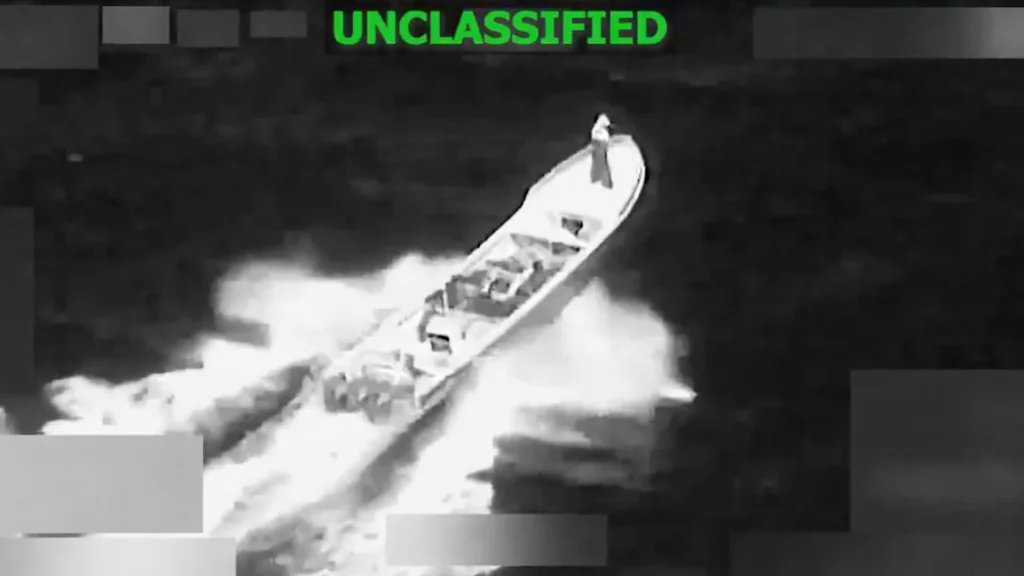
U.S. Southern Command announced the strike and posted a video on X showing a vessel moving across open water before a massive explosion consumed it in flames. The command repeated its standard justification, saying it had targeted alleged drug traffickers operating along known smuggling routes.
No further details were provided about who was on the boat, what evidence existed that drugs were aboard, or whether any survivors were recovered.
A Campaign That Has Not Slowed
The boat strikes began as the United States assembled its largest military footprint in Latin America and the Caribbean in a generation. They have continued without interruption — and in recent weeks have actually intensified — despite the simultaneous demands of the Iran war pulling on American military resources and attention across the globe.
President Donald Trump has characterized the campaign as an armed conflict with cartels across the Western Hemisphere, framing the strikes as a necessary response to the flow of narcotics into the United States and the American overdose deaths that follow. He has called the targets “narcoterrorists” and placed the operations within his administration’s broader posture of military assertiveness in the region.
The strikes have taken place in both the Caribbean Sea and the eastern Pacific Ocean. At least 188 people have been killed across all the attacks combined. The military has presented no evidence in any individual case that the destroyed vessels were carrying drugs at the time they were hit.
The campaign unfolded in the months leading up to January’s raid that captured then-Venezuelan President Nicolás Maduro. American forces seized Maduro and brought him to New York to face federal drug trafficking charges. He has pleaded not guilty.
The Legal Question Nobody Has Answered
Legal scholars and members of Congress have raised sustained challenges to the strikes’ legitimacy under both U.S. and international law. The core problem is straightforward: the United States is not formally at war with any of the countries in whose waters these strikes are taking place. Blowing up a boat and killing the people on it, without a declaration of war, without arrest, without trial, and without publicly available evidence of wrongdoing, sits in deeply contested legal territory.
The Trump administration has not resolved that tension. It has instead asserted the authority to act and continued acting, posting videos of explosions on social media while declining to address the legal framework in any detail.
Congress has received no formal war powers notification covering these operations. The administration’s position appears to rest on the president’s commander-in-chief authority combined with the designation of cartels as terrorist organizations — a designation that, critics argue, does not by itself authorize the killing of people on boats in sovereign or international waters without due process.
Accountability in an Evidence-Free Campaign
The number 188 deserves to sit with readers for a moment. That is how many people the U.S. military has killed in these strikes since September. Not arrested. Not indicted. Not tried. Killed — in explosions, on boats, in waters far from any American court.
The administration says they were drug traffickers. It has shown videos of boats burning. It has not shown drugs. It has not identified victims by name. It has not explained what intelligence justified each individual strike, what legal authority permitted it, or what review process — if any — preceded the decision to fire.
In any conventional law enforcement context, killing 188 people without charges, evidence, or trial would produce immediate institutional reckoning. In the framing of armed conflict that Trump has applied to cartel operations, those questions get pushed to the margins — which may be precisely the point of that framing.
The strikes are popular with a segment of the American public that wants aggressive action on drug trafficking. They are cheap to execute relative to other military operations. They generate shareable content. And they impose no immediate political cost on an administration that has shown little interest in the legal challenges its critics raise.
What they have not done is demonstrably reduce the flow of drugs into the United States. Cocaine and fentanyl do not move exclusively by boat. Trafficking networks reroute. The people on the boats — whoever they actually were — are replaceable within the organizations that send them. The 188 people killed since September are not coming back.
Whether that exchange — lives taken, no evidence presented, trafficking networks intact — constitutes an effective counter-narcotics strategy or a legally dubious use of military force against people who may or may not have been doing what the government claims, is a question the administration has so far declined to answer in any forum where it could be seriously tested.
The Associated Press





