

NASHVILLE, Tenn. — Tennessee Republicans tore apart the state’s only majority-Black congressional district Thursday, pushing through a new map that splits Memphis across three separate Republican-leaning districts and sets up the likely end of a Democratic congressional seat that has existed for nearly two decades — all within days of a Supreme Court ruling that stripped away the federal protections that had kept such moves in check.
Governor Bill Lee signed the map into law the same day. The Tennessee NAACP filed a lawsuit hours later.
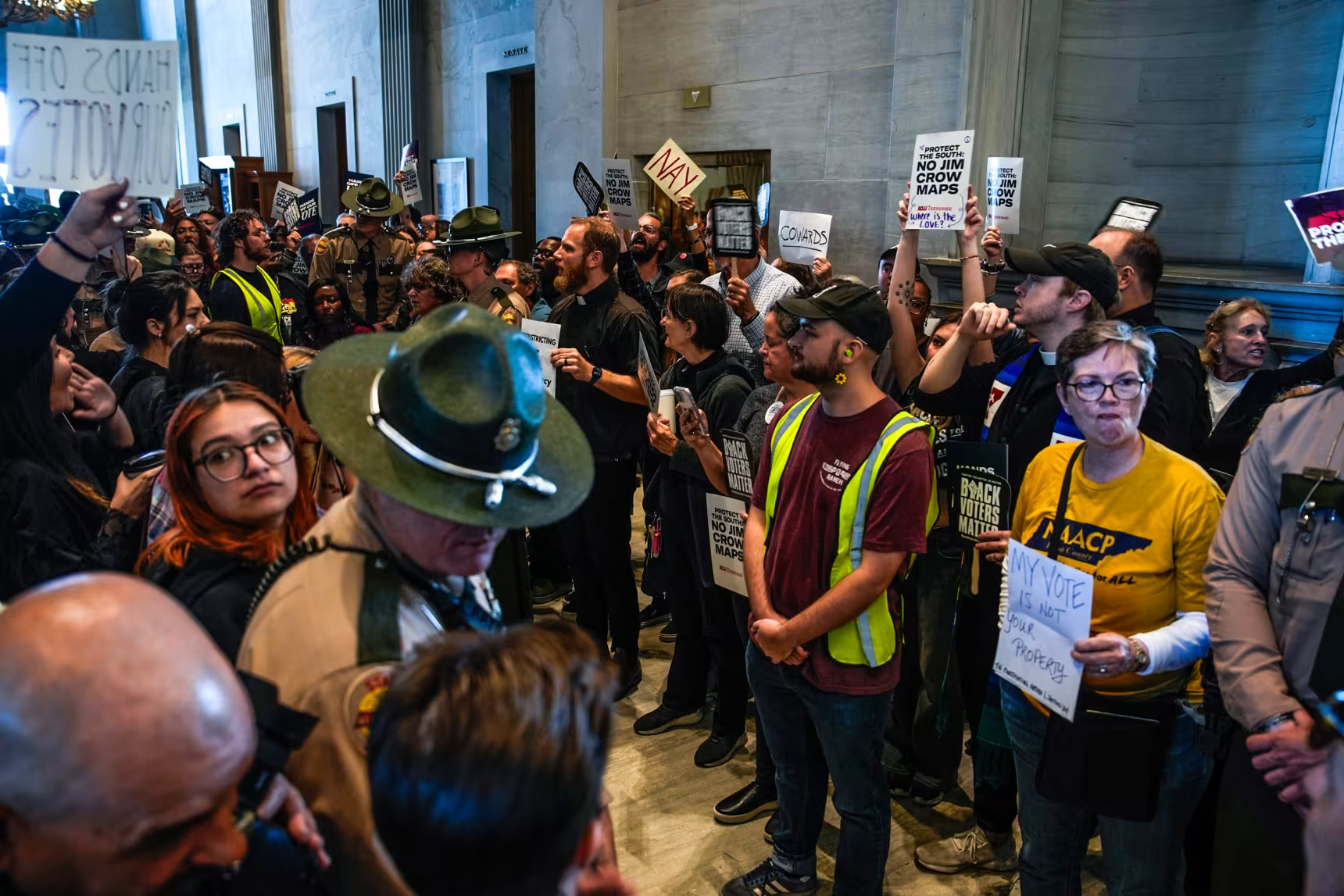
The vote did not happen quietly. Protesters packed the gallery and filled the hallways of the state capitol, chanting “no new maps” and “we the people” and sounding air horns loud enough to disrupt floor proceedings. Republican House Speaker Cameron Sexton had protesters removed from the balcony repeatedly as the vote moved forward. Black lawmakers stood at the front of the House chamber linking arms in prayer as the final tally was called.
In the Senate, Democratic state Sen. Charlane Oliver climbed on top of her desk and unfurled a bedsheet that read “No Jim Crow 2.0” and “Stop the TN Steal.” Other Democrats turned their backs on the chamber dais. Protesters chanting outside the Senate doors could be heard inside throughout the debate.
The map passed anyway.
What the Map Does
The new district lines carve up the Memphis-based seat held by Democratic Rep. Steve Cohen, who has represented the city since 2007, spreading his constituents into three districts that stretch hundreds of miles east into rural Republican Tennessee. The plan also further divides the Nashville metropolitan area — the state’s other Democratic stronghold — into five separate districts.
The result is a congressional map that positions Republicans to win all nine of Tennessee’s U.S. House seats in November’s midterm elections. Republicans already control eight of the nine. Cohen’s district is the last Democratic seat in the state.
Memphis is a majority-Black city. Shelby County, which contains Memphis, is now divided three ways under the new lines. The city’s history in the American civil rights movement made the symbolism of the vote land with particular force for those who opposed it.
What Lawmakers Said
Republican state Sen. John Stevens, who sponsored the redistricting bill, kept his justification simple. “Tennessee is a conservative state,” Stevens said. “Its congressional delegation should reflect that.”
Stevens said the maps were drawn using census data to elect more Republicans. Democrats noted the census does not include partisan registration data, raising questions about how partisan outcomes could be the stated goal of a process that relied on demographic information.
Republican state Rep. Jason Zachary was more direct about what the party stood to gain. “This gives us a unique opportunity for the first time in history to have an all-Republican delegation sent from Tennessee to Washington, D.C., to represent conservative values,” Zachary said.
No Republican spoke in defense of the map on the House floor. When one member rose to speak, the noise from protesters in the gallery became so loud the speaker called the vote while Democratic members stood and walked out.
Democratic lawmakers did not hold back. State Rep. Justin Jones, a Black Democrat, drew a straight line from the new map to the segregation-era laws the civil rights movement was built to dismantle.
“It is a form of Jim Crow terror,” Jones said. “You know what you’re doing. It’s shameful.”
Democratic Rep. Gloria Johnson of Knoxville was equally blunt. “This is not a special session,” she said from the floor. “This is a white-power rally and a white-power grab. Vote yes — you’re telling everyone you’re racist.”
State Sen. Raumesh Akbari, the Memphis Democrat who leads the Senate Democratic caucus, addressed her colleagues directly as the vote approached.
“When you had an opportunity to do right, did you beat people back on Edmund Pettus Bridge?” Akbari said. “When you had an opportunity to do right, did you vote to make sure that those Black folks in Memphis who believe in this state, who pay their taxes, who work just like everyone else, have a right to be politically represented by folks who share their interest and who advocate for them on a federal level?”
The Supreme Court Decision That Started It
Tennessee moved this fast because a door that had been legally closed swung open last week. The U.S. Supreme Court issued a 6-3 ruling finding that Louisiana had improperly relied on race when drawing a second majority-Black congressional district to comply with the Voting Rights Act. The decision effectively dismantled the Act’s core protection for minority voters in redistricting — the legal shield that had blocked moves like Thursday’s Tennessee vote for decades.
President Donald Trump pushed Republican-led states to take advantage of the ruling immediately. Tennessee was the first to act, but it is unlikely to be the last.
Louisiana has suspended its May 16 U.S. House primary — even though tens of thousands of voters had already cast early ballots — to give Republican lawmakers time to draw a new map eliminating a majority-Black district. In South Carolina, Republicans are moving legislation to erase the majority-Black district held by Democratic Rep. Jim Clyburn, a civil rights activist serving his 17th term in Congress. Alabama has asked the Supreme Court to reverse a court order that created a second majority-Black district in 2023 and allow the state to revert to a single majority-Black seat. Alabama Republicans also advanced a bill this week to postpone the state’s May 19 primary if the court rules in their favor.
Taken together, the three states — Louisiana, South Carolina, and Alabama — hold five majority-minority congressional districts currently represented by Democrats. All five are now in play.
The Tennessee branch of the NAACP filed suit Thursday against Governor Lee and the state legislature seeking to block the new map, alleging the redistricting violated state law and the Tennessee constitution. The legal challenge sets up a fight that could reach federal courts as the November midterms approach and the new district lines are already in effect for candidate filing.
Thursday’s vote is the latest move in a mid-decade redistricting war that has reshaped the national congressional map at a pace and intensity rarely seen outside of the once-a-decade post-census cycle. It began last year when Trump pressed Texas Republicans to abandon their existing map and redraw lines targeting five Democratic incumbents. Other states in both parties followed.
Republicans have built a net advantage of roughly four House seats across nine states from the ongoing cycle, with Louisiana, South Carolina, and Alabama still in motion. Litigation in Virginia, Florida, and Missouri could shift the numbers further in either direction. Republican gains across all pending states could reach as many as 14 seats. Democrats are pursuing their own redistricting opportunities in states they control and could pick up as many as 10.
Tennessee will become the ninth state to enact a new congressional map ahead of the midterms. States where filing deadlines have already passed are now looking at the 2028 cycle for further map changes.
The Supreme Court ruling that enabled Thursday’s vote did something the civil rights movement spent decades fighting to prevent. The Voting Rights Act of 1965 was written specifically to stop states from using the mechanics of democracy — district lines, voting rules, registration requirements — to dilute Black political power. For 60 years, that law provided legal grounds to challenge exactly the kind of map Tennessee approved Thursday.
That legal architecture is now severely weakened. What Republicans in Tennessee, Louisiana, Alabama, and South Carolina are doing is not a surprise — it was the predictable and immediate consequence of a ruling that told them the federal law protecting minority voting power no longer applied in the same way. The question the ruling left unanswered is what replaces it.
State constitutions, like the one the NAACP cited in its Tennessee lawsuit, offer one avenue. Federal litigation under remaining Voting Rights Act provisions offers another. But both paths are slower than the redistricting process, and maps that are in place when November arrives will determine who wins the seats regardless of what courts eventually decide.
The deeper issue is what the dissolution of majority-minority districts means for the communities they were designed to represent. Memphis is a majority-Black city. Its voters are now spread across three districts stretching into rural Republican Tennessee. Their collective political voice, which once had the weight to elect a representative of their choosing, has been diluted into three districts where they are a minority in each.
That is the point. Republican lawmakers said so openly. The only question is whether the legal system moves fast enough to do anything about it before the ballots are counted.
NBC/AP/Reuters





