

Donald Trump shot down Iran’s counteroffer to end their 10-week war on Sunday with four words on social media — “TOTALLY UNACCEPTABLE!” — sending oil prices climbing nearly 3 percent Monday and leaving the Strait of Hormuz locked shut, global shipping paralyzed, and the Persian Gulf on edge as drones struck ships and entered the airspace of three American-allied Gulf states within hours of the diplomatic breakdown.
Iran had delivered its response to the latest U.S. peace proposal through Pakistani mediators. Tehran’s terms, as broadcast on Iranian state television and confirmed by the semiofficial Tasnim news agency, amounted to a comprehensive reordering of the conflict’s terms in Iran’s favor: war reparations from the United States, full Iranian sovereignty over the Strait of Hormuz, an end to all sanctions, release of frozen Iranian assets held in foreign banks, termination of the U.S. naval blockade, and a guarantee of no further American military strikes. Tehran also demanded that any deal address the fighting in Lebanon, where U.S. ally Israel continues battling the Iran-backed militant group Hezbollah.
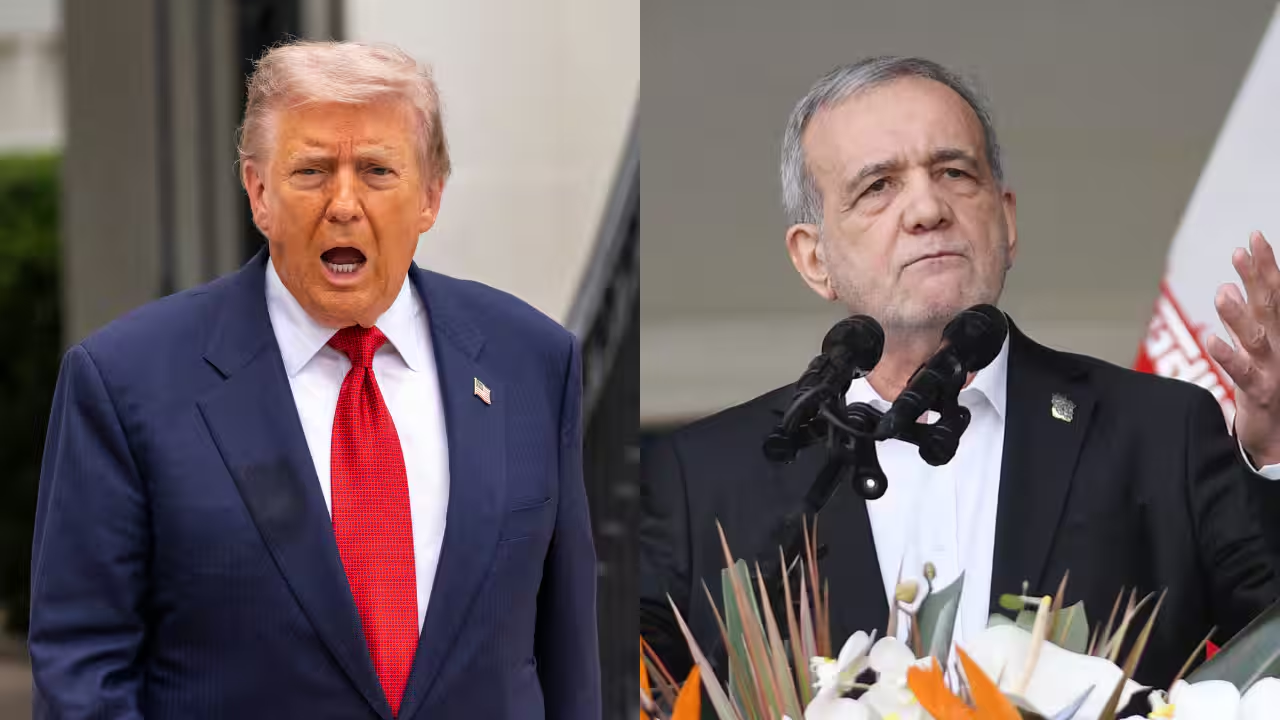
Iranian state television characterized the U.S. proposal that preceded it as tantamount to surrender. Iranian President Masoud Pezeshkian posted on social media that Iran would “never bow down to the enemy” and would “defend national interests with strength.”
Trump’s reply offered no specifics — just the rejection and a warning. In an earlier post, he accused Tehran of “playing games” with the United States for nearly 50 years and added: “They will be laughing no longer.”
After Trump’s dismissal, Iran’s Foreign Ministry spokesperson Esmaeil Baghaei defended Tehran’s position Monday without backing away from it. “Our demand is legitimate: demanding an end to the war, lifting the blockade and piracy, and releasing Iranian assets that have been unjustly frozen,” Baghaei said. “Safe passage through the Strait of Hormuz and establishing security in the region and Lebanon were other demands of Iran, which are considered a generous and responsible offer for regional security.”
Trump’s own assessment of where things stood was blunt and contradictory. “They are defeated,” he said in remarks aired Sunday, “but that doesn’t mean they’re done.”
Drones Over the Gulf
The diplomatic collapse was accompanied by fresh military pressure across the Gulf. The UAE said it intercepted two drones it attributed to Iran. Qatar condemned a drone strike that hit a cargo ship en route from Abu Dhabi in Qatari waters, igniting a small fire aboard the vessel. Kuwait’s defense forces said they responded to hostile drones that entered Kuwaiti airspace, though Brigadier General Saud Abdulaziz Al Otaibi declined to identify their origin.
No casualties were reported in any of the three incidents. No group immediately claimed responsibility, though Iran and its allied militant networks have launched hundreds of drone attacks since the war began Feb. 28 with U.S. and Israeli strikes on Iran.
Qatar’s Foreign Ministry called the ship attack a “dangerous and unacceptable escalation that threatens the security and safety of maritime trade routes and vital supplies in the region.” The United Kingdom Maritime Trade Operations Center confirmed the ship incident without disclosing the vessel’s owner or flag.
Iran’s Revolutionary Guard navy issued a standing warning that any attack on Iranian oil tankers or commercial vessels would be met with a “heavy assault” on U.S. bases in the region and enemy ships. On Friday, U.S. forces struck two Iranian oil tankers it said were attempting to breach the American naval blockade of Iranian ports — a blockade that has been in effect since April 13 and that Washington says has turned back 61 commercial vessels and disabled four.
The Nuclear Question
Beneath the exchange of rejected proposals and drone attacks lies the issue that may ultimately determine whether any deal is possible at all: Iran’s stockpile of highly enriched uranium.
The U.N. nuclear agency has confirmed Iran holds more than 440 kilograms of uranium enriched to 60 percent purity — a short technical step from weapons-grade material. The International Atomic Energy Agency director-general told the Associated Press last month that the majority of that stockpile is likely located at Iran’s Isfahan nuclear complex, a facility that was struck by U.S.-Israeli airstrikes during a 12-day war last year and faced less intensive attacks this year.
Israeli Prime Minister Benjamin Netanyahu was explicit on CBS News’ “60 Minutes” Sunday: the war is not finished because the enriched uranium has not been removed from Iran. “Trump has said to me, ‘I want to go in there,'” Netanyahu said. “And I think it can be done physically.”
Netanyahu simultaneously said the best path was diplomatic but did not rule out a physical operation to seize or destroy the stockpile.
Russian President Vladimir Putin added Moscow’s position to the mix Saturday, saying Russia’s offer to take Iran’s enriched uranium and hold it as part of a negotiated settlement remained available. That proposal, which would theoretically resolve Trump’s core demand without requiring Iran to surrender its nuclear infrastructure to Washington or Jerusalem, has not gained visible traction in the current diplomatic framework.
An Iranian military spokesperson told the state news agency IRNA that Iranian forces were on “full readiness” to protect sites where uranium is stored, warning against any infiltration or helicopter-borne operation to seize the material.
Iran’s new Supreme Leader Mojtaba Khamenei, who has not appeared publicly since being wounded in the war’s opening strikes, issued what state television described as new and decisive directives for the continuation of military operations and confrontation with Iran’s enemies, delivered during a meeting with the head of the joint military command.
Netanyahu also used the CBS interview to push back against New York Times reporting that he sold Trump on launching the Iran war by promising it would bring about regime change in Tehran. “We both agreed that there was both uncertainty and risk involved,” Netanyahu said. He acknowledged that the problem of the strait “was understood as the fighting went on” — a concession that the waterway’s closure was not fully anticipated when the strikes began.
Netanyahu added that he wants to reduce U.S. military aid to Israel — currently running at $3.8 billion annually — to zero over the next decade, a statement that landed against a backdrop of declining American public support for Israel following the Gaza war’s civilian death toll.
A Trickle Through the Strait
The Strait of Hormuz, which carried one-fifth of the world’s oil and liquefied natural gas before the war began, has been reduced to a trickle. Shipping data from Kpler and LSEG showed three crude-laden tankers exited the waterway last week, traveling with their tracking systems switched off to avoid Iranian detection and attack.
South Korea confirmed initial findings from its investigation into last week’s incident involving the South Korean-operated vessel HMM NAMU, which suffered an explosion and fire while anchored in the strait. Two unidentified objects struck the vessel approximately one minute apart. South Korean officials said they had not yet determined responsibility.
A brief U.S. attempt to guide commercial ships through the strait under naval escort — the operation Trump called “Project Freedom” — was quickly suspended after limited results and continued Iranian resistance.
The deadlock has pushed oil prices upward and is generating domestic political pain for Trump. Surveys show the Iran war is unpopular with American voters facing sharply higher gasoline prices, with nationwide congressional elections less than six months away. Republicans’ narrow House majority will be at stake in those elections, creating a time pressure on Trump that Iran’s negotiators are not blind to.
Beijing as the Next Pressure Point
Trump is expected to arrive in Beijing Wednesday, where Iran is among the subjects on the agenda for talks with Chinese President Xi Jinping. Trump has been pressing China to use its leverage over Tehran to push the Iranians toward a deal. China is Iran’s largest oil customer and one of the few major economies that has maintained economic ties with Tehran throughout the war.
Iran’s Foreign Ministry signaled Monday that Beijing should use Trump’s visit to push back against Washington rather than pressure Tehran. Baghaei said China’s leaders “know very well how to use these opportunities to warn about the consequences of the U.S.’ illegal and bullying actions on regional peace and security as well as on economic stability and international security.”
Whether Beijing plays the role Trump wants or the role Tehran is asking for will shape the next phase of a conflict that has so far resisted every diplomatic off-ramp attempted.
U.S. Ambassador to the United Nations Mike Waltz told ABC that Trump was giving diplomacy “every chance we possibly can before going back to hostilities.” The phrase “going back to hostilities” was not accidental — it was a reminder, delivered publicly, that the military option has not been taken off the table.
The Gap That Keeps the War Going
The exchange of rejected proposals on Sunday revealed a negotiating gap that is not primarily tactical — it is structural. The U.S. wants to end the war, reopen the strait, and dismantle Iran’s nuclear program in a single integrated agreement. Iran wants to end the war first and discuss everything else afterward, while retaining sovereignty over the strait and keeping its nuclear infrastructure intact.
Those positions are not the product of miscommunication. They reflect genuinely incompatible assessments of what the war has decided. Washington believes Iran was sufficiently damaged by strikes on its military and nuclear facilities that it should accept terms reflecting that damage. Tehran believes it has demonstrated enough resilience — by keeping the strait closed, by sustaining drone campaigns against Gulf Arab states, by absorbing strikes and continuing to threaten U.S. assets — that it can negotiate from a position of at least partial strength.
Both assessments contain some truth, which is exactly what makes the gap so hard to close. Netanyahu’s admission that the strait problem “was understood as the fighting went on” hints at a core miscalculation in the war’s original planning: that Iran would fold faster than it has.
Trump’s Beijing trip offers perhaps the clearest remaining diplomatic lever. China has the economic relationship with Iran that could, if Beijing chose to use it, create pressure on Tehran to move. Whether Xi will apply that pressure — or use the meeting to push back against Washington’s Gulf posture as Iran’s foreign ministry hopes — may determine whether this war finds its off-ramp before the American midterm elections make continued conflict politically untenable for the administration that started it.
AP/Reuters





