

Health officials confirmed new infections Monday as the final phase of evacuations from a cruise ship hit by a deadly virus outbreak, Hantavirus, moved toward completion, with authorities emphasizing that the broader public faces limited risk.
A French passenger and an American traveler tested positive for hantavirus after being removed from the vessel MV Hondius, which has been anchored off Tenerife during a complex international response operation. Officials indicated that the French patient’s condition had worsened following her return home, while U.S. authorities described the American case as mild.
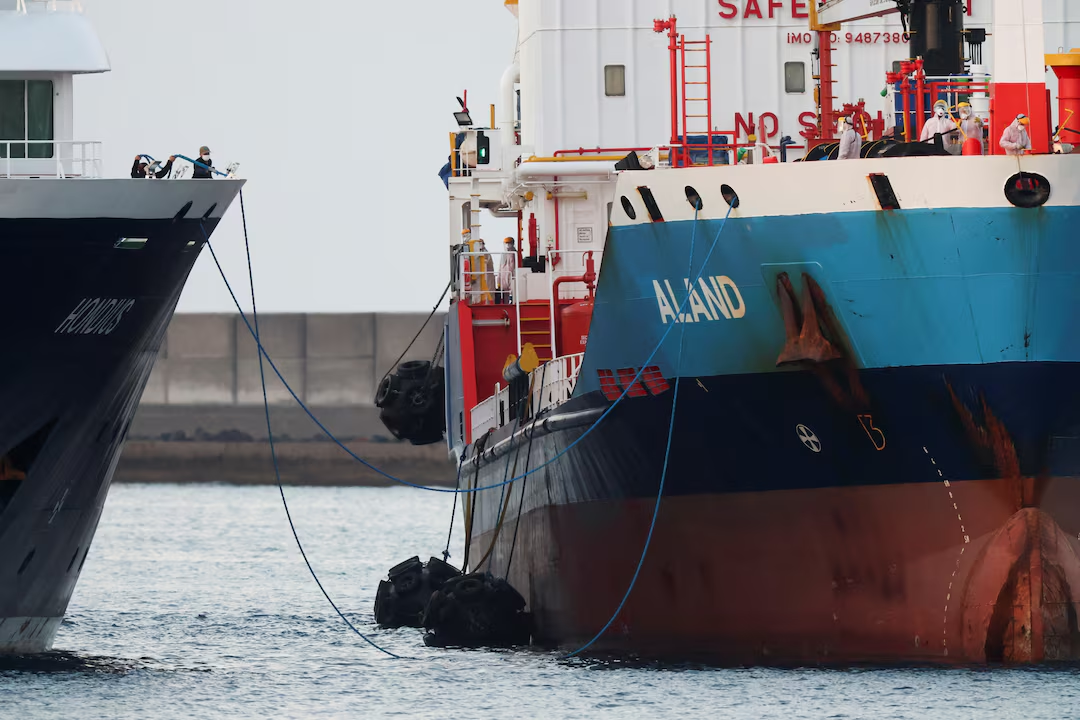
The ship, which had been carrying passengers and crew from more than 20 countries, is now nearing the end of a large-scale evacuation coordinated by World Health Organization and European authorities. Spanish officials said the remaining passengers were scheduled to disembark Monday, marking the final stage of a process that has seen dozens of people flown back to their home countries.
The outbreak has claimed three lives since the voyage began, including two passengers from the Netherlands and one from Germany. Health officials cautioned that some individuals exposed to the virus may still develop symptoms, raising the possibility that confirmed cases could increase.
French Health Minister Stephanie Rist said the infected passenger showed signs of deterioration after arriving in France. Meanwhile, the U.S. Department of Health and Human Services indicated that one of 17 Americans evacuated from the ship tested positive for the Andes strain of the virus, while another exhibited mild symptoms.
U.S. passengers were transported to the University of Nebraska Medical Center for evaluation and monitoring, with one individual placed in a specialized containment unit. Health officials said others would undergo observation to assess their level of exposure and risk of transmission.
The vessel had departed from southern Argentina in March and traveled through Antarctic waters before heading north. The outbreak came to light in early May after a passenger who had disembarked earlier required intensive care treatment in South Africa. By that time, at least one death had already occurred onboard.
Spanish Health Minister Mónica García said repatriation flights were arranged for passengers whose home countries had not deployed their own aircraft. One flight was set to carry travelers to the Netherlands, while another would transport passengers to Australia and other destinations.
Once all passengers have disembarked, the ship is expected to return to the Netherlands, where it will undergo a full disinfection process. A reduced crew will remain onboard for the journey, officials said.
Despite the severity of the outbreak onboard, global health authorities stressed that hantavirus poses a far lower transmission risk than the virus that caused the COVID-19 pandemic. The disease is typically spread through contact with infected rodents, though limited human-to-human transmission has been observed in rare cases involving the Andes strain.
Jay Bhattacharya, acting director of the Centers for Disease Control and Prevention, said the situation should not be compared to COVID-19, noting that the virus is less contagious and unlikely to spread widely among the general population.
The World Health Organization has recommended a monitoring period for all passengers, advising daily health checks either at home or in designated facilities. Several countries have already implemented quarantine or observation measures for returning travelers.
The Associated Press noted that this marks the first documented outbreak of hantavirus on a cruise ship, an unusual setting for a disease more commonly linked to rural or wilderness exposure.
The outbreak aboard the MV Hondius highlights the evolving challenges of managing infectious diseases in highly mobile and international environments. Cruise ships, by their nature, bring together passengers from diverse regions in close quarters, creating conditions that can complicate containment efforts when an outbreak occurs.
Although hantavirus is not typically associated with maritime settings, the presence of the Andes strain introduces a rare but important factor: the possibility of limited person-to-person transmission. This distinction likely prompted the rapid and coordinated response involving multiple governments and international health agencies.
The scale of the evacuation effort underscores how lessons from the COVID-19 pandemic continue to shape global health responses. Rapid identification, isolation and repatriation of affected individuals have become standard practice, even for diseases that pose a lower overall risk.
At the same time, the situation reveals the logistical complexity of managing outbreaks that involve multiple jurisdictions. Coordinating flights, quarantine measures and medical care across more than 20 countries requires significant planning and cooperation, particularly when passengers must be transported safely without increasing the risk of further spread.
The decision to anchor the vessel near Tenerife and carry out evacuations in stages reflects a cautious approach aimed at minimizing disruption while ensuring health protocols are followed. Such operations can strain local resources but also demonstrate the capacity for international collaboration in crisis situations.
Public messaging has played a critical role in this case. Officials have repeatedly emphasized that the virus is not easily transmissible and does not pose a widespread threat. This effort to provide reassurance is essential in preventing panic, especially in the wake of recent global health crises.
Looking ahead, the incident may lead to stricter health monitoring protocols for cruise operations, particularly for voyages that include remote or high-risk environments. Enhanced screening, improved onboard medical capabilities and clearer guidelines for handling suspected cases could become more common.
While the evacuation operation is nearing completion, the situation serves as a reminder that even rare diseases can present significant challenges when they emerge in global travel settings. The balance between vigilance and measured response will remain critical as health authorities continue to monitor the aftermath of the outbreak.
AP/Reuters





