

The Trump administration announced Monday it was creating a $1.7 billion taxpayer-funded compensation pool for people who claim they were wrongfully targeted by the Biden administration’s Justice Department, framing the arrangement as a settlement that would resolve President Donald Trump’s lawsuit against the Internal Revenue Service over the leak of his tax returns.
The fund, which the Justice Department named the Anti-Weaponization Fund, would be overseen by a five-member commission with authority to hand out more than a billion dollars with no legal obligation to publicly explain its decisions, identify recipients, or disclose its procedures. Trump would retain the power to remove commission members without cause. The money would be drawn from the Treasury Department’s Judgment Fund, a permanent federal appropriation used to pay court judgments and settlements.
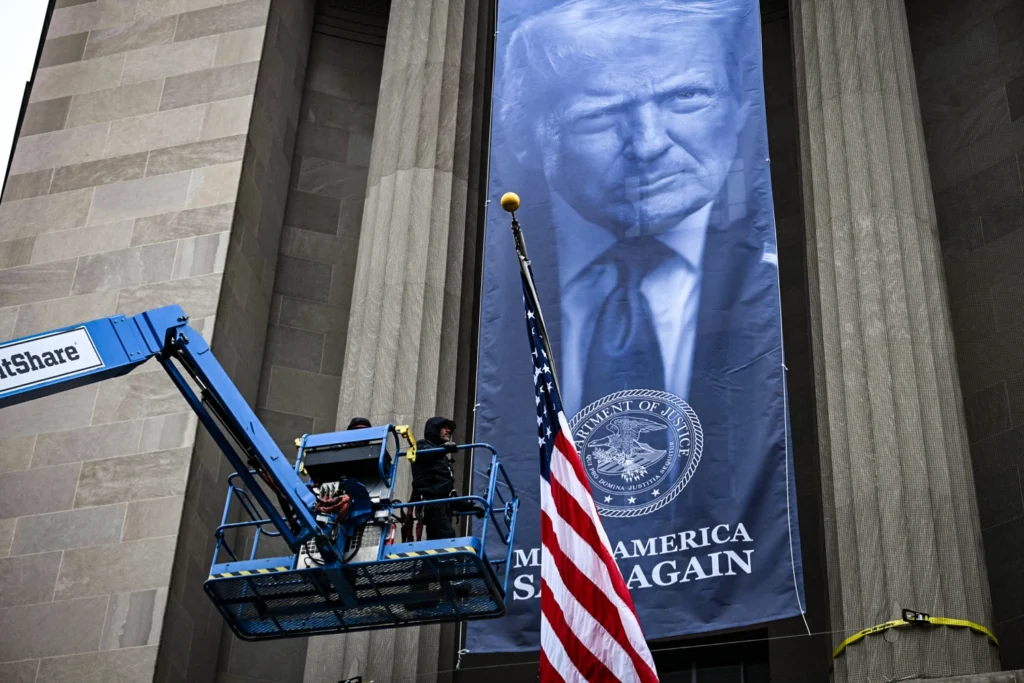
Acting Attorney General Todd Blanche announced the fund in a statement, calling it “a lawful process for victims of lawfare and weaponization to be heard and seek redress.”
Trump’s personal lawyers filed papers the same day in federal court in Florida moving to voluntarily dismiss the president’s $10 billion lawsuit against the IRS. The president, his sons Donald Trump Jr. and Eric Trump, and the Trump Organization had filed the suit in January, alleging the IRS failed to prevent a former contractor from leaking their confidential tax records.
The settlement is also expected to resolve approximately $230 million in legal claims Trump filed related to the 2022 search of his Mar-a-Lago estate and the Russia investigation he faced during his first term, according to sources familiar with the matter who spoke to ABC News. Under the settlement terms, Trump himself is expected to be barred from directly receiving payments related to those three legal claims. Entities associated with Trump are not explicitly prohibited from filing additional claims.
Who Could Get the Money
The potential pool of beneficiaries is broad. The nearly 1,600 individuals charged in connection with the January 6, 2021 attack on the U.S. Capitol could apply, as could anyone alleging they were harmed by what the administration characterizes as the Biden-era weaponization of federal law enforcement. Trump blanket-pardoned the January 6 defendants when he returned to office, and hundreds have since sought financial compensation from the government.
Trump has spoken warmly about that group for years. “They were patriots as far as I was concerned,” he told Newsmax last year. “I talk about them a lot. They were treated very unfairly.”
The fund would also potentially cover individuals caught up in the Trump-Russia investigation, people prosecuted alongside Trump’s aides during his first term, and others who can argue they were targets of politically motivated legal action. The commission’s majority-vote process for awarding money and the identities of those who receive it could be kept entirely private, ABC News confirmed through sources familiar with the arrangement.
The IRS Lawsuit and Its Origins
Trump’s underlying lawsuit grew from the leak of his and the Trump Organization’s tax records between 2018 and 2020. In 2024, former IRS contractor Charles Edward Littlejohn, who worked for the defense technology firm Booz Allen Hamilton, was sentenced to five years in federal prison after pleading guilty to leaking the records to two news organizations. Charging documents did not name the outlets, but the description and timeframe match stories published by the New York Times and ProPublica. The 2020 New York Times investigation found Trump paid $750 in federal income taxes the year he first entered the White House and paid nothing in some prior years, attributing the outcome to colossal reported business losses.
Trump alleged in his lawsuit that the leak caused reputational harm, financial damage, public embarrassment, and unfairly tarnished his business reputation. His sons were named as co-plaintiffs.
The case was heading toward a difficult moment in court. U.S. District Judge Kathleen Williams had questioned in a ruling last month whether Trump and the government defendants, the Treasury Department and IRS, were sufficiently in conflict with each other for the case to legally proceed, given that Trump as president controls both agencies. She had ordered the parties to explain by Wednesday why the case should continue. The voluntary dismissal makes that deadline moot.
Trump’s lawyers argued in the dismissal filing that the court had no need to weigh in because they were withdrawing the case themselves, and that the administration had never formally replied to the underlying suit.
Democrats and Watchdogs React
The backlash was immediate and fierce. Rep. Jamie Raskin, the top Democrat on the House Judiciary Committee, called the fund a racket.
“This case is nothing but a racket designed to take $1.7 billion of taxpayer dollars out of the Treasury and pour it into a huge slush fund for Trump at DOJ to hand out to his private militia of insurrectionists, rioters, and white supremacists, including those who brutally beat police officers on January 6, 2021, and sycophant accomplices to his election stealing schemes,” Raskin said in a statement.
Skye Perryman, president and CEO of Democracy Forward, an advocacy group that had filed a friend-of-the-court brief challenging the lawsuit, called the resolution a sham. “This case was always a sham, and another ploy by the President to access taxpayer funds to line his pockets,” Perryman said, pledging to continue fighting the settlement.
A group of 93 members of Congress filed a legal brief flagging their intent to challenge the arrangement. A coalition of outside legal experts had previously written to the court warning that the case presented significant constitutional concerns about whether a sitting president could sue a federal agency he controls for damages to his personal interests.
“This case is unprecedented: A sitting president seeks monetary damages for alleged harm to his personal interests from an executive agency that he controls,” the legal experts wrote, adding that the court should examine whether settlement discussions were conducted at arm’s length and free from risk of collusion.
Trump’s lawyers countered that the voluntary dismissal rendered those concerns irrelevant.
The Broader Retribution Campaign
The Anti-Weaponization Fund fits within a pattern that has defined the second Trump administration’s approach to the Justice Department from its first weeks. Trump pardoned or commuted the sentences of January 6 defendants on his first day back in office. His Justice Department has since approved payouts to individuals caught up in the Trump-Russia investigation and has opened investigations and brought criminal charges against people Trump considers political opponents.
The administration has run a so-called Weaponization Working Group within the Justice Department for the past year, examining what it describes as anti-conservative and anti-Christian bias in the federal law enforcement and intelligence communities during the Biden years. Former Biden administration officials have consistently denied those characterizations. Merrick Garland, who served as Biden’s attorney general, repeatedly said his decisions followed facts, evidence, and law, and noted that his department also investigated Biden over classified documents and prosecuted Biden’s son Hunter on tax and gun charges.
No charges have been brought through the Weaponization Working Group investigation and it remains unclear whether any will be.
Trump himself acknowledged the unusual optics of the arrangement in a conversation last year. “It’s interesting because I’m the one that makes a decision, right, and that decision would have to go across my desk,” he said in the Oval Office. “It’s awfully strange to make a decision where I’m paying myself.”
When asked in February how potential damages from the IRS lawsuit might be handled, he suggested the money could go to charity. “We could make it a substantial amount,” he said at the time. “Nobody would care because it’s going to go to numerous very good charities.” The compensation fund announced Monday does not direct the money to charities.
A Fund Without Precedent or Oversight
The Anti-Weaponization Fund is difficult to place within any established category of American legal or governmental practice. It shares surface features with victim compensation funds set up after disasters like the Deepwater Horizon oil spill, which paid provable claims through a structured administrative process with defined eligibility criteria. It has been compared to truth and reconciliation commissions that governments have used in the aftermath of apartheid in South Africa and the Canadian residential school system.
Neither comparison holds. The Deepwater Horizon fund paid people who could demonstrate measurable economic harm from an industrial disaster. The proposed commission would pay people who claim political persecution, under standards the commission itself defines, through a process it is not required to explain, to recipients it is not required to name. The president whose allies stand to benefit retains removal power over the people making those decisions.
The constitutional dimension that Judge Williams identified is not resolved by dismissing the case. It is embedded in the fund itself. A president directing taxpayer money through a commission he controls, to compensate people he has already characterized as patriots and victims, toward purposes his own administration defines, is an arrangement that exists outside any established framework of government accountability. Congress appropriated no money for this fund. No legislation authorized it. The Judgment Fund from which it would draw was created to pay adjudicated claims, not to pre-fund politically defined compensation pools at presidential direction.
Democrats have vowed to fight it. Watchdog groups have pledged legal challenges. Ninety-three members of Congress have filed briefs signaling opposition. Whether any of those challenges succeed, and through what mechanism, is the central legal question the announcement Monday opened rather than closed.
What is already clear is that the administration’s willingness to use the full machinery of the executive branch to reward political allies and settle personal grievances has reached a new threshold. The IRS lawsuit was always unusual. Resolving it with a $1.7 billion taxpayer-funded compensation commission that the president controls is something else entirely.





