

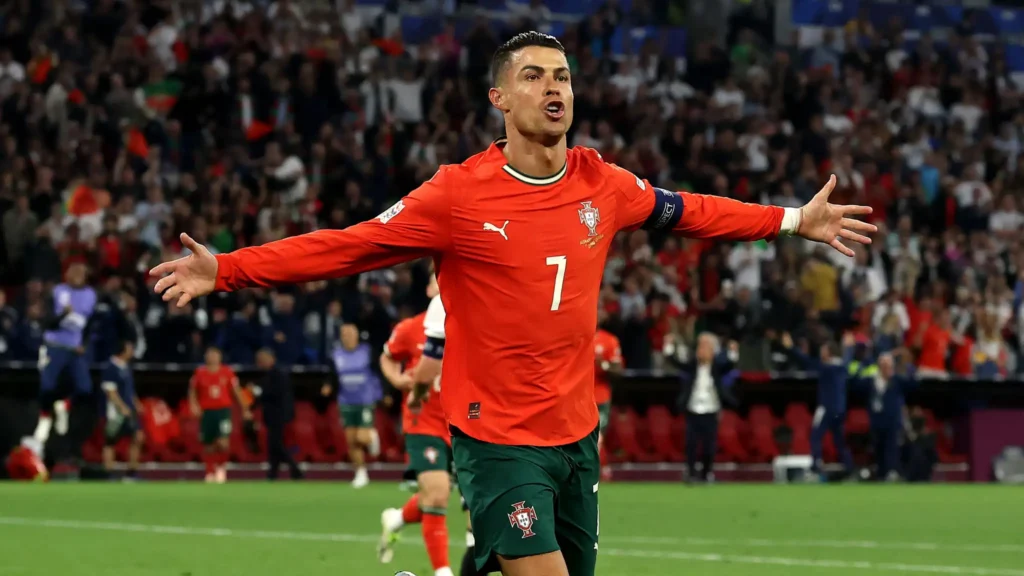
Cristiano Ronaldo will chase history one final time this summer after Portugal coach Roberto Martinez named the 41-year-old captain in his World Cup squad Tuesday, setting the stage for what Ronaldo himself has called his last shot at the only major trophy that has eluded him throughout the most decorated international career in men’s football.
The announcement carried something heavier than a roster list. Martinez included the late Diogo Jota as a permanent, unofficial member of the squad, describing the 28-year-old Liverpool forward who died in a car crash in Spain last July as “the plus one forever.”
“The final list includes 27 names plus one,” Martinez said at the press conference. “To lose Diogo Jota was an unforgettable moment and a very difficult moment. But the next day it was a responsibility for all of us to fight for Diogo Jota’s dream and for the example that he was in our national team. The spirit, the strength, the example of Diogo Jota, the plus one. He will be the plus one forever.”
Jota had been a regular fixture in Portugal’s national setup and was widely expected to be part of the 2026 World Cup campaign before his death. His presence in Martinez’s words, if not on the pitch, set the emotional tone for a squad announcement that balanced grief with genuine ambition.
Ronaldo’s Record Pursuit
The football world will be watching Ronaldo as closely as it watches Portugal when the tournament begins. If he appears in any match, he becomes the first man in history to play in six World Cup finals, joining Argentina’s Lionel Messi, who also has five appearances and is expected to be named in his own country’s squad for a tournament he will be attending as defending champion.
Ronaldo holds the all-time records for appearances and goals in men’s international football, 226 caps and 143 goals. He is already the only man to have scored in five consecutive World Cups. A goal in the United States this summer would give him six.
He told CNN in November that this tournament would “definitely” be his last World Cup. He is 41 years old, playing his club football for Al Nassr in Saudi Arabia after leaving Europe’s elite club competition, and has spoken publicly and privately about the significance of what Portugal is trying to accomplish.
Martinez defended Ronaldo’s inclusion on merit rather than sentiment. “When we talk about Cristiano Ronaldo, we talk about two players,” the coach said. “We talk about the icon of world soccer and we talk about the player, our captain, who has the same demands as the other players, the competitiveness to be in the national team. Our captain is an example. We want him to continue with the same level of responsibility and leadership inside the locker room.”
The Squad Martinez Built
The 27-player list, one beyond the maximum of 26 permitted for final tournament squads, includes a fourth goalkeeper in Ricardo Velho, who Martinez said would participate only in the event of injury to one of the three primary keepers. The coach said he personally contacted nearly every player he chose not to include, a notable omission being midfielder Joao Palhinha despite his strong club form, along with Mateus Fernandes.
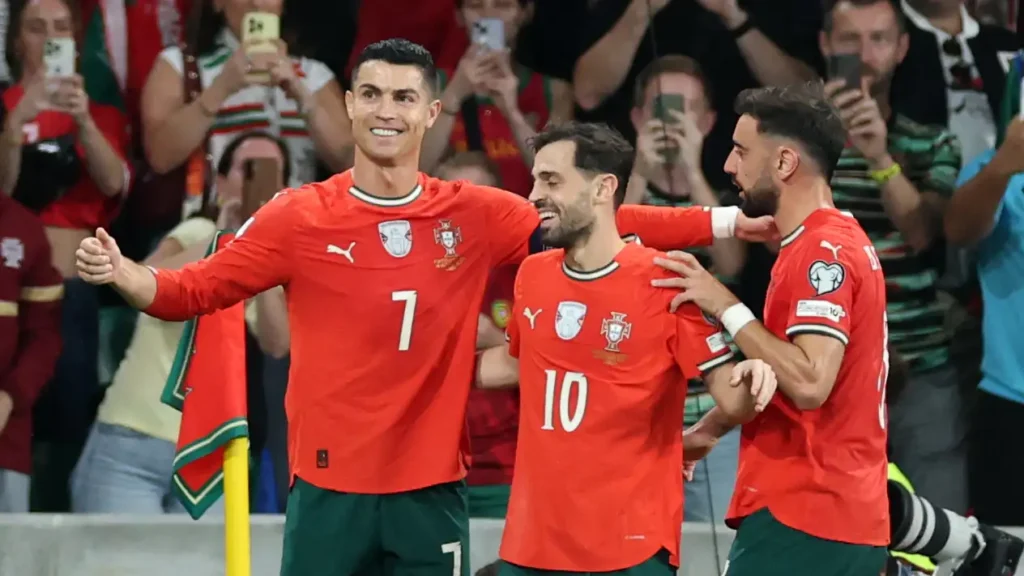
Ronaldo’s Al Nassr club teammate João Félix is also in the squad. The European club game is heavily represented through Bruno Fernandes of Manchester United, Bernardo Silva and Ruben Dias of Manchester City, and the Paris Saint-Germain contingent of Nuno Mendes, Vitinha, João Neves, and Gonçalo Ramos. Pedro Neto comes in from Chelsea. Francisco Conceição from Juventus and Rafael Leão from AC Milan complete the forward options.
Portugal opens its World Cup campaign against Congo on June 17 in Houston. The team is placed in Group K alongside Colombia, Uzbekistan, and Congo. Preparations begin June 1, with warmup matches against Chile on June 6 and Nigeria on June 10, before the squad travels to the United States on June 12.
Candidate, Not Favorite
Martinez was careful about where he positioned Portugal in the broader tournament conversation. The coach framed his team’s ambitions with a precision that avoided both false modesty and overconfidence. Portugal won the 2025 Nations League, defeating Germany in the semifinals and Spain in the final, arriving at the World Cup with genuine form and a strong generation of players across every position.
But Martinez drew a clear line between aspiration and expectation. “The World Cup is not about playing well, not about having talent,” he said. “There are many challenges. I think only a national team that has already won the World Cup can be a favorite. We welcome the pressure, it’s not a problem, but I think ‘candidate’ is probably a better word to describe the good moment that we’ve been going through.”
He added: “Considering the talent and the spirit of our group, we all can dream. We can dream, yes, and be a candidate, but not a favorite.”
The Weight of a Final Chance
The Portugal squad announcement contains two narratives running in parallel that rarely coexist in a single roster reveal.
The first is the story of Diogo Jota, a young man at the peak of his career, a consistent contributor to one of Europe’s most competitive national teams, killed before he could reach what should have been his moment. Martinez’s decision to frame the squad as 27 plus one is not a gimmick. It is a genuine acknowledgment that grief does not disappear because a tournament schedule demands focus and professional purpose. Every player in that squad will carry Jota’s name into the summer, which is both a burden and a form of motivation that cannot be manufactured.
The second is the story of Ronaldo himself. He is the greatest scorer in international football history, the holder of records that may stand for generations, and a player who has given Portugal everything across two decades of service except the one thing he and the country want most. He has never won a World Cup. He finished third in 2006, the tournament that first announced Portugal as a genuine force. He has been a leading figure in every campaign since, each one ending short of the final in circumstances that seemed always to place the dream just out of reach.
At 41, playing away from Europe’s elite stage, he is not the same physical force he was at 25 or 30. Martinez’s framing of Ronaldo as both an icon and a demanding professional suggests a coach who has thought carefully about how to manage the tension between what Ronaldo represents symbolically and what he contributes practically within a squad that does not need to be built around him to be competitive.
Portugal has enough quality in this generation, Fernandes, Bernardo Silva, Ruben Dias, Nuno Mendes, João Neves, to be a genuine contender regardless of what Ronaldo individually produces. The 2025 Nations League title was not won on reputation. It was won on collective quality and tactical organization. If that holds through the World Cup, Portugal has a legitimate path.
Whether Ronaldo scores, assists, or simply lifts the trophy on the bench having contributed less than in previous tournaments, the summer will carry meaning beyond tactics and results. He is chasing something that defines the conversation around his place in football history. And somewhere in that conversation, a 28-year-old from Liverpool who loved his country and never got his World Cup will be the plus one forever.
Goals.com/AP





