

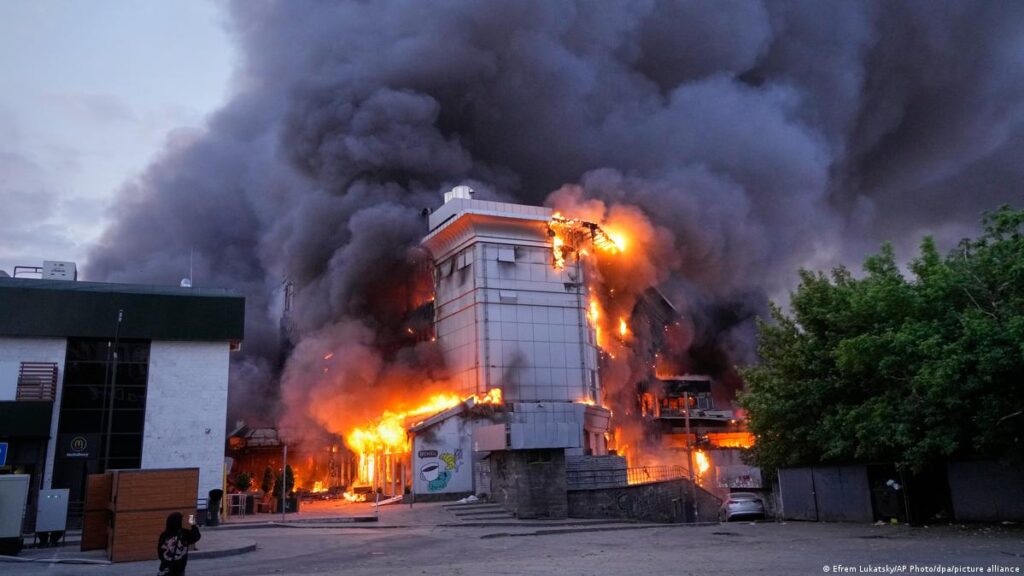
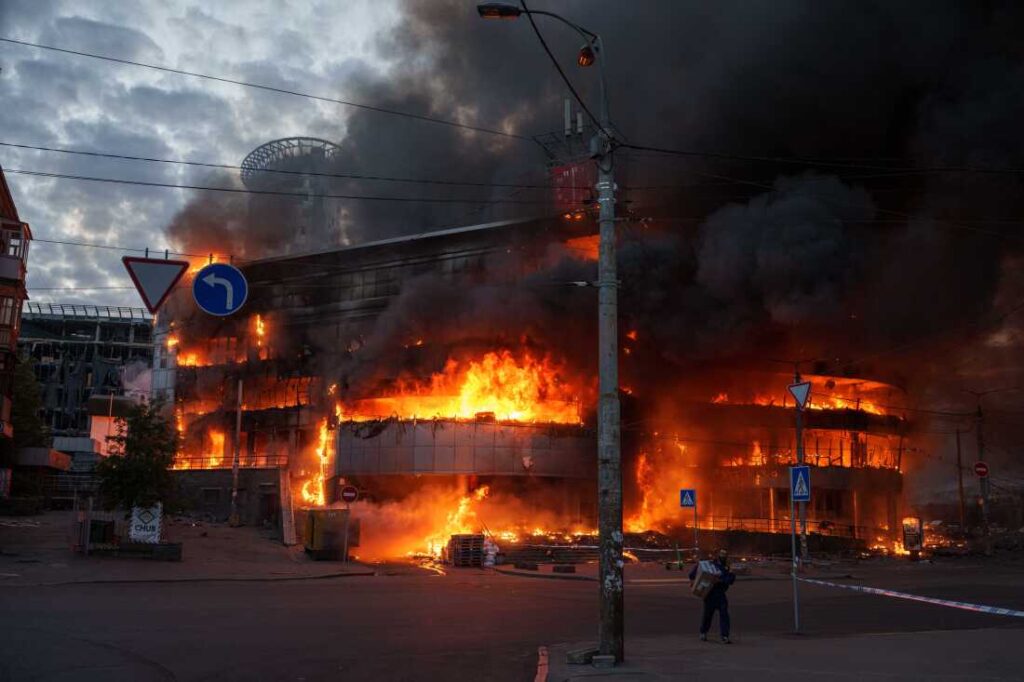
Russia launched one of the most devastating aerial assaults on Kyiv since the war began early Sunday, firing a nuclear-capable Oreshnik hypersonic missile alongside hundreds of drones and other ballistic weapons in an overnight bombardment that killed at least four people, wounded more than 80, damaged 50 locations across the capital, and drove residents into metro stations as explosions shook buildings from just after 1 a.m. until dawn revealed a city scarred by fire and collapsed walls.
It was only the third time Russia has deployed the Oreshnik in the war, and the first time it struck a target so close to the Ukrainian capital. The missile hit Bila Tserkva, a city of 200,000 people approximately 40 miles from Kyiv’s outskirts, Ukrainian President Volodymyr Zelensky confirmed in a Telegram post. Ukraine’s Air Force said Russia launched 90 missiles and 600 drones in total. Air defenses destroyed or jammed 549 drones and 55 missiles. Around 19 missiles failed to reach their targets. The ones that got through left their mark across the capital and surrounding region.
At least two people were killed and 69 wounded in Kyiv itself, Mayor Vitali Klitschko confirmed. Two more were killed and nine injured in strikes across the broader Kyiv region, said regional governor Mykola Kalashnyk. Eleven people were wounded in the central city of Cherkasy when a drone crashed into an apartment building, Prime Minister Yuliia Svyrydenko said.
“It was a terrible night for Kyiv,” Klitschko wrote on Telegram from one of the strike sites. “Right now, rescuers are putting out fires and clearing debris. Medics are providing assistance to the victims.”
What the Oreshnik Is
The Oreshnik, whose name translates from Russian as hazelnut tree, is a multiple-warhead ballistic missile capable of carrying either conventional or nuclear payloads. Russian President Vladimir Putin has described it as immune to any existing missile defense system, citing its reported velocity of Mach 10 — ten times the speed of sound. Putin has said the weapon travels like a meteorite and is capable of destroying underground bunkers three or more floors deep, and that several Oreshniks armed with conventional warheads could produce destruction comparable to a nuclear strike.
Russia first used the Oreshnik against the Ukrainian city of Dnipro in November 2024. The second deployment struck the western Lviv region in January. Sunday’s use near Kyiv represented a geographic escalation, bringing the weapon to striking distance of Ukraine’s capital for the first time and demonstrating Russia’s willingness to deploy its most advanced conventional strike capability against the country’s political and population center.
Russia’s Defense Ministry confirmed the Oreshnik was used alongside Iskander, Kinzhal, and Zircon missiles, saying the strikes targeted Ukrainian military command facilities, air bases, and military-industrial sites in retaliation for what Moscow characterized as Ukrainian strikes on civilian targets in Russia. Ukraine denies targeting civilians.
Dawn in a Damaged City
When the sun rose Sunday, black smoke drifted across Kyiv’s skyline from fires still burning in multiple districts. Firefighters worked through the morning with hoses trained on damaged residential buildings. The front facade of one five-story building had collapsed entirely. Windows were blown out in Ukraine’s Foreign Ministry. Damage was reported near Independence Square, Kyiv’s historic central plaza, and inside a metro station foyer. Police department buildings were damaged. Schools, shopping centers, supermarkets, and warehouses were hit across multiple districts.
“It was a terrible night, and there had never been anything like it in the entire war,” said Svitlana Onofryichuk, 55, who had worked at a market that burned for 22 years. “I am very sorry that I have to say goodbye to Kyiv now, I am not staying there anymore. My job is gone, everything is gone, everything has burned down.”
Yevhen Zosin, 74, grabbed his dog when the first explosion hit and was thrown backward by the shockwave from a second. “We both survived, she and I,” he said. “My apartment was blown to pieces.”
Nataliia Zvarych, 62, spent more than three hours in a metro station through the night, listening to explosions above ground. “It was terrifying, scary,” she said.
A school building was damaged by a strike while people sheltered inside, Klitschko said.
Ukraine’s Air Defense Gap
The scale of the attack and the number of strikes that reached their targets laid bare a chronic vulnerability in Ukraine’s defensive position. Kyiv relies heavily on U.S. Patriot air defense systems to intercept ballistic missiles, but interceptor stocks are critically depleted and represent one of Ukraine’s most urgent and consistent requests to Western partners. By saturating the capital with 90 missiles and 600 drones simultaneously, Russia appears to be pursuing a deliberate strategy of forcing Ukraine to exhaust its limited interceptor inventory ahead of what Kyiv’s military planners fear could be a more intense summer campaign.
Zelensky said not all ballistic missiles were intercepted and that Kyiv was the primary target of the night’s assault. Ukraine’s Defense Ministry has identified the development of a domestically produced air defense interceptor as a top priority, but the timeline and funding required make that a medium-term solution at best.
The Starobilsk Dormitory and Russia’s Justification
Russia framed Sunday’s attack as retaliation for a Ukrainian drone strike on a college dormitory in Russian-occupied eastern Ukraine on May 22. Putin had publicly ordered the Russian military to prepare retaliatory proposals after the Starobilsk strike, which Moscow said killed 21 people and wounded 42. The Kremlin-installed authorities of the Luhansk region declared two days of mourning.
At a United Nations Security Council emergency meeting convened at Russia’s request to discuss the Starobilsk strike, Ukrainian Ambassador Andrii Melnyk rejected Russian accusations of war crimes, calling them a “pure propaganda show” and insisting that the May 22 operations exclusively targeted Russian military assets.
Zelensky, for his part, said Russia had also specifically targeted Kyiv’s water supply infrastructure Sunday, attempting to damage it before summer increases demand on the system.
Zelensky’s Call for Consequences
The Ukrainian president used Sunday’s assault to press Western governments for a stronger response to Russia’s use of its most powerful conventional weapons against civilian-populated areas.
“It’s important that this does not remain without consequences for Russia,” Zelensky said on Telegram. “Decisions are needed — from the United States, from Europe and others.”
He had warned as early as Saturday that intelligence from Ukraine, the United States, and European partners indicated Russia was planning an Oreshnik strike. The warning did not prevent the attack. It did give Kyiv residents slightly more time to reach shelter before the first explosions.
The Oreshnik as Strategic Signal
The decision to fire an Oreshnik in the vicinity of Kyiv, for only the third time in the war and the first time at this proximity to the capital, carries a message that extends beyond the immediate damage assessment. Russia is demonstrating that it retains the will and the capability to escalate the technical sophistication of its attacks even as diplomatic pressure for a ceasefire builds and as the U.S. and European partners debate the scope of further military assistance to Ukraine.
The Oreshnik’s use near Kyiv is a specific signal directed at multiple audiences simultaneously. For Ukrainian civilians, it is a reminder that no location is beyond Moscow’s reach. For Western governments, it is a demonstration that Russia is not conserving its most advanced weapons in anticipation of negotiations — it is using them, and it has more. For the NATO alliance’s eastern members, it is a data point about Russian operational doctrine and escalation tolerance that their own defense planners are already incorporating into threat assessments.
Putin’s claim that the Oreshnik is immune to any existing defense system has not been independently verified, and Ukraine’s air defense forces have demonstrated throughout the war a capacity to adapt and improve interception rates against weapons Russia once described as unstoppable. But the fundamental equation of a hypersonic, multi-warhead ballistic missile against air defense interceptor stocks that are already running critically low creates a structural vulnerability that no amount of operational ingenuity fully resolves without more hardware.
The 55 residents of Kyiv who were wounded Sunday morning going about their lives in a capital that has endured nearly four years of bombardment are not abstractions in a strategic calculation. They are the population that the Oreshnik’s designers, the Russian military planners, and every Western government that has so far withheld certain weapons from Ukraine have been factoring into decisions whose consequences arrive at street level every time the sirens sound.
Svitlana Onofryichuk is leaving Kyiv. She is not alone.
Reuters/AP





