

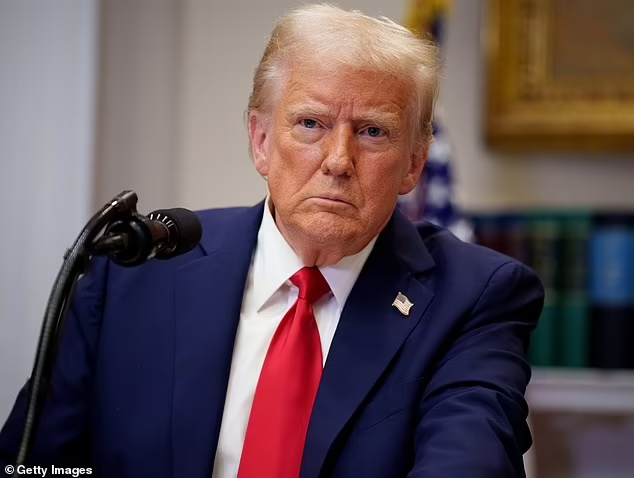
President Donald Trump said negotiations with Iran are advancing but warned against rushing into a final agreement, even as officials point to growing momentum toward a deal that could end months of conflict and ease global energy pressures.
Diplomatic discussions are moving forward in what Trump described as a steady and constructive manner, with improving engagement between both sides. Speaking after a series of calls with regional leaders, he indicated that key elements of a broader agreement are largely settled, though final terms remain under review.
Insights shared with The Associated Press indicate that negotiators are working toward a framework that would halt hostilities, reopen the Strait of Hormuz, and address concerns surrounding Iran’s stockpile of highly enriched uranium. However, individuals familiar with the talks cautioned that the agreement has not yet been finalized and could still face last minute setbacks.
Officials involved in the discussions say the proposed arrangement would require Iran to relinquish its reserves of highly enriched uranium, a central demand from Washington. The plan under consideration includes a transition period during which portions of the material could be diluted while the remainder may be transferred to a third country.
Data from the International Atomic Energy Agency shows Iran currently holds uranium enriched to levels close to weapons grade, intensifying international concern. Iranian leaders, including President Masoud Pezeshkian, have maintained that the country’s nuclear program is intended for peaceful purposes.
U.S. Secretary of State Marco Rubio, speaking during a visit to India, pointed to meaningful progress in the talks, though he emphasized that several critical issues remain unresolved, including long term restrictions on enrichment and guarantees against nuclear weapons development.
A central pillar of the negotiations is the phased reopening of the Strait of Hormuz, a vital corridor through which a significant share of the world’s oil supply passes. The waterway has been effectively closed since the escalation of conflict in late February, when strikes by the United States and Israel triggered retaliation from Tehran.
The disruption has sent oil and gas prices sharply higher, straining economies worldwide. Analysts say even if the strait reopens soon, it could take weeks or longer for shipping flows and market stability to return.
Under the emerging framework, the United States would gradually ease restrictions on Iran’s oil exports through sanctions waivers, while also addressing access to frozen financial assets. Officials say these steps would unfold alongside continued negotiations over a defined period.
Beyond the nuclear issue, the proposed agreement also touches on broader regional tensions, including the conflict involving Hezbollah in Lebanon. Officials say the draft includes provisions aimed at ending that fighting, though clashes have continued despite a fragile ceasefire.
Israeli Prime Minister Benjamin Netanyahu has stressed that any final agreement must eliminate the threat posed by Iran’s nuclear ambitions, while maintaining Israel’s right to act against perceived dangers.
The cautious tone adopted by Trump reflects the complexity of a deal that extends far beyond a simple ceasefire. While negotiators appear closer than at any point in recent weeks, the repeated pattern of near agreements followed by setbacks suggests deep mistrust remains between Washington and Tehran.
The potential reopening of the Strait of Hormuz carries global significance. Energy markets, already strained by geopolitical instability, are highly sensitive to developments in the region. A successful agreement could stabilize prices and restore confidence, but any collapse in talks risks triggering renewed volatility.
Equally important is the nuclear dimension. Requiring Iran to scale back its enriched uranium stockpile would mark a major diplomatic achievement for the United States, yet enforcement and verification remain critical challenges. Without clear mechanisms, skepticism is likely to persist among allies and critics alike.
Regionally, the inclusion of provisions addressing conflicts tied to Iran’s allied groups signals a broader attempt to reset security dynamics across the Middle East. However, the durability of such arrangements will depend on compliance from multiple actors, not just Tehran.
Ultimately, the negotiations highlight a delicate balance between urgency and caution. While there is clear pressure to secure a deal that ends hostilities and stabilizes global markets, the risks of a flawed or incomplete agreement could carry long term consequences.





