

A train slammed into a school minibus at a level crossing in northern Belgium on Tuesday morning, killing four people including two children and leaving five other young passengers hospitalized in critical condition that later stabilized, in a crash that drew expressions of grief from the country’s prime minister, its regional leaders, and the president of the European Union.
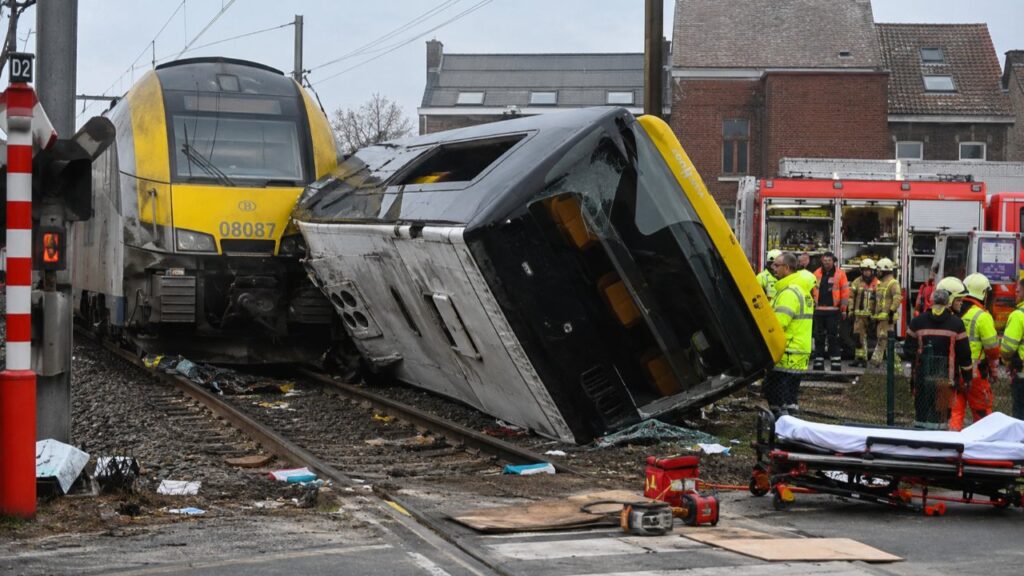
The collision occurred at 8:08 a.m. at a crossing near Buggenhout station, approximately 23 kilometers northwest of Brussels. A minibus carrying seven children, a teacher, and a driver was struck by a train that was approaching the station roughly one kilometer away. The train driver applied the emergency brake but could not stop in time.
Among the dead were a 12-year-old child, a 15-year-old child, a 27-year-old teacher, and the 49-year-old bus driver. Two other people sustained severe injuries. The five remaining children on board were taken to hospital in critical condition but were described as stable by the time officials held a press conference.
“The impact was extremely violent,” police spokesperson Frederic Sacre told reporters. “It happened at around 8:08 a.m. when a minibus was struck by a train that was due to stop at the next station, which was about a kilometre away.”
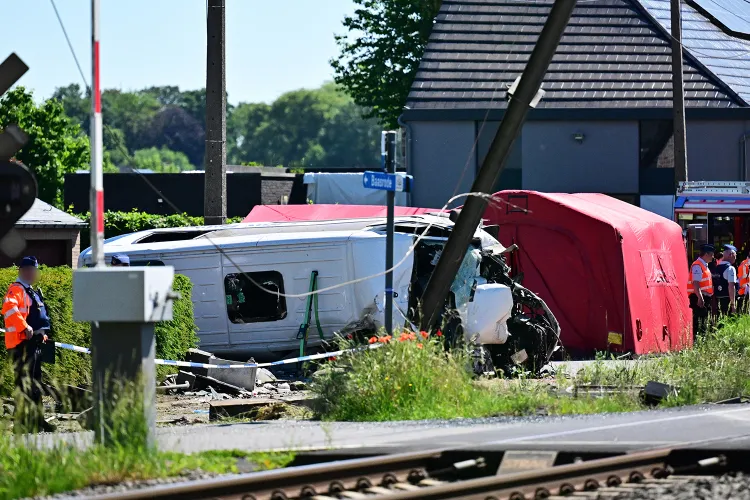
Belgian media images showed the minibus on its side next to the railway line, badly crumpled, with emergency response tents erected around the scene as crews worked to reach passengers.
The Crossing Was Secured When the Crash Happened
The central question confronting investigators is how a collision occurred at a crossing whose safety systems appear to have been functioning. Security camera footage reviewed by authorities showed the barriers were down and the traffic lights were red at the moment of impact. The train was already braking before the driver activated the emergency brake.
Thomas Baeken of rail infrastructure operator Infrabel told Belgian broadcaster VRT NWS that the physical evidence pointed toward a functioning crossing. “The collision took place at 8:08 a.m. Footage shows that the barriers were down and the traffic lights were red,” Baeken said. “We do not know how the accident could have happened.”
He added: “The train was already braking. The train driver did apply the emergency brake, but was unable to avoid a collision.” Infrabel said it would cooperate fully with the police investigation. Investigators are working to determine why the minibus entered the crossing despite the barriers and signals.
Approximately 100 passengers were aboard the train at the time of the collision. None were reported killed or seriously injured. One person was taken to hospital suffering from shock.
Transport Minister Jean-Luc Crucke confirmed the death toll and described the crossing’s security barriers as having been deployed at the time of the crash. Police said the children on board were believed to attend a special education school, though that was not officially confirmed at the time of initial reporting.
A Country in Mourning
The response from Belgian and European officials came swiftly. Prime Minister Bart De Wever wrote on X that he was “deeply moved by the horrific accident in Buggenhout” and extended his thoughts to the affected families.
Interior Minister Bernard Quintin said he had learned of the accident “with great dismay” and addressed the injured directly in his statement. “I wish the injured much strength,” Quintin wrote.
Deputy Prime Minister Maxime Prevot confirmed the deaths on social media, writing that four people had been killed including two children. Flemish regional president Matthias Diependaele expressed gratitude to emergency services at the scene and said his thoughts were with everyone touched by the accident.
European Commission President Ursula von der Leyen, herself Belgian by birth, said she was heartbroken. “My deepest condolences go out to the victims’ families and their loved ones. Today, Europe grieves with Belgium,” she wrote.
Train services on the affected line were suspended following the crash, with replacement buses deployed for passengers. Infrabel said further disruptions were possible as the investigation continued.
A Persistent Problem on Belgium’s Rail Network
Belgium’s railway network is one of the densest in Europe, threading through towns, villages, and urban districts in a country roughly the size of Maryland. The proximity of that network to everyday life creates a persistent safety challenge at the thousands of level crossings where road traffic and rail lines intersect.
Infrabel’s own data showed that five people were killed at level crossings in 2025, the lowest figure recorded since 2020. The deaths at Buggenhout already surpass last year’s annual toll in a single incident, putting renewed pressure on a rail safety conversation that Belgium’s transport authorities have been having for years without fully resolving it.
The question of why the Buggenhout minibus entered a crossing whose barriers and warning lights were active will likely shape whatever policy response follows this accident. If the investigation establishes driver error, the focus will fall on driver training, road markings, and crossing visibility. If it establishes a mechanical failure in the vehicle that prevented the driver from stopping, the focus shifts to vehicle safety standards for buses carrying children. If it reveals something more ambiguous, the response will be harder to define and harder to implement.
What is not ambiguous is the human reality of Tuesday morning in Buggenhout. Seven children boarded a minibus on their way to school. By the time their families were notified, two of them would not be coming home.
Level Crossings and the Limits of Safety Systems
The Buggenhout accident illustrates a fundamental tension in transport safety engineering. Level crossings in Belgium and across Europe have been progressively equipped with better warning systems, automated barriers, and camera monitoring precisely because human behavior at those crossings has historically been a source of deadly accidents. The logic is that if you make the crossing difficult enough to enter when a train is approaching, the number of collisions drops.
The Buggenhout footage, according to investigators, showed that the safety systems worked as designed. The barriers were down. The lights were red. The train was already braking. And the collision happened anyway.
That outcome forces a harder question about what safety engineering can and cannot guarantee. Systems designed around the assumption that barriers and warning signals will change driver behavior work when drivers perceive, process, and respond to those signals correctly and in time. They do not work when a driver is distracted, impaired, confused, or mechanically unable to stop regardless of what the signals show. No warning system in the world can fully substitute for the seconds of attention and the physical capacity to stop that a driver needs in the final approach to a crossing.
Belgium will investigate this accident thoroughly, as it should. The investigation will produce findings, and those findings will likely generate recommendations for improved safety measures at the crossing or across the network more broadly. That process matters. But it will not restore what was lost Tuesday morning in Buggenhout, and it will not answer the question that the families of the dead will ask for the rest of their lives: why, on a morning when everything was supposed to work, it did not.
Reuters/People/Euronews





