

A fire tore through a girls’ dormitory in central Kenya before dawn Thursday, killing at least 16 students and injuring 79 others at Utumishi Girls Academy in Gilgil, as investigators working the scene found a locked emergency exit where all 16 of the dead were discovered and preliminary evidence pointing toward arson.
The fire broke out just after midnight in the Meline Waithera Block, a dormitory housing 220 students drawn from Grade 10, Form 3, and Form 4. School principal Joycelene Muraguri reported the blaze to Gilgil Police Station at approximately 4:30 a.m. Officers arriving at the school, located about seven kilometers north of the station, found the dormitory already engulfed in flames.
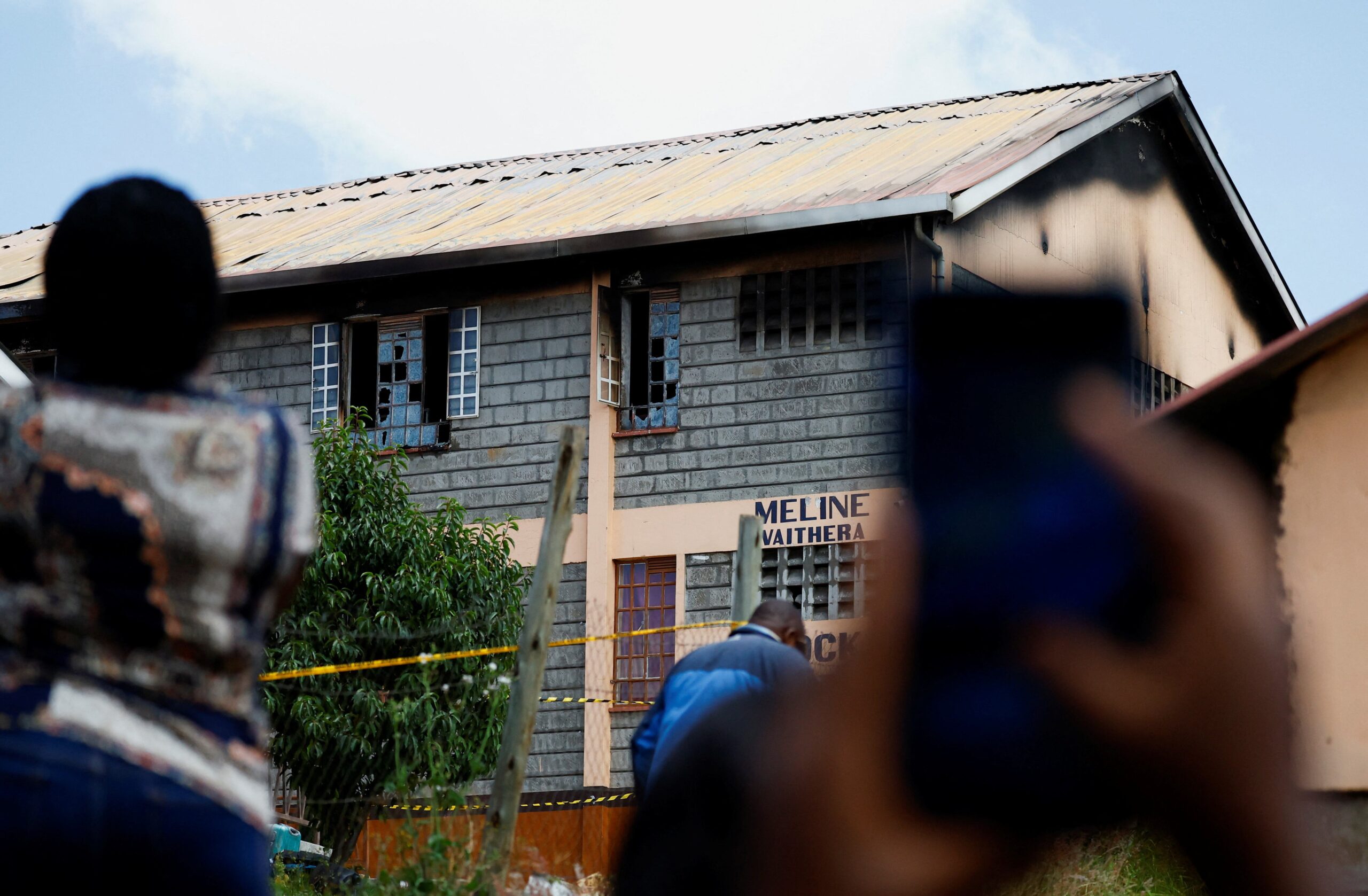
The emergency exit door was locked when the fire swept through the building. Students rushed toward it as the fire advanced. Sixteen of them burned to death at that exit before anyone could force it open. Security guards tried to break the door down, but by the time they got through, it was too late. Other students who managed to reach windows jumped from the balcony to escape. Some suffered burns getting out. Those on lower floors had a better chance. Those upstairs did not.
“Many of those who were upstairs jumped from the balcony,” local resident Wambui Nderitu, who rushed to the school in the early hours, told local broadcaster Asulab TV.
A multi-agency response was mounted to fight the blaze, involving fire brigades from Naivasha, Kenya Defence Forces personnel, water bowsers from the Anti-Stock Theft Unit, the Kenya Forest Service, and the National Youth Service. The joint teams eventually contained the fire after it burned for more than two hours.
Injured students were taken to Gilgil Sub-County Hospital and St. Mark’s Hospital. Education Minister Julius Ogamba confirmed the death toll and said 79 students were injured in the disaster, though 71 of those injured had already been discharged from hospital by Thursday afternoon. The victims had not yet been identified as of Thursday morning, a source of mounting anger for parents who gathered outside the destroyed dormitory demanding to see their children.
Arson Investigation Under Way
Detectives from the Directorate of Criminal Investigations took over the scene and have been working through witness accounts, CCTV footage, and physical evidence. More than 20 students, the school matron, security guards, and the school administration have been questioned. Investigators are also examining whether an electrical fault could have started the fire, though the preliminary direction of the inquiry pointed elsewhere.
Multiple survivors told first responders that a student had lit a mattress with a match, according to one first responder who spoke to Reuters without authorization to address the media. That person did not know what the student’s motive might have been. Interior Minister Kipchumba Murkomen, speaking at the school, urged the public not to speculate on the cause while the investigation continued.
Key witness accounts described the fire starting at the main entrance to the Meline Waithera Block and spreading rapidly through the dormitory. The locked emergency exit, the speed of the fire’s movement, and the concentration of deaths at a single blocked point are all elements that investigators are working to explain.
Detectives are also asking why the school matron was absent and unreachable when the incident occurred. That question, along with why the emergency exit was locked in a dormitory housing 220 girls, sits at the center of an investigation whose findings the government had not yet publicly presented as of Thursday evening.
Parents Waiting, a Nation Mourning
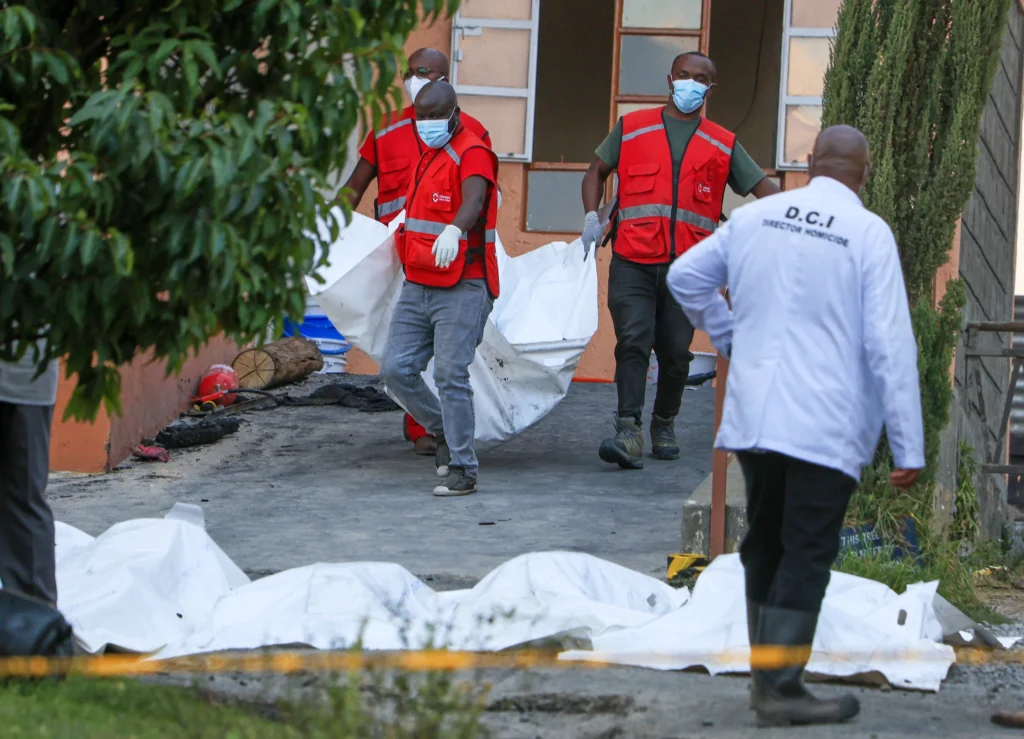
Hundreds of family members converged on the school through the morning, many having driven through the night after hearing news of the fire. Some confronted police officers guarding the site, demanding to see the remains of victims who had not yet been collected. The anger was raw and understandable: parents whose children attended the school knew that 16 girls were dead inside a building where 220 had been sleeping, and many still did not know which 16.
Bernard Omwandho, a representative of the parents’ association, urged calm while acknowledging the agony of waiting. “Most of the parents who are still here are those whose daughters are being questioned,” he said. “I hope that those being questioned will be able to at least shed some light or give us a hint on what really transpired.”
Elizabeth Rioba, whose two daughters attend the school, told the Associated Press she was relieved to find both girls alive but shaken by what one of them had witnessed. “She’s very traumatized, but I’m relieved she’s OK and I’m sad for all these children who have died,” Rioba said. Her daughter had seen a friend become trapped trying to jump from a window.
Another resident, Leah Wanjiru, told Asulab TV she had heard screaming and come outside to find the school ablaze. “We started fetching water, trying to help put out the fire and rescue people,” she said.
President William Ruto issued a statement of condolence. “No words can truly ease the pain of losing young lives filled with promise, hope, and dreams for the future,” Ruto said. “As a nation, we mourn with the parents, guardians, teachers, and fellow students who are enduring this unimaginable tragedy.”
A School With a Specific Connection
Utumishi Girls Academy is a government secondary school managed and sponsored by the Kenya Police Service. Many of its more than 800 students are the daughters of police officers, giving the disaster a particular resonance within the institution that manages both the school and the ongoing investigation. The school is located approximately 120 kilometers northwest of Nairobi, in Gilgil in the Rift Valley.
The Kenya Red Cross deployed psychological support teams for students and families at the site.
A Recurring Pattern With No Permanent Fix
School fires have killed students in Kenya with a frequency that has alarmed education officials for decades without producing the systemic changes that would prevent them. The government recorded more than 100 school fires in Kenya in 2024 alone. Researchers who study the phenomenon have found that many are deliberately set by students protesting harsh discipline, poor living conditions, or inadequate food. Others begin from electrical faults in aging infrastructure that was not built or maintained to support the populations crowded into it.
In 2024, 21 students burned to death in a school fire in Nyeri County. Its cause was never conclusively established. In 2017, 10 students died in a school fire in Nairobi, and a student was subsequently charged with murder. Kenya’s deadliest school dormitory fire on record occurred in 2001 at Kyanguli Secondary School near Machakos, where 67 boys were killed in a blaze authorities attributed to arson. The student charged in connection with that fire was convicted.
The pattern is consistent enough to have produced regulatory responses, official inquiries, and national conversations about school safety. It has not yet produced the physical changes in Kenya’s school infrastructure, the fire safety equipment, the unlocked emergency exits, and the functioning suppression systems, that would make the next fire less deadly when it comes.
The Locked Door That Killed 16 Girls
The locked emergency exit at Meline Waithera Block is not an investigation footnote. It is the central fact of Thursday’s death toll. Sixteen students are dead not simply because a fire broke out in a dormitory, but because when they reached the exit designated for exactly this kind of emergency, the door did not open.
School dormitory emergency exits are locked in Kenya for reasons that are understandable on their surface. Open emergency exits create security vulnerabilities, allow students to leave unsupervised at night, and invite exactly the kind of unauthorized movement that boarding school administrators spend considerable energy preventing. The problem is that the logic which makes locking those doors sensible on a normal night makes them lethal on a night when the building is on fire.
This is not a new tension and it is not unique to Kenya. Schools across East Africa and in many other parts of the world operate dormitories that prioritize security and discipline over fire egress because fires are rare and unauthorized departures are not. The calculation works until the fire comes. Then it fails catastrophically, and in the specific way that Thursday’s fire failed: all the deaths concentrated at the one point where students expected to find escape and found a locked door instead.
The investigation into whether this was arson or an electrical fault will determine criminal accountability. It will not change the fact that 16 girls who reached an emergency exit are dead. That outcome was produced by a policy, not just a fire, and the policy is the thing that needs to change before the next dormitory burns.
CitizenDigital/AP/Reuters





