

A powerful explosion at a building believed to be storing mining explosives tore through a village in northeastern Myanmar on Sunday, killing more than 45 people and injuring dozens, rescue workers and local media said.
The blast struck around midday in Kaungtup village in Namhkam township, an area near the Chinese border that is under the control of the Ta’ang National Liberation Army, an ethnic armed group engaged in conflict with Myanmar’s central authorities.
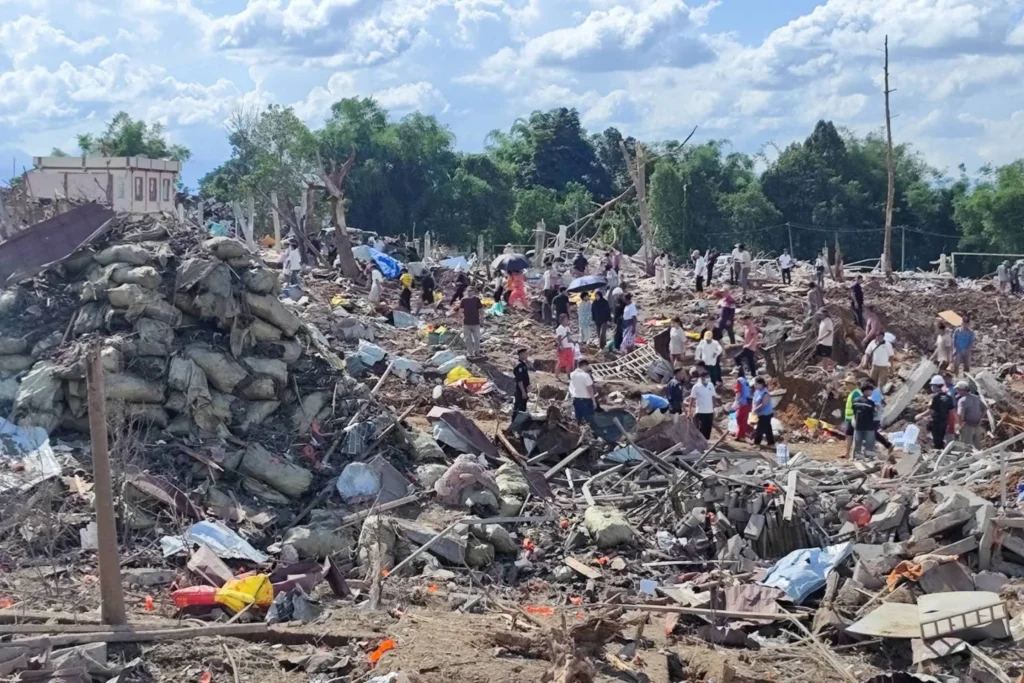
Rescue teams working at the scene said at least 46 bodies, including six children, had been recovered by evening. The victims were taken for cremation as emergency crews continued searching through debris. One rescuer, who spoke to The Associated Press on condition of anonymity due to security concerns, said at least 74 injured people were transported to a nearby hospital.
Another responder in Namhkam gave a similar account, saying the blast killed around 40 people and caused widespread destruction to homes in the surrounding area, with more than 100 buildings damaged.
Independent media outlets in Myanmar, including the Shan State based Shwe Phee Myay news agency, placed the death toll higher, estimating between 50 and 55 fatalities. Images circulating online showed thick smoke rising over the village and structures reduced to rubble.
China’s state broadcaster CCTV said the explosion resulted in multiple casualties and extensive damage to residential buildings, though it did not confirm specific figures. Early findings indicated that the blast originated at a storage site containing large quantities of explosives used for mining operations.
In a statement shared on its Telegram channel, the Ta’ang National Liberation Army acknowledged that gelignite had been stored at the site for use in mining and quarrying. The group said an investigation into the cause of the explosion is underway.
Gelignite, commonly used in industrial blasting, can become unstable if improperly handled or stored for long periods, raising questions about safety conditions at the facility.
The region has been under the control of the armed group since late 2023, when an alliance of ethnic forces launched a major offensive against Myanmar’s military. Although a ceasefire was reached following talks mediated by China last year, tensions remain high across the region.
Myanmar has faced ongoing instability since the military seized power in 2021, ousting the elected government of Aung San Suu Kyi. The takeover sparked widespread protests that evolved into armed resistance, leaving large parts of the country gripped by conflict.
The explosion highlights the growing risks associated with industrial activities in conflict zones, where oversight and safety enforcement are often limited or absent. In areas controlled by armed groups, storage and handling of hazardous materials such as explosives can fall outside formal regulatory frameworks, increasing the likelihood of catastrophic accidents.
The incident also underscores the broader humanitarian impact of Myanmar’s prolonged instability. Communities in contested regions often face a dual threat from both armed conflict and unsafe infrastructure tied to informal economies such as mining and quarrying.
Beyond the immediate loss of life, the destruction of homes and displacement of residents is likely to deepen hardship in a region already strained by conflict and limited access to medical care. Recovery efforts may also be complicated by the area’s political status, which restricts coordination with central authorities and international aid organizations.
The proximity to the Chinese border adds another layer of concern, as cross border implications of such incidents can heighten regional sensitivities, particularly where trade and security interests intersect.
As investigations continue, the tragedy may renew scrutiny over how explosive materials are managed in unstable regions and whether stronger safeguards can be enforced despite ongoing conflict.
EnglishAawsat/AP





